
Rebate Tracking Software: Real-Time Accruals & Visibility
Rebate tracking software gives real-time accrual dashboards, partner statements and reconciliation. Why spreadsheet tracking breaks at multi-tier scale.
In short
Rebate tracking software gives a real-time view of rebate accruals across a channel — live accrual dashboards, partner statements and reconciliation — so finance always knows the running liability and receivable rather than estimating at quarter-end.
Rebate tracking software gives a real-time view of rebate accruals across a channel — live accrual dashboards, partner statements and reconciliation — so finance always knows the running liability and receivable rather than estimating at quarter-end. It is the visibility layer of the rebate management software stack.
What it does
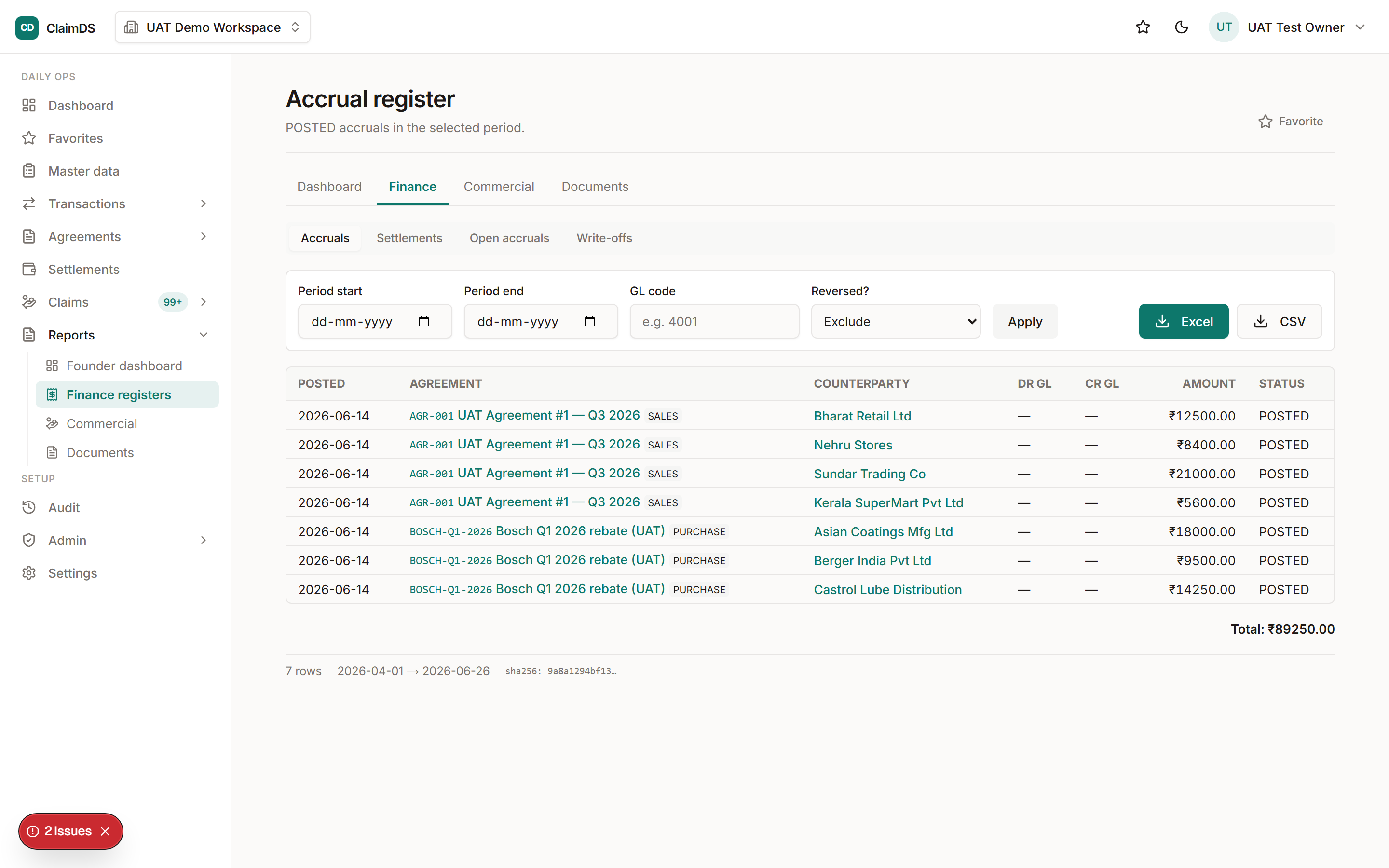
Rebate tracking software keeps a live accrual for every scheme as sales or purchases post, surfaces partner statements, and reconciles accrual against settlement. The result is one number finance can trust at any moment: what the business owes, and is owed, across the channel. The accrual mechanics are in volume rebates and the recognition rules in rebate accounting.
What must rebate tracking actually cover?
"Tracking" sounds like one dashboard; it is actually four ledgers that have to stay consistent with each other, all the time.
| Tracking surface | The question it answers |
|---|---|
| Real-time accruals | What have we accrued, per scheme and per partner, as of today? |
| Attainment against slabs | Where does each partner sit against its slab boundaries, and at what rate is it accruing now? |
| Claim status | Which claims are submitted, validated, approved or settled — and which are stuck? |
| Settlement ledger | What has been settled, by which credit note, against which accrual? |
The accrual surface is the hardest to get right, because it must recompute as transactions post rather than at period-end — the method is the same whether you accrue what you owe partners or what suppliers owe you. Claim status matters because a rebate earned but stuck between Submitted and Approved is invisible in a pure accrual view; the stages are in the claim process explained. And the settlement ledger is what closes the loop: accrual minus settlement should trend to zero per scheme, and a persistent gap is either leakage or over-accrual — both things finance needs to see early, not at year-end.
Tracking vs processing
| Tracking | Processing |
|---|---|
| Live view of what is accruing and owed | Validating, approving and settling claims |
| Answers "what do we owe right now?" | Answers "is this claim correct and settled?" |
| Visibility, before settlement | Action, at settlement |
Good rebate software does both, but it is the tracking layer that gives finance foresight rather than hindsight.
What does slab attainment tracking look like?
A live example (illustrative numbers only). A distributor is two months into a quarterly scheme with slabs at 1% up to ₹50 lakh, 1.5% up to ₹1 crore, and 2% above that.
| Item | Value |
|---|---|
| Quarter-to-date turnover | ₹62,00,000 |
| Current slab | 1.5% (above the ₹50 lakh boundary) |
| Accrued to date | ₹50,00,000 × 1% + ₹12,00,000 × 1.5% = ₹68,000 |
| Distance to the 2% slab | ₹38,00,000 |
Every invoice that posts updates all four numbers. Sales can see which distributors are within striking distance of the next slab while there is still a month to act; finance watches the liability curve steepen as partners approach boundaries; and the distributor sees the same attainment figure on its own statement, which is what prevents the end-of-quarter argument. The layer that turns these live numbers into decisions — scheme ROI, slab-design feedback, partner trends — is rebate analytics, which sits on top of tracking rather than replacing it.
Why spreadsheet tracking breaks
Across many schemes, tiers and partners, a workbook drifts out of sync, hides errors, and can only be reconciled after the fact. Spreadsheets give a stale estimate; software gives a live number. At multi-tier scale this gap is where leakage and surprises live — the core argument for purpose-built tracking over Excel.
Which spreadsheet failure modes should you expect?
The breakdown is predictable enough to name its modes. Version drift — two copies of the tracker disagree, and nobody knows which is truth. Formula rot — a slab boundary or rate gets edited in one row and not another, and the error compounds silently for a quarter. No claim-status memory — the sheet knows what should be owed, but not which claims are stuck where. Month-end reconstruction — the accrual is rebuilt from scratch every close rather than maintained continuously, which is where the hours go, as catalogued in the challenges of manual rebate processing. Key-person risk — one analyst understands the workbook, and their absence is an outage. No audit trail — when a partner disputes a number, the sheet cannot show how it was derived. Automation removes these mechanically rather than by vigilance; the case is made in the benefits of automating rebate calculations.
Which features should rebate tracking software include?
| Feature | What it gives you |
|---|---|
| Live accrual engine | Per-scheme, per-partner accruals that update as transactions post |
| Slab and attainment views | Distance-to-next-slab per partner, for sales teams and for partners themselves |
| Partner statements | Self-serve running statements that pre-empt disputes |
| Claim pipeline tracking | Every claim's stage, with stuck-claim flags and ageing |
| Settlement ledger and reconciliation | Accrued-versus-settled variance, per scheme |
| Analytics layer | Scheme ROI, trends and slab-design feedback on top of the tracked data |
| Reporting outputs | Provision schedules and disclosures that tie to the ledger — see financial reporting accuracy |
How does the data get in?
Tracking is only as live as its feed. Primary sales come from the ERP; secondary and tertiary sales come from distributor management systems or partner uploads; scheme masters and partner masters have to arrive as structured data, not PDFs. The practical wiring — connectors, file-based imports, validation on ingest, and what happens when a feed breaks — is covered in ERP integration for claims, rebate and TPM software. One test worth running before you buy: when a day's sales file arrives late, how stale is the accrual, and does the system tell you it is stale? A tracking layer that presents a stale number as a live one is more dangerous than a spreadsheet, because it carries an authority the spreadsheet never claimed. Good systems timestamp every feed, show the as-of date next to every accrual, and flag partners whose data has stopped arriving — which in multi-tier channels is often the first sign of a bigger reconciliation problem downstream.
What visibility changes
A live accrual changes month-end from a reconstruction into a check, lets finance forecast scheme liability accurately, and gives partners trustworthy statements that reduce disputes. It is the foundation the CFO revenue-leakage playbook builds on. Buy-side tracking covers supplier rebates; sell-side covers distributor and dealer rebates.
Where does GST touch rebate tracking?
At pointer level: tracking meets tax at the settlement ledger, where accruals convert into credit notes. The note type and its disclosure fields matter — see GST credit notes for rebates under Rule 53(1A) — and the recognition rules that connect the accrual to the books are in rebate accounting with GST credit notes. Treat the specifics as positions to verify with a professional, not defaults to assume.
GST note: This article is general information, not tax or legal advice. Where settlement involves GST credit notes, positions — including CBIC Circular No. 251/08/2025-GST and the Finance Act 2026 amendments to Section 34 of the CGST Act, assented 30 March 2026 but not yet notified into force as of publication — must be re-verified at publish time with a qualified professional.
Frequently asked questions
What is rebate tracking software?
Rebate tracking software gives a real-time view of rebate accruals across a channel — live accrual dashboards, partner statements and reconciliation — so finance always knows the running liability and receivable instead of estimating at quarter-end.
What is the difference between rebate tracking and rebate processing?
Tracking is the live view of what is accruing and owed; processing is the act of validating, approving and settling claims. Good rebate software does both, but tracking is what gives finance visibility before settlement.
Why does spreadsheet rebate tracking break down?
At multi-tier scale, spreadsheets cannot keep a single live accrual across many schemes and partners. They drift out of sync, hide errors, and give only a stale quarter-end estimate rather than a real-time number.
What data does rebate tracking software need?
Four feeds — transaction data (primary sales from the ERP, secondary and tertiary sales from DMS or partner uploads), scheme masters with slabs and windows as structured data, partner masters, and settlement records including credit notes. The accrual is only as live and accurate as these feeds.
What is slab attainment tracking?
A live view of each partner's progress against its slab boundaries — current turnover, current rate, accrued amount and the distance to the next slab. It lets sales act while the quarter is still open, and lets partners see the same number the manufacturer sees, which prevents settlement disputes.
How does rebate tracking help at audit time?
Every accrued rupee traces to the transactions that produced it, every settlement traces back to an accrual and a credit note, and partner statements show the same numbers throughout. That accrual-to-settlement trail is what auditors and assessing officers ask for, and what spreadsheets cannot reconstruct after the fact.
See RebateLedger on your own claims data
A 30-minute walkthrough tailored to how your channel actually settles claims.