
The Claim Process Explained: From Submission to Settlement
The channel claim process step by step — creation, documentation, validation, approval, settlement and reconciliation, with owners and SLAs.
In short
The claim process is the lifecycle a channel claim follows: creation and submission, documentation, validation against the agreement and data, approval, settlement (usually by credit note), and reconciliation against the accrual. Making each stage explicit — with owners and SLAs — turns claims from a backlog into a controlled flow.
The claim process is the lifecycle a channel claim follows from start to finish: it is created and submitted, documented with evidence, validated against the agreement and data, approved, settled (usually by credit note), and reconciled against the accrual or expected amount. Making each stage explicit is what turns claims from a backlog into a controlled flow.
The six stages
- Create and submit. The claim is raised with a clear reason and reference (invoice, scheme, agreement).
- Document. Evidence is attached — invoices, scheme terms, stock or damage records.
- Validate. The claim is checked against the agreement and the underlying data.
- Approve. The validated claim is approved with the right authority and segregation of duties.
- Settle. The amount is settled, usually by GST credit note.
- Reconcile. The settlement is matched against the accrual or expected amount; any gap is resolved.
This is the generic backbone behind every claim type in the claims management hub; the submission detail is in how to submit a claim request.
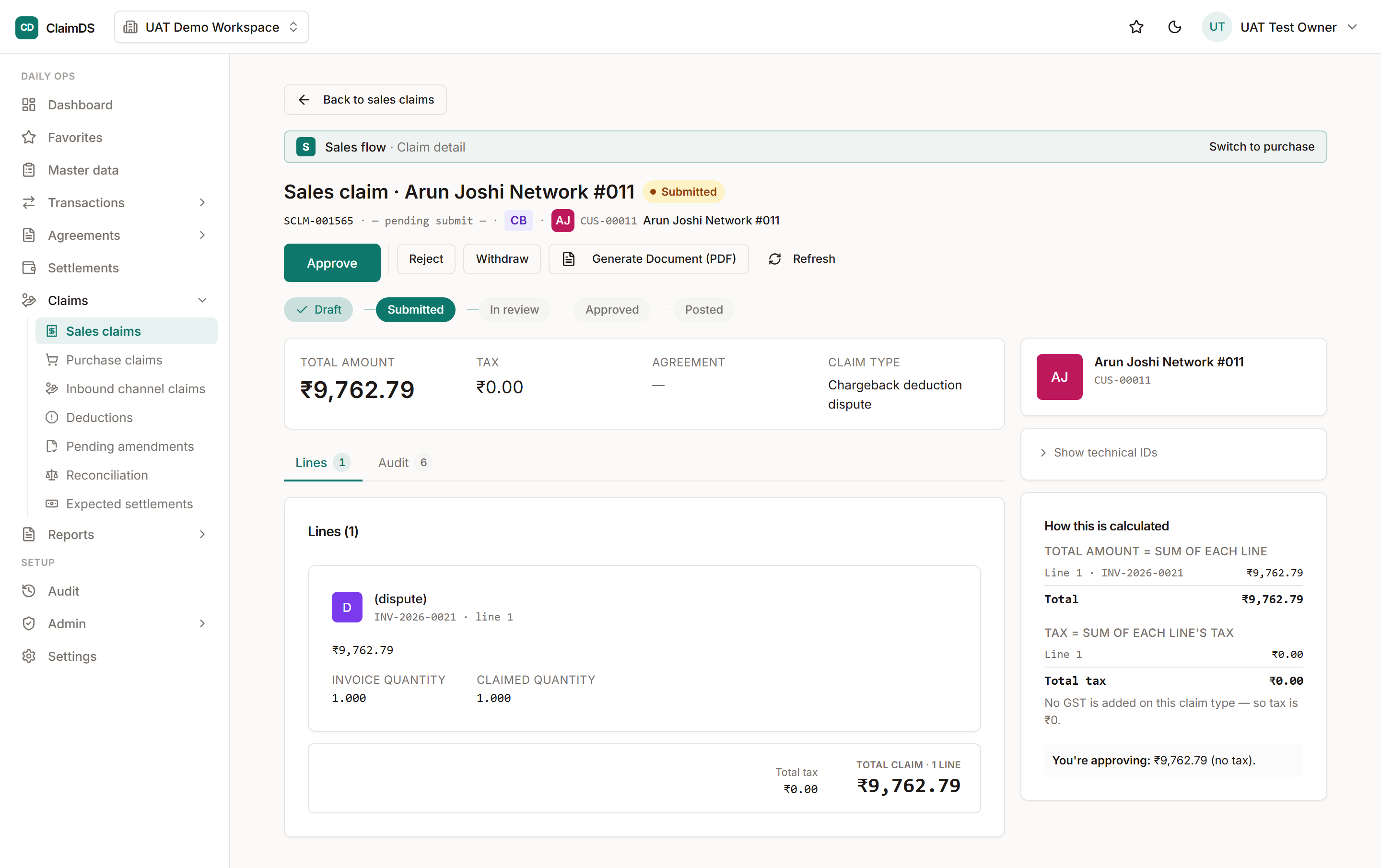
Owners and turnaround
| Stage | Typical owner | What good looks like |
|---|---|---|
| Create / document | Commercial / ops | Complete evidence at submission |
| Validate | Finance | Rules applied consistently |
| Approve | Approver | Authority + segregation of duties |
| Settle | Finance | Correct credit-note type |
| Reconcile | Finance | Settlement matches accrual |
In status terms, the six stages collapse into the four states most systems display — Submitted → Validated → Approved → Settled — with documentation folded into submission and reconciliation following settlement. The rest of this guide walks each state: who acts, what evidence matters, what goes wrong, and what a reasonable clock looks like.
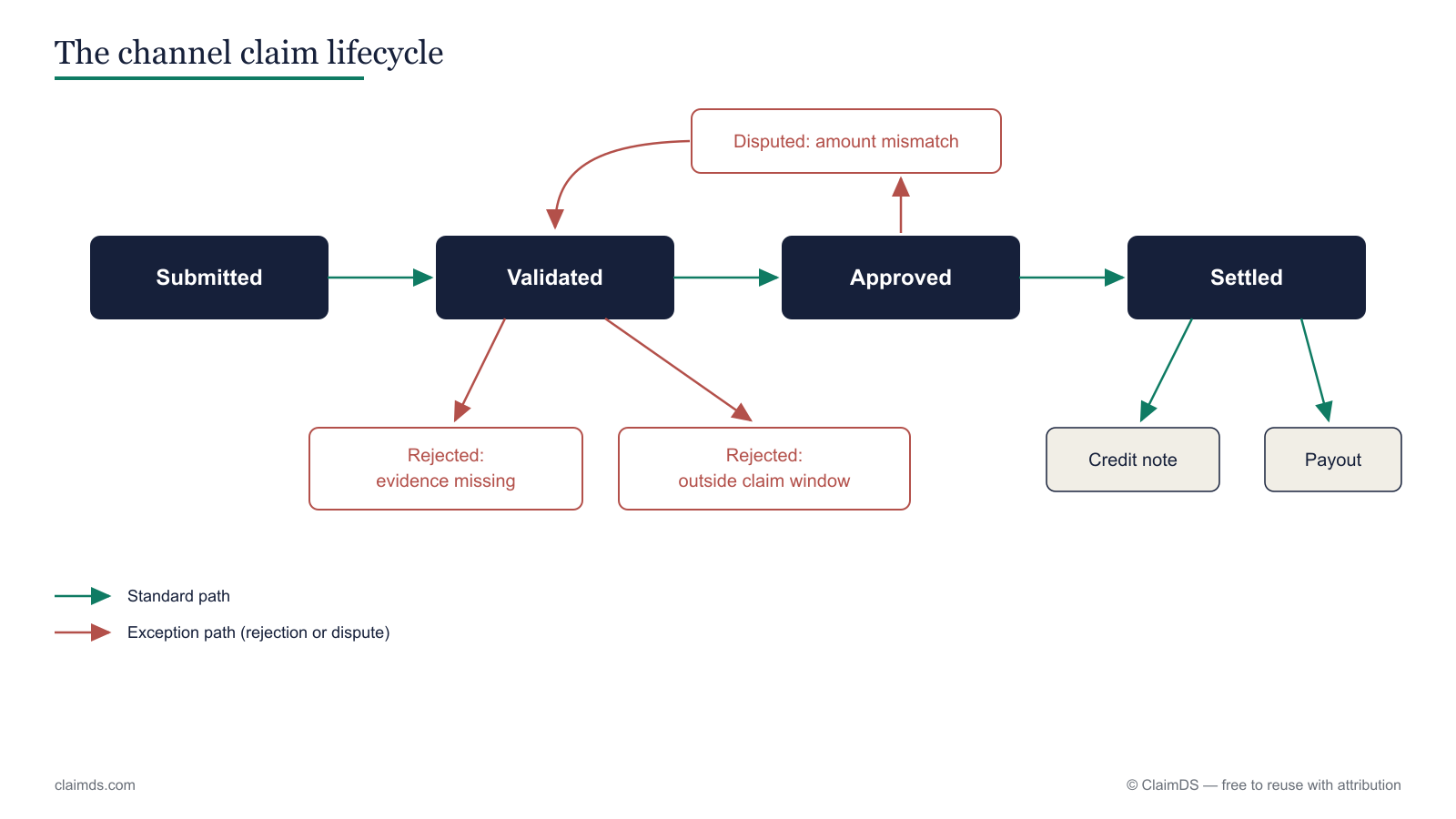
Source: RebateLedger — this diagram is free to reuse with a link back to this article.
What happens at the Submitted stage?
Who acts: the claimant — a distributor, dealer or the field team raising the claim on their behalf — plus whoever operates intake on the brand side.
What evidence matters: the claim's identity. A submission is complete when it names the scheme it claims under, the specific invoices it rests on, the amount with its calculation basis, and the supporting documents for its claim type. The working checklist is in how to submit a claim request; the arithmetic is covered in how distributor claims are calculated.
What goes wrong: vague references ("Q1 scheme"), amounts with no calculation shown, evidence promised but not attached, and — worst of all — claims that never enter a system at all, arriving by email or WhatsApp and living outside any queue. Unlogged intake is a leading leak in why distributor claims slip through the cracks.
Cycle-time expectation: submission itself is minutes once the evidence pack is assembled. The clock that matters is the claim window — a perfect claim submitted after the window closes is a written-off claim.
What happens at the Validated stage?
Who acts: finance, or a claims/commercial operations desk applying finance's rules.
What evidence matters: the cross-check. Validation tests three things — eligibility (does the scheme actually cover this claimant, product and period?), arithmetic (does the claimed amount follow from the rate and the transaction data?), and evidence (do the attached documents support the physical facts — stock held, damage incurred, display executed?).
What goes wrong: this is where most claims stall. Missing or mismatched documents force a query loop back to the submitter; rate disagreements surface when the agreement's terms were never modelled anywhere checkable; and manual line-by-line ties simply do not happen every cycle — one of the classic challenges of manual rebate processing.
Cycle-time expectation: with complete evidence and modelled scheme terms, validation is a same-day to two-to-three-working-day step (illustrative). With incomplete evidence it becomes open-ended correspondence — which is why completeness at submission is the highest-leverage fix in the whole process.
What happens at the Approved stage?
Who acts: the approver the delegation-of-authority matrix names for that claim's value band and type — a sales manager, finance manager, controller or, for small validated claims, the system itself via auto-approval.
What evidence matters: the validation record. An approver should review a claim that has already passed checks, with any exception flags surfaced — not re-perform validation from scratch.
What goes wrong: the two classic failures are approval before validation (the same claim crosses the same desk twice) and everything routes to one person (one leave application away from a frozen pipeline). Both are design errors — the full treatment, including authority thresholds, SLAs and escalation, is in designing claim and rebate approval workflows.
Cycle-time expectation: auto-approval is instant; human approval steps deserve an SLA of a few working days each with automatic escalation on breach (illustrative). If approval consumes most of your cycle time, the bottleneck is the routing design, not the approvers.
What happens at the Settled stage?
Who acts: finance executes; the claimant's accounts team receives and books.
What evidence matters: the settlement instrument and its linkage. In the Indian channel, settlement is usually a GST credit note — and the choice between a tax credit note and a financial (commercial) credit note carries ITC consequences for the recipient, explained in financial vs. tax credit notes under GST. The credit note should reference the claim, and the claim should reference the scheme and invoices, so the paper trail runs unbroken from scheme terms to settlement document — the discipline the scheme-settlement GST documentation playbook formalises.
What goes wrong: the wrong credit-note type, settlement issued with no claim reference (a reconciliation headache on both sides), and part-settlements nobody records as partial — so the balance quietly evaporates.
Cycle-time expectation: once approved, settlement is an execution step measured in days, usually batched with the credit-note cycle.
Reconciliation: the stage that catches everything else
After settlement, the amount settled is matched against the accrual or expected amount. A clean match closes the loop; a gap means something upstream was wrong — a rate misapplied, a claim part-paid, a scheme accrued but never claimed. Reconciliation is where silent revenue leakage becomes visible: an unreconciled book is a leak with no gauge on it.
The lifecycle at a glance
| Status | Who acts | Evidence in play | Common failure | Clock (illustrative) |
|---|---|---|---|---|
| Submitted | Claimant / field | Scheme ref, invoices, amount basis, claim-type documents | Vague references, unlogged intake, window missed | Minutes to submit; watch the claim window |
| Validated | Finance / ops | Eligibility, arithmetic, evidence cross-check | Missing documents; rates never modelled | 2–3 working days with complete evidence |
| Approved | DoA-matrix approver / auto | Validation record + exception flags | Approval before validation; one-person queue | Instant (auto) to a few days per human step |
| Settled | Finance | GST credit note referencing the claim | Wrong note type; no claim reference | Days, batched with credit-note cycle |
| Reconciled | Finance | Settlement vs accrual match | Gaps ignored; part-payments untracked | Same cycle as settlement |
A worked example (illustrative)
A distributor claims under a quarterly volume scheme: 8% on ₹15,00,000 of eligible purchases = ₹1,20,000. Submitted on day 2 after quarter close with invoice list and scheme number. Validation (day 4) finds ₹50,000 of invoices outside the scheme's product scope — the base drops to ₹14,50,000 and the claim adjusts to 8% × ₹14,50,000 = ₹1,16,000, reason coded and visible to the distributor. The delegation matrix routes it to the sales manager, then a finance executive (days 5–8). A credit note referencing the claim issues in the next batch (day 10), and reconciliation matches it against the revised accrual — closed, with a complete trail. Total: ten days, no email archaeology. All figures are illustrative.
Where claims get stuck
Two stages dominate delays: validation (missing or mismatched evidence) and reconciliation (settlement not matching the accrual). Both are solved by capturing evidence up front and reconciling automatically — see distributor claims management for the operational view.
What about exceptions, rejections and disputes?
The unhappy paths deserve design rather than improvisation. Three rules cover most of it:
- Rejections carry a coded reason and a resubmission window. A rejected claim that vanishes into silence becomes a partner dispute six months later.
- Exceptions route, they don't queue-jump. A claim over the scheme cap or submitted late goes to a defined exception approver with the reason coded — the routing patterns are in the approval-workflow design guide.
- Deduction-style claims get matched, not fought line-by-line. When partners deduct first and justify later, the process runs in reverse — the disciplines in deduction management best practices are the companion playbook.
One process, many claim types
The same six-stage process underlies rebates, chargebacks, price protection and buyback — only the evidence and validation rules change. That is why a single platform across claim types is more efficient than separate tools: see the related processes for chargebacks and buyback.
Related reading: how returns, reversals and cancellations move through the same claim process.
Track turnaround time (TAT) per stage so bottlenecks are visible — the basis of the benchmark in the ROI & settlement-time guide. A process this shape is also what makes partner-facing transparency possible: when every claim has a status, partners stop calling to ask where their money is — the visibility argument behind channel partner incentive tracking. To see the full lifecycle running on your own claim types, book a demo.
Related reading
The process above is the backbone. These go deeper at the points it usually breaks:
- The claim lifecycle, end to end — from scheme published to settlement reconciled.
- Rebate claim documentation — the evidence set for each claim type, and the ten reasons claims get rejected.
- How to audit rebate claims — twelve validation tests you can run against every claim rather than a sample.
- Claim and rebate approval workflows — designing approvals that do not bottleneck settlement.
- Quick commerce claims and deductions — a third channel model with its own claim behaviour.
GST note: This article is general information, not tax or legal advice. Where settlement involves GST credit notes, positions — including CBIC Circular No. 251/08/2025-GST and the Finance Act 2026 amendments to Section 34 of the CGST Act, assented 30 March 2026 but not yet notified into force as of publication — must be re-verified at publish time with a qualified professional.
Frequently asked questions
What is the claim process?
The claim process is the lifecycle a channel claim follows — creation and submission, documentation, validation against the agreement and data, approval, settlement (usually by credit note), and reconciliation against the accrual or expected amount.
Who owns each stage of the claim process?
Typically commercial or operations create and document claims, finance validates and settles, and a designated approver applies authority. Clear ownership at each stage keeps the process repeatable and auditable.
Where do claims get stuck?
Claims stall most at validation, when evidence is missing or does not match the agreement, and at reconciliation, when settlement does not align with the accrual. Defined SLAs and an audit trail keep claims moving.
How long should the claim process take end to end?
There is no universal number — it depends on claim type, evidence quality and approval design. The workable discipline is to set an SLA per stage (illustrative: two to three working days each for validation and approval), track turnaround per stage, and treat the end-to-end total as a budget you manage rather than an outcome you discover.
What is the difference between validation and approval?
Validation is a checking step: the claim is tested against the scheme terms and the underlying transaction data. Approval is an authority step: someone with the right delegation signs off on paying a claim that has already been validated. Keeping them separate means approvers spend judgement only on claims that already check out.
What happens when a claim fails a stage?
A claim that fails validation goes back to the submitter with a coded reason and a resubmission window; a claim flagged as an exception routes to a defined exception approver instead of the normal chain; a disputed settlement opens a tracked dispute flow. The common thread: every unhappy path is recorded in the system, never resolved over email.
What does a claim status like 'await to load' mean in a portal?
It means the claim record exists but the system is still waiting for something to load — typically supporting documents, or the batch process that pulls the claim into the queue. Validation has not started, and the processing clock usually has not either. If it persists beyond a few days, confirm every mandatory attachment actually uploaded, re-attach in the accepted format, and contact the helpdesk with the claim reference.
What does it mean when a claim is put on hold or in suspense?
A hold parks a claim outside the normal flow without deciding it — pending a duplicate check, a partner clarification, an audit, or budget approval — while preserving its registration date and queue position. Keep holds honest: every hold carries a reason code, an owner and a review date, ageing reports show held claims separately, and a quarterly review forces each one to move, so suspense never becomes a graveyard.
See RebateLedger on your own claims data
A 30-minute walkthrough tailored to how your channel actually settles claims.