
The Chargeback Process: How Trade Chargebacks Work
The trade chargeback process step by step — trigger, documentation, validation, approval and settlement. Trade/channel chargebacks, not card chargebacks.
In short
The trade chargeback process is the lifecycle a channel deduction follows: raised with a reason, documented with evidence, validated against the agreement and data, approved, and settled — usually netted in a GST credit note. Making each step explicit turns an opaque deduction into a defensible, auditable claim.
The chargeback process is the lifecycle a trade/channel deduction follows: it is raised with a reason, documented with evidence, validated against the agreement and data, approved, and settled — usually netted in a GST credit note. Making each step explicit turns an opaque deduction into a defensible, auditable claim.
Trade chargebacks, not card chargebacks. This describes deductions and claims between a manufacturer and a channel partner — not a customer's bank reversing a card payment.
The five steps
Raised → documented → validated → approved → settled.
- Raise the chargeback. A deduction or claim is logged with a clear reason code — scheme, price difference, damage, return — against the partner.
- Document the claim. Supporting evidence is attached: scheme circular, invoice reference, damage note, stock record. Weak documentation is the single biggest cause of later disputes.
- Validate. The chargeback is checked against the agreement and the underlying data — is it eligible, in-window and correctly calculated?
- Approve. The validated amount is approved with the right authority and segregation of duties.
- Settle. The amount is settled, typically netted into a GST credit note, and the record is closed with a full trail.
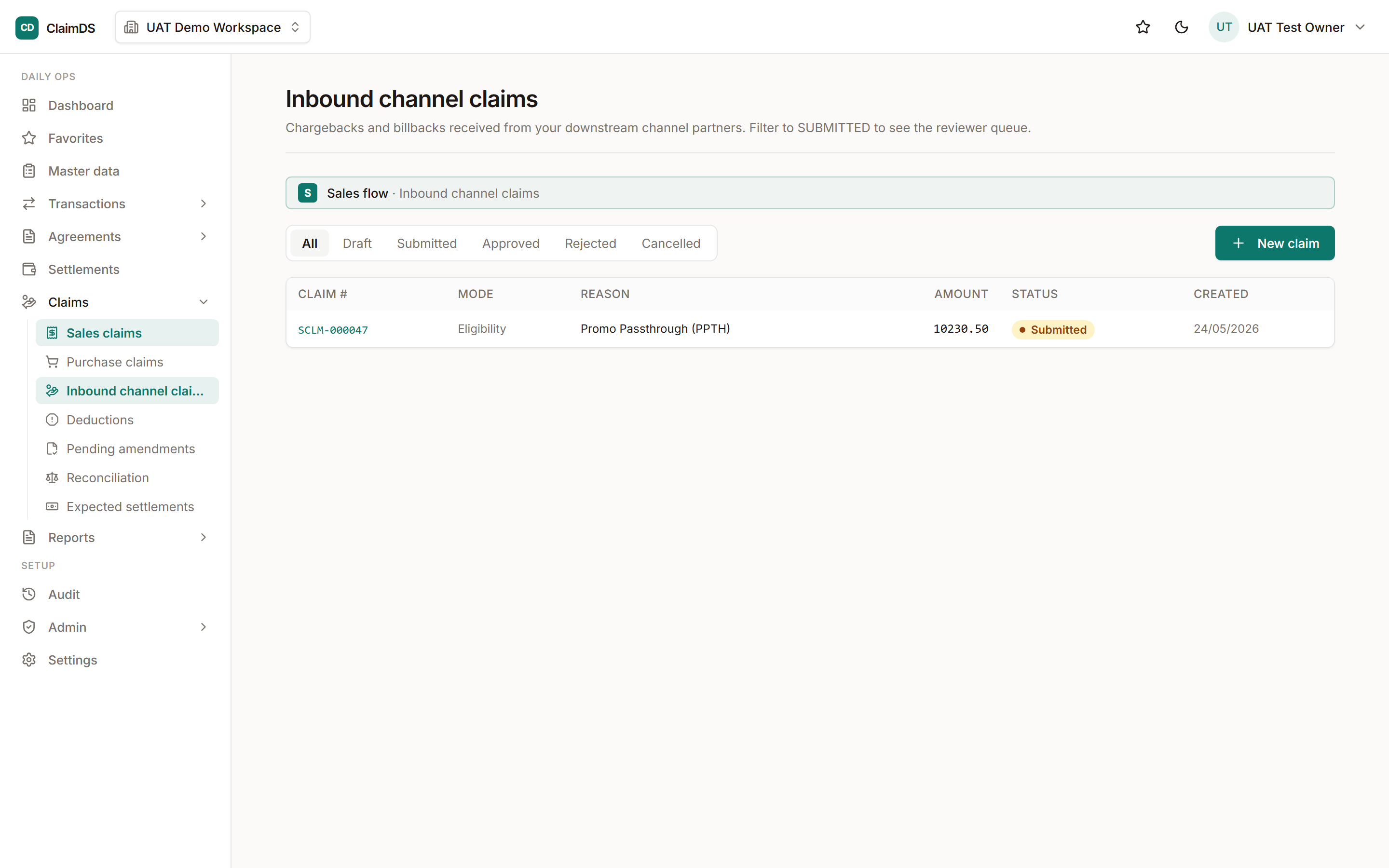
For the full hub view see chargeback management software; for disputed deductions see the chargeback dispute process.
How does a chargeback actually arrive?
Three ways, and each needs the same response. A debit note is the formal version — the partner raises a document against the supplier for the amount it believes it is owed. A short payment is the blunt version — the remittance simply arrives light, with the deduction listed (or not) on the remittance advice. And a notice or portal entry is the modern-trade version, where a compliance charge or promotional recovery appears in the retailer's supplier portal before any money moves at all. The document is not the event. Whichever form it takes, what has actually happened is the same: a partner has asserted a claim against you, and the clock has started.
That is why the first real step of the lifecycle is capture and coding, not validation. Every deduction — however it arrived — gets logged as its own record with a reason code within days, not weeks: scheme, price difference, damage, return, compliance. An uncoded deduction cannot be routed, validated or aged; it just sits inside a receivables balance looking like a late payment. Reason-coding at capture is the habit that separates teams that manage chargebacks from teams that discover them at quarter-end, and it sits at the top of any list of deduction management best practices. Where the money runs the other way — the partner billing the supplier for an agreed entitlement rather than the supplier being charged — the same capture discipline applies to billbacks; the billbacks vs chargebacks vs deductions glossary maps the whole family.
Where chargebacks get stuck
Two choke points dominate. Validation stalls when evidence is missing or does not match the agreement. Settlement stalls when a disputed amount is neither resolved nor written off — it just sits, ageing. Reason codes, evidence capture and an audit trail keep the queue moving, which is the core argument for chargeback claim software.
How do you decide whether to accept or dispute?
Validation ends in a decision, and the decision tree is short — three checks, run in order.
| Check, in order | If it passes | If it fails |
|---|---|---|
| 1. Agreement — does a recorded agreement cover this charge? | Go to check 2 | Dispute as unsupported |
| 2. Evidence — do the documents support the quantity and rate? | Go to check 3 | Dispute, or accept only the supported portion |
| 3. Window — was it raised inside the claim window? | Accept and settle | Dispute as out-of-window |
Three legitimate outcomes fall out of that tree. Accept — the charge is valid; settle it promptly and move on, because a valid chargeback that ages helps no one. Partial accept — part of the amount is supported; approve that part and document exactly why the balance is not, so the partner sees an adjustment with a reason rather than an arbitrary haircut. Dispute — the charge fails a check; push back with the specific gap named, not a generic objection, because a dispute that says "evidence covers 90 outlets, claim covers 100" resolves in days while "we disagree" resolves never. The worst outcome is the unofficial fourth: doing nothing. Silence converts into acceptance the moment dispute windows lapse, which is why the decision — any decision — matters more than teams realise. The same triage is what a supplier runs on inbound distributor claims; the mechanics are symmetrical.
A worked example
A distributor debits ₹1,20,000 against a supplier, citing a display scheme. (Illustrative numbers only.)
| Step | Finding |
|---|---|
| Capture | Debit note logged, reason-coded as scheme |
| Agreement check | Scheme exists: ₹1,000 per outlet across 100 enrolled outlets — supports ₹1,00,000 at most |
| Evidence check | Display photos and the outlet list evidence 90 outlets |
| Decision | Accept ₹90,000; dispute ₹30,000 |
| Settlement | ₹90,000 settled by credit note; ₹30,000 disputed with the gaps documented |
The ₹30,000 dispute is really two different problems, and recording them separately is the point. ₹20,000 was never in the agreement — the debit simply overshot the scheme's ceiling, and no evidence can cure that. ₹10,000 is an evidence shortfall on 10 outlets the distributor may yet be able to prove, so that portion can reopen if photos arrive before the window closes. One dispute line with two coded reasons resolves cleanly; one lump-sum rejection breeds a quarrel.
Why do deadlines decide outcomes?
Every stage of this lifecycle has a clock on it, and the clocks are not decorative. Claim windows in the agreement decide whether a charge was validly raised at all — an out-of-window deduction is disputable on that ground alone, but only if someone checks the date. Dispute windows decide whether your objection counts; a perfect rebuttal filed after the partner's cut-off is just a memo. And settlement deadlines carry tax consequences: where the resolution is a credit note, GST credit-note time limits constrain how late the adjustment can carry its tax effect, and whether it is a financial or a GST credit note changes what those limits mean, and how chargebacks and other channel settlements are taxed in India sets out the instrument-by-instrument view — pointer-level only here; the details are a tax position.
Deadline discipline is therefore a metric problem, not a virtue problem. Track days-deduction-outstanding on every open chargeback, age the queue weekly, and escalate anything approaching a window rather than discovering it afterwards — the same ageing lens a finance leader applies in the CFO claims and deductions playbook. Teams that watch the clocks dispute in time, settle in time, and close the quarter with a short, explained tail. Teams that do not, write off.
Who owns each stage
Typically commercial or sales-ops raises and documents; finance validates and settles; an approver applies authority. Clarity on ownership — not heroics — is what makes the process repeatable. The receivables-side view is deduction reason codes and claim matching. The generic backbone across all claim types is in the claim process explained. Worth knowing too that the word runs in opposite directions in different markets, and that a chargeback and a billback are validated against entirely different things: see billback vs chargeback.
Chargebacks in depth
- Billback vs chargeback — what each is validated against, and why the word runs in opposite directions in different markets.
- Chargebacks in FMCG distribution — volume, deduction behaviour and the reconciliation load.
- Chargebacks in pharma distribution — stockist chargebacks against institutional and trade pricing.
- The chargeback dispute process — step-by-step resolution when validation fails.
- Build a chargeback and billback simulator in Excel — modelling the arithmetic before you commit to terms.
GST note: This article is general information, not tax or legal advice. Where settlement involves GST credit notes, positions — including CBIC Circular No. 251/08/2025-GST and the Finance Act 2026 amendments to Section 34 of the CGST Act, assented 30 March 2026 but not yet notified into force as of publication — must be re-verified at publish time with a qualified professional.
Frequently asked questions
What is the trade chargeback process?
The trade chargeback process is the lifecycle a channel deduction or claim follows: it is raised with a reason, documented with evidence, validated against the agreement and data, approved, and settled — usually netted in a GST credit note.
Where do chargebacks get stuck?
Chargebacks stall at validation, when evidence is missing or does not match the agreement, and at settlement, when disputed amounts are neither resolved nor written off. Clear reason codes and an audit trail keep the process moving.
Is this the same as a card chargeback process?
No. This is the trade/channel chargeback process between a manufacturer and a distributor or dealer, not a card or payment chargeback handled through a bank or card network.
How do you decide whether to accept or dispute a trade chargeback?
Run three checks in order: does a recorded agreement cover the charge, does the evidence support the quantity and rate, and was it raised inside the claim window? Pass all three and you accept and settle. Fail any one and you dispute with the specific gap named — or accept partially where only part of the amount is supported.
What is the difference between a chargeback and a debit note?
A debit note is the document; the chargeback is the commercial event it carries. In Indian channels a partner typically communicates a chargeback by raising a debit note against the supplier, or by short-paying a remittance and listing the deduction on the remittance advice.
How long should the trade chargeback process take?
Set internal service levels and measure against them: capture and reason-code within days of the debit note arriving, reach an accept-or-dispute decision within the validation window the agreement allows, and settle or escalate within the same quarter. Chargebacks that age past a quarter usually end as unexamined write-offs.
Are there time limits for settling chargebacks in India?
Two clocks matter. Commercially, contractual claim windows — commonly 30 to 90 days — after which claims lapse; enforce them consistently or they become meaningless. Statutorily, a GST credit note must be declared by the statutory deadline after the financial year, so late-settled claims can lose the output-tax reduction; commercial credit notes carry no GST deadline. Adjudicate within the year where possible and sweep aged approved claims before the cut-off.
How does a distributor account for chargeback claims in its books?
Generally as a reduction of purchase cost, not income. When the claim right crystallises, the distributor recognises a receivable against purchases or cost of goods sold, so gross margin reflects the effective net cost; the credit note then nets against amounts owed to the manufacturer. Provide against doubtful claims rather than carrying them indefinitely. If settlement comes via a GST credit note, proportionate input-tax-credit reversal applies — confirm entries with your accountant.
See RebateLedger on your own claims data
A 30-minute walkthrough tailored to how your channel actually settles claims.