
Chargebacks in FMCG Distribution (India)
Chargebacks and deductions in Indian FMCG distribution — modern vs general trade, scheme and damage/expiry deductions, and distributor recovery.
In short
In Indian FMCG, chargebacks are deductions a brand applies against a distributor — scheme and promotion deductions, damage and expiry deductions, and trade-spend recoveries. They behave differently across modern trade and general trade, and their volume makes them one of the biggest sources of distributor revenue leakage.
In Indian FMCG, chargebacks are the deductions a brand applies against a distributor — scheme and promotion deductions, damage and expiry deductions, and trade-spend recoveries. They behave differently across modern trade and general trade, and their sheer volume makes them one of the biggest sources of distributor revenue leakage.
FMCG deduction context
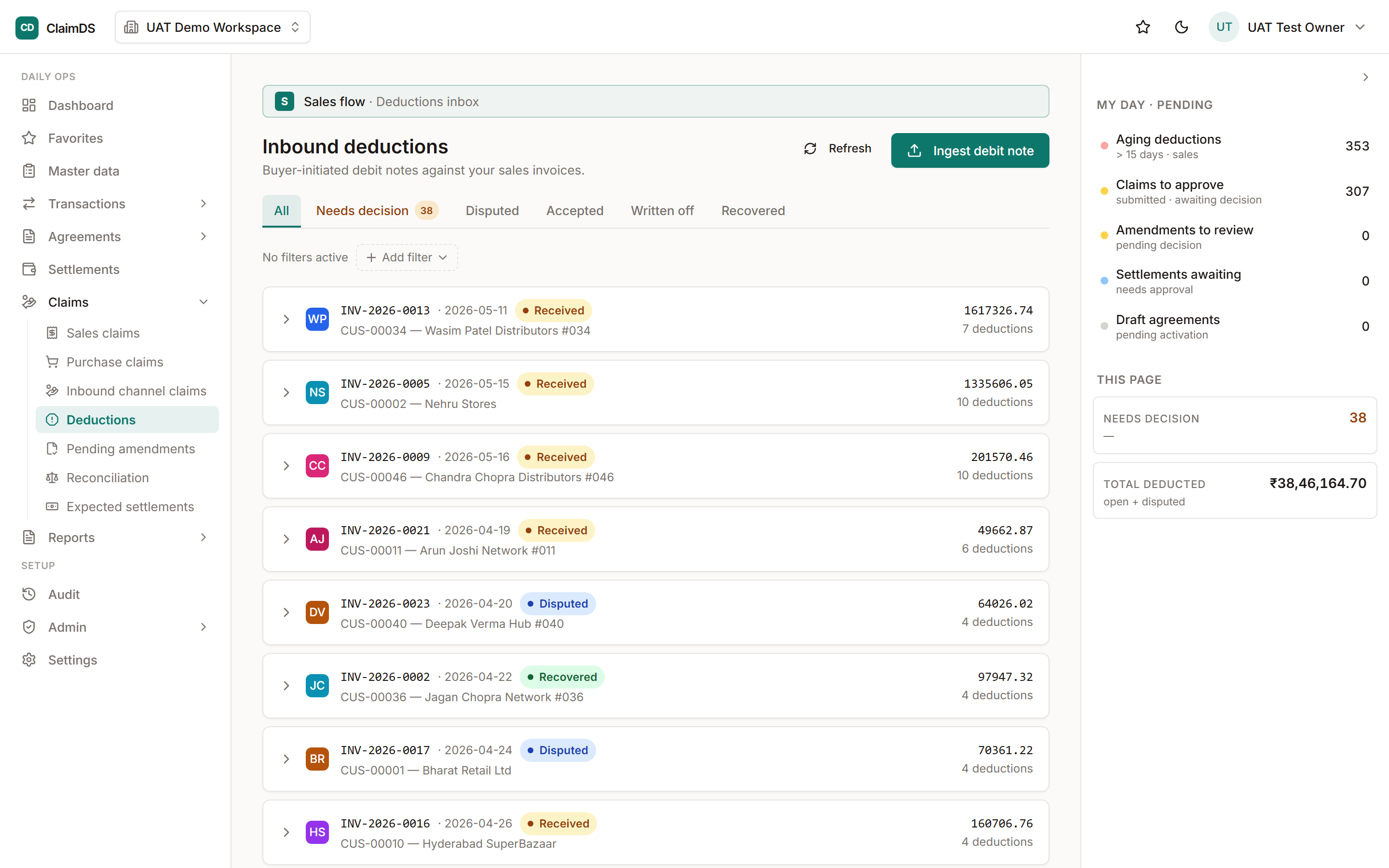
FMCG runs on high volume, thin margins and dense scheme activity, so deductions are constant and small-but-many. A single distributor can face hundreds of deductions a month across brands and outlets. This is the FMCG-specific view of the chargeback management hub, and it pairs with buyback in FMCG on the returns side.
Related reading: how claims and rebates flow across the Indian FMCG channel.
Verify at publish: Indian distributor-body advocacy on expired/damaged stock — confirm current positions before citing any specific claim or figure; do not state numbers that are not verified.
Modern trade vs general trade
| Aspect | Modern trade | General trade |
|---|---|---|
| Outlets | Organised retail chains | Many small independent outlets |
| Deductions | Larger, contractual (listing, visibility, promo) | Numerous, scheme-driven |
| Tracking difficulty | Fewer but complex | High volume, hard to reconcile |
Both benefit from the distributor claims discipline. The direction of each flow matters too: some of these are the retailer or distributor charging the supplier, others are the supplier recovering funded amounts from the channel — the billbacks vs chargebacks vs deductions glossary keeps the vocabulary straight, and what is a billback covers the supplier-pays direction in depth.
What compliance chargebacks does modern trade raise?
Modern trade's distinctive contribution is the compliance chargeback — a deduction not for goods or schemes but for how the supply itself performed against the trading agreement. Three families dominate.
| Compliance chargeback | What triggers it | What defends against it |
|---|---|---|
| Fill rate / short supply | Units delivered fall short of the purchase order, or miss the delivery window | Delivery documentation: PO, invoice, signed proof of delivery, gate-entry records |
| ASN / labelling errors | Advance shipping notice missing or mismatched; cartons or pallets labelled off-spec | The ASN transmission record and photos of compliant labelling at dispatch |
| Shelf-life on receipt | Stock arrives with less remaining shelf life than the agreement's receiving threshold | Batch and manufacturing-date records for the specific consignment |
A worked fill-rate example shows the shape (illustrative numbers only). A chain's purchase order asks for 10,000 units at ₹50; the supplier ships 9,200 in the window. The 800-unit shortfall represents ₹40,000 of unfulfilled order value, and the trading agreement specifies a service-level penalty against it — deducted automatically via the portal, no negotiation, no phone call. The deduction is contractual and arithmetic; the only questions worth asking at validation are whether the shortfall count matches your dispatch records and whether the penalty was computed per the agreed terms. Suppliers lose these disputes not because the chains are wrong but because nobody can produce the delivery paperwork within the dispute window.
Shelf-life-on-receipt deserves special respect because it is a rejection-plus-chargeback: stock below the receiving threshold is refused at the gate or charged back later, and it then re-enters your own channel as near-expiry inventory — connecting directly to the stock compensation process on the other side.
How do GT damage and expiry deductions work?
General trade generates the opposite pattern: no portals, no service-level clauses — instead a continuous drizzle of damage and expiry claims flowing up from thousands of small outlets. A retailer hands damaged or expired packs back to the distributor's salesman; the distributor accumulates them, files claims against the brand, and nets the amount from payments when settlement drags. The volume is small per line and immense in aggregate, and each line needs the same questions answered: which stock, which supply, whose custody when the damage happened?
The custody question is the substantive one. Damage in the brand's warehouse or in transit is the brand's cost; damage from a distributor's poor godown practice is, by most agreements, at least partly the distributor's. Expiry sits in between — driven by how much was sold in versus how fast it sold through — which is why expiry-heavy categories negotiate explicit return and destruction terms. The settlement mechanics, including how credit notes for expired and damaged goods returns carry the adjustment and where the GST treatment turns on saleable-versus-unsaleable classification, are their own subject — pointer-level here. The buyback route is the structured alternative: agree upfront what comes back and at what value, instead of litigating each crate after the fact.
When do FMCG chargebacks spike?
Deduction volume follows the promotional calendar with a lag. Festive sell-in — the year's biggest — loads the channel with stock, schemes and displays simultaneously, and each unwinds into deductions in the following weeks: unsold promotional stock, damage from overfull godowns, scheme settlements landing at period close, display and visibility recoveries invoiced after the event. Monsoon adds a seasonal damage wave of its own. Scheme-period ends — month, quarter, festival — each produce a settlement pulse, which is one reason the types of trade schemes a brand runs directly shape the deduction load its finance team inherits.
The operational consequence: a deduction process sized for the average month drowns in the spike months, and what drowns gets written off. Teams that know the spike is coming pre-clear the queue, staff validation for the surge, and hold dispute discipline exactly when volume peaks — because claim windows do not extend just because everyone is busy.
What evidence actually survives?
The evidence window closes at the moment of receipt or return. A goods-receipt note annotated with damage counts on the day the truck arrived is proof; an email three weeks later saying stock "arrived damaged" is an assertion. The evidence that wins FMCG disputes is boring and contemporaneous: signed delivery challans with exceptions noted, date-stamped photographs of damaged cartons, batch and expiry records tying the stock to a specific supply, portal screenshots with timestamps, and the running claim register that shows when each item was raised. This is the same discipline that makes FMCG distributor claim calculations verifiable rather than negotiable, and it is the heart of deduction management best practices: capture evidence as a habit at the moment events happen, because you cannot know in advance which crate becomes a dispute.
Common deduction types
- Scheme/promotion deductions — funded scheme amounts recovered at settlement.
- Damage and expiry deductions — for stock damaged or expired in the channel.
- Trade-spend recoveries — visibility, display and listing costs.
The distributor recovery challenge
The volume is the problem. Valid deductions get written off and invalid ones accepted simply because no one can review hundreds of line items by hand each month. Software turns the deduction flood into a managed queue — validating against agreements, capturing evidence, and tracking days-deduction-outstanding. See the dispute mechanics in the chargeback dispute process and the finance view in the CFO revenue-leakage playbook.
Chargebacks rarely arrive alone: the same distributor is usually claiming scheme payouts and damage credits in the same month, funded from the same trade budget. Managing that budget as one pool rather than several is the case for a trade promotion management platform.
GST note: This article is general information, not tax or legal advice. Where settlement involves GST credit notes, positions — including CBIC Circular No. 251/08/2025-GST and the Finance Act 2026 amendments to Section 34 of the CGST Act, assented 30 March 2026 but not yet notified into force as of publication — must be re-verified at publish time with a qualified professional.
Frequently asked questions
What are chargebacks in FMCG distribution?
In Indian FMCG, chargebacks are deductions a brand applies against a distributor — scheme and promotion deductions, damage and expiry deductions, and trade-spend recoveries. They differ between modern trade and general trade and are a major source of distributor revenue leakage.
How do modern trade and general trade deductions differ?
Modern trade deductions tend to be larger, contractual and tied to listing, visibility and promotion terms. General trade deductions are more numerous and scheme-driven across many small outlets, making them harder to track and reconcile.
How do FMCG distributors recover deductions?
By validating each deduction against the agreement and data, capturing evidence, disputing invalid deductions within the window, and tracking days-deduction-outstanding. Software makes this feasible across the high volume of FMCG deductions.
What is a fill-rate chargeback in modern trade?
A penalty a modern-trade chain deducts when a supplier ships less than the purchase order required — measured as units delivered against units ordered, often within a delivery window. The terms live in the trading agreement, the deduction arrives via the retailer's portal or debit note, and the defence is delivery documentation that proves what actually shipped and when.
What evidence defends against FMCG damage and expiry deductions?
Evidence created at the moment of receipt or return: goods-receipt notes annotated with damage counts, delivery challans signed with exceptions noted, date-stamped photographs, and batch or expiry records tying stock to the supply that delivered it. Evidence reconstructed weeks later persuades no one.
Why do FMCG chargebacks spike after the festive season?
Because festive sell-in loads the channel with stock, promotions and displays all at once — and every one of those unwinds into deductions afterwards. Unsold promotional stock, damage from crowded godowns, scheme settlements and display-cost recoveries all land in the following weeks, so the post-festive quarter carries the year's heaviest deduction volume.
What are the most common reasons retailers issue chargebacks to suppliers?
The usual triggers: shortages where invoiced quantity exceeds what the retailer recorded; late or early delivery outside the window; missed appointments; fill-rate failures; labelling and barcode errors; missing or inaccurate shipment notices; wrong carton configuration; price differences between purchase order and invoice; and unauthorised substitutions. Rank your own chargebacks by reason code and value — a handful of causes usually drive most of the cost, making prevention a focused operations project.
Should companies set a write-off threshold for small chargebacks and deductions?
Yes. Investigating every deduction costs more than it recovers, so mature teams set a documented threshold below which valid-looking deductions are coded and absorbed. Derive it from your own data — research cost versus historical recovery by reason code. Keep three safeguards: still code small write-offs so patterns stay visible, review the threshold annually, and exclude suspected duplicates and fraud from auto-write-off regardless of amount.
See RebateLedger on your own claims data
A 30-minute walkthrough tailored to how your channel actually settles claims.