
Chargeback Management Software for Channel & Distribution (India)
Trade chargeback management software for Indian channel and distribution — not card chargebacks. Types, the process, and what software automates.
In short
Trade chargeback management software automates the raising, validation, approval and settlement of chargebacks and deductions between manufacturers and channel partners — scheme, price-difference, damage and return deductions in FMCG and pharma distribution. It is distinct from card-payment chargeback tools.
Trade chargeback management software automates the raising, validation, approval and settlement of chargebacks and deductions between manufacturers and their channel partners — scheme, price-difference, damage and return deductions in FMCG and pharma distribution. It replaces manual deduction-matching with rules, evidence capture and an audit trail.
Trade chargebacks, not card chargebacks. This is about channel/trade chargebacks: deductions and claims between a manufacturer and a distributor or dealer. It is not about card or payment chargebacks (a customer's bank reversing a card transaction). Those are a different problem with different tools.
What a trade chargeback is
In Indian distribution, a trade chargeback is a deduction or claim raised across the channel — a brand deducting against a distributor for a scheme it funded, a price difference, damaged goods, or a return. These are part of the same money-flow as rebates and price protection, and they belong in one system. The umbrella is claims management software; the receivables view is deduction reason codes and claim matching, and the term glossary is billbacks vs chargebacks vs deductions.
Trade chargeback types
| Type | Raised for |
|---|---|
| Scheme / promotion deduction | Funded scheme amounts deducted at settlement |
| Price-difference chargeback | Price changes on stock in the channel |
| Damage / shortage | Goods damaged or short on receipt |
| Return / expiry deduction | Returns of unsold or expired stock |
Each needs its own evidence and validation. The processes are detailed in the chargeback process and the chargeback dispute process.
The management process
A chargeback is raised with a reason and evidence, validated against the agreement and data, approved, and settled — typically netted in a credit note. Making each step explicit is what converts an opaque deduction into a defensible one.
How does the chargeback lifecycle run in Indian channels?
Four stages — and the first is the one most teams skip.
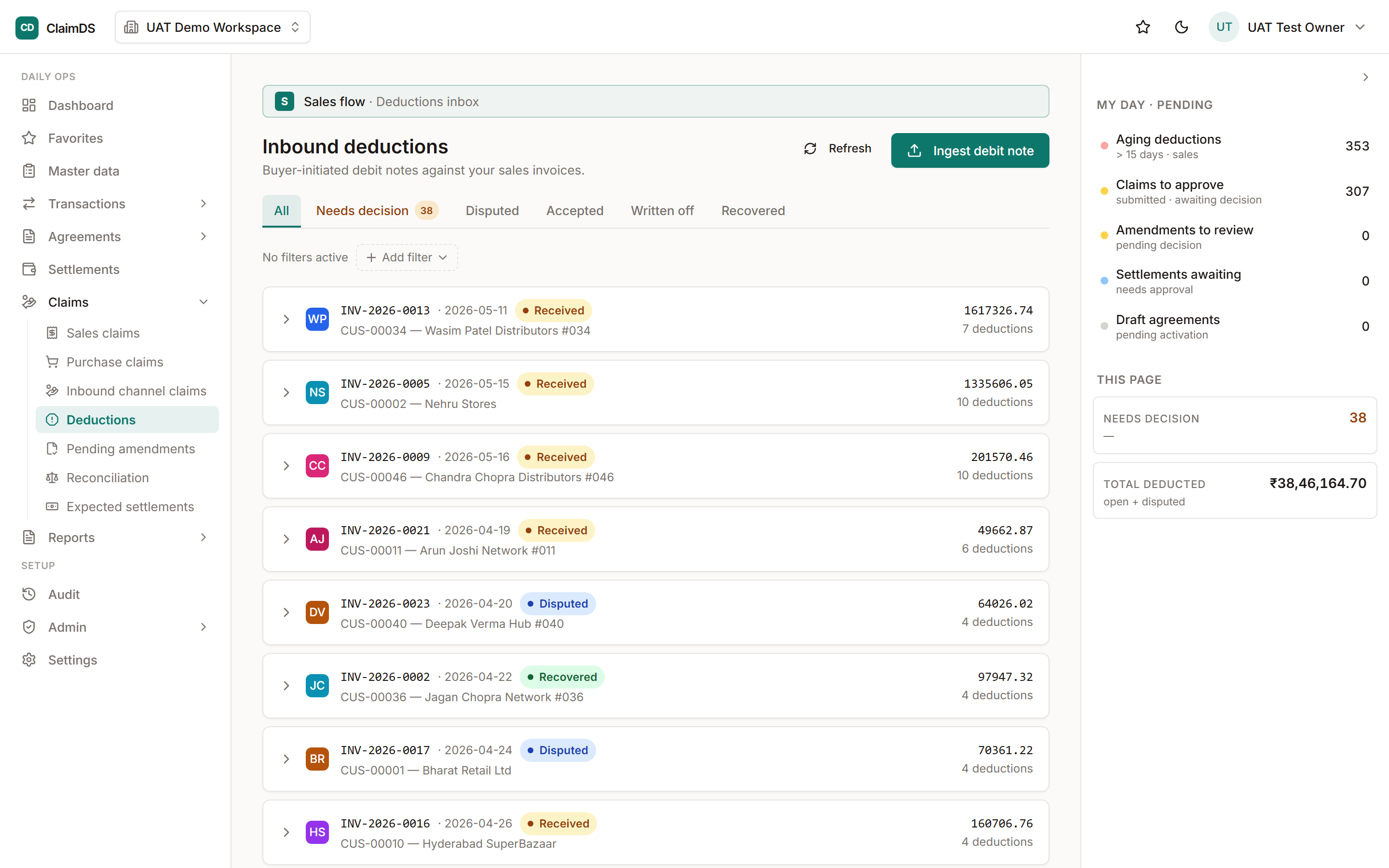
Intake. Chargebacks arrive scattered: as deductions on remittance advices, debit notes from modern-trade chains, DMS claim entries, damage reports, plain emails. The first job is capture — every deduction lands in one queue with a reason code, a partner, an amount and a date. Anything that never enters the queue can never be validated, disputed or even counted.
Validation. Each chargeback is matched three ways — to the agreement or trade scheme that supposedly authorises it, to the source data (sales, receipts, stock) that supposedly evidences it, and to prior claims to catch duplicates. The output is a decision per line: valid, invalid, or partially valid.
Dispute. Invalid and overclaimed lines go back to the partner with evidence attached — the agreement clause, the data, the duplicate reference. Disputes carry deadlines on both sides, so the queue has to track ageing, not just status.
Settlement. Valid amounts settle — typically netted through a credit note — and the ledger records what was accepted, what was disputed and what was recovered, following the same Submitted → Validated → Approved → Settled lifecycle described in the claim process explained.
A worked intake (illustrative numbers only): a distributor remits a payment short by ₹1,84,000 — ₹1,10,000 tagged to a funded scheme, ₹50,000 as a price-difference claim, ₹24,000 for damage. Validation confirms the scheme deduction, finds the price difference overclaimed by ₹8,000 against the price master, and finds no goods-receipt evidence for the damage. Result: ₹1,52,000 accepted, ₹32,000 disputed with reasons attached. Without the queue, the likely outcome was ₹1,84,000 silently absorbed.
How deep should the dispute workflow go?
Deeper than most teams build it. A dispute is not an email thread; it is a case, with an owner, a deadline, an evidence pack and an outcome. The workflow needs partial acceptance (accept ₹1,52,000, dispute ₹32,000 — not all-or-nothing), reason codes on every rejection so patterns become visible, escalation paths for when a partner does not respond, and a clean write-off decision at the end so nothing ages silently. The step-by-step is in the chargeback dispute process; the discipline of keeping the deduction pile young and moving is deduction management best practices. Direction matters too — a chargeback recovers money from the partner, while its mirror image, the billback, is the partner billing the supplier. A good system handles both flows in one queue, because a partner's remittance mixes them freely.
What software automates
Core jobs: match deductions to claims, validate against agreements, capture evidence, flag anomalies, and keep an immutable audit trail. Dedicated chargeback claim software automates the matching and validation that humans cannot do reliably at scale, and surfaces invalid or duplicate deductions for dispute — see also chargeback fraud detection.
What features should chargeback management software have?
| Feature | Why it matters |
|---|---|
| Single intake queue | Every deduction from every source lands in one place with a reason code |
| Agreement and scheme matching | Each chargeback validates against a recorded agreement, not against memory |
| Duplicate detection | The same deduction claimed twice is flagged, not paid twice |
| Evidence vault | Debit notes, GRNs, photos and correspondence attach to the line they support |
| Dispute case management | Owners, deadlines, escalation and partial acceptance built in |
| Approval workflow | Thresholds and delegation so large write-offs are decisions, not defaults |
| GST credit-note settlement | Accepted amounts settle by the correct note type and reconcile to the ledger |
| ERP/DMS integration | Remittance and sales data flow in automatically — see ERP integration for claims software |
| Immutable audit trail | Every acceptance, dispute and write-off is traceable later |
FMCG and pharma
Chargebacks differ by industry. FMCG sees modern-trade and general-trade deductions and scheme-related claims (chargebacks in FMCG); pharma's CFA/stockist model adds contract-price vs list-price chargebacks (chargebacks in pharma).
How do modern-trade and general-trade chargebacks differ?
They differ enough that a process tuned for one will underperform on the other.
| Modern trade | General trade | |
|---|---|---|
| Who initiates | Retail chains deduct from payments owed to the brand or distributor | Distributors and dealers raise claims against the brand |
| Typical triggers | Promotion funding, margin support, fill-rate and service-level penalties, returns | Scheme claims, price differences, damage and expiry |
| Paper trail | Structured debit notes and vendor-portal downloads | Claims, emails and DMS entries of varying quality |
| Volume pattern | Fewer, larger, contract-driven lines | Many small scheme-driven lines |
| Dispute posture | Formal windows, portal-based, deadline-enforced | Relationship-driven and negotiated |
Modern-trade chargebacks reward a team that can pull structured data out of retailer portals and dispute within contractual windows; general-trade chargebacks reward a team that can standardise messy intake and validate at volume. The software has to do both, because most Indian brands sell through both.
Why deductions leak
Without a system, valid deductions get written off because nobody could prove them, and invalid ones get accepted because nobody had time to dispute them. Both are leakage. Software turns the deduction pile into a managed, auditable queue. The finance-leadership framing is in the CFO revenue-leakage playbook.
Which metrics should a chargeback team track?
| Metric | What it tells you |
|---|---|
| Deduction ageing | How long chargebacks sit unresolved — the earliest leakage warning |
| Validation turnaround | Days from intake to a valid/invalid decision |
| Dispute win rate | Whether your evidence actually holds up |
| Recovery rate on invalid deductions | Leakage prevented, in rupees |
| Write-off rate and value | Leakage accepted — and whether it is trending down |
| Settlement cycle time | What partners experience, and the working capital the process consumes |
Baseline these before automating anything, then track them quarterly; they are the raw material for the payback arithmetic in the claims-management ROI benchmark. For the customer-side commercial view, see customer deduction and chargeback management.
Where does GST enter chargeback settlement?
At pointer level: chargebacks that settle by credit note raise the same tax questions as any post-sale adjustment — whether the note is a tax credit note or a financial one, and whether it lands within the GST credit-note time limits. The answers depend on the deduction type and its documentation, so treat them as positions to verify, not defaults.
One scoping note before you evaluate anything: confirm which instrument you are actually buying for. Chargebacks and billbacks need different validation, and a platform that only aggregates cannot settle a billback — billback vs chargeback sets out the difference.
GST note: This article is general information, not tax or legal advice. Where settlement involves GST credit notes, positions — including CBIC Circular No. 251/08/2025-GST and the Finance Act 2026 amendments to Section 34 of the CGST Act, assented 30 March 2026 but not yet notified into force as of publication — must be re-verified at publish time with a qualified professional.
Frequently asked questions
What is trade chargeback management software?
Trade chargeback management software automates the raising, validation, approval and settlement of chargebacks and deductions between manufacturers and channel partners — such as scheme, price-difference and damage deductions in FMCG and pharma distribution. It is distinct from card/payment chargeback tools.
Are trade chargebacks the same as card chargebacks?
No. A card chargeback is a payment dispute reversed through a bank or card network. A trade chargeback is a deduction or claim raised between a manufacturer and a channel partner over schemes, pricing, damage or returns. This guide covers trade chargebacks only.
How does software reduce chargeback leakage?
By validating each chargeback against the agreement and source data, matching deductions to claims, capturing evidence, and keeping an audit trail — so invalid deductions are disputed and valid ones are settled accurately rather than written off.
What is the difference between a trade chargeback and a billback?
Direction. In a trade chargeback the supplier recovers money from the channel partner, or the partner deducts against amounts the supplier funded. In a billback the partner bills the supplier for an agreed post-sale amount, so money flows from supplier to partner. Both are post-sale adjustments, initiated from opposite sides.
How do modern-trade chargebacks differ from general-trade ones?
Modern-trade chargebacks are fewer, larger and contract-driven — retail chains deduct through structured debit notes with formal dispute windows. General-trade chargebacks are many small scheme-driven claims from distributors and dealers with messier paperwork. The first rewards deadline discipline; the second rewards high-volume validation.
Which metrics matter most in chargeback management?
Deduction ageing, validation turnaround, dispute win rate, recovery rate on invalid deductions, write-off rate and settlement cycle time. Together they show whether leakage is being prevented or silently absorbed, and they are the baseline for measuring what software actually improved.
What features should you look for in chargeback software?
Evaluate eight capabilities: versioned masters with effective dates; structured claim intake with mandatory fields and attachments; automated line-level validation with straight-through processing for clean claims; delegation-of-authority workflow with audit logs; settlement with correct GST treatment on credit notes; ERP integration for posting; analytics covering ageing, recovery rates and anomaly flags; and dispute management with deadlines. Weight the list by your pain — dispute-heavy businesses need validation depth, volume-heavy ones need straight-through rates.
How does chargeback software integrate with ERP and DMS systems?
Integration runs both ways. Inbound, the system pulls what validation needs: customer and product masters, price lists and invoices from the ERP, and secondary-sales data from the DMS where claims depend on downstream transactions. Outbound, approved claims become credit notes posted to the ERP with correct ledger mapping and GST fields. Keep one source of truth per data type: masters in the ERP, claim lifecycle in the claims system.
See RebateLedger on your own claims data
A 30-minute walkthrough tailored to how your channel actually settles claims.