
Chargeback Claim Software & Solutions (India)
Trade chargeback claim software automates deduction matching, validation, evidence capture and settlement in Indian channels, plus a buyer checklist.
In short
Trade chargeback claim software automates deduction-to-claim matching, validation against agreements, evidence capture, anomaly flagging and settlement — so valid deductions are settled accurately and invalid ones are disputed rather than written off. This is trade chargebacks, not card-payment chargebacks.
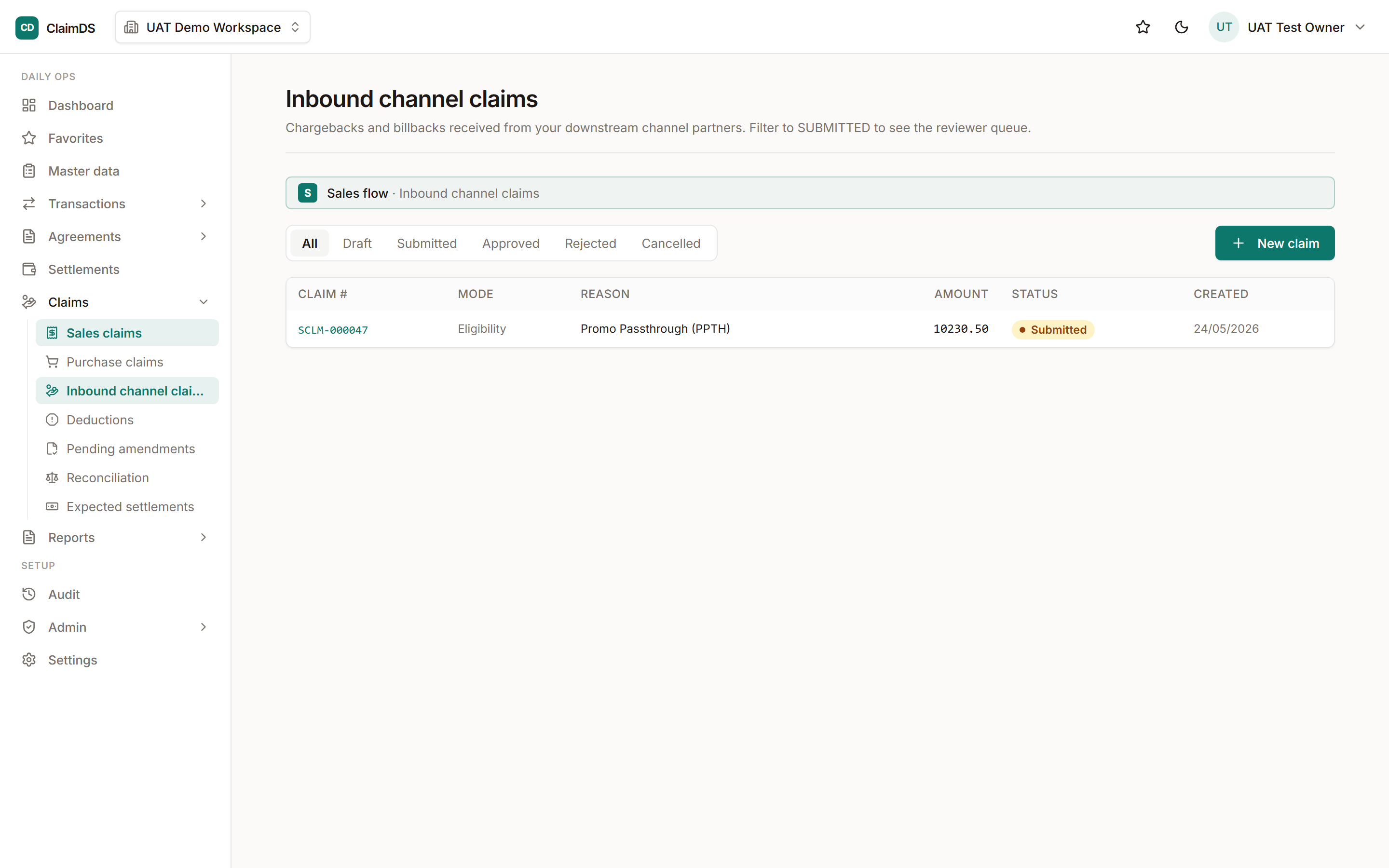
Chargeback claim software automates the claim-level mechanics of trade deductions: matching deductions to claims, validating against agreements and source data, capturing evidence, flagging anomalies, and settling — so valid deductions are paid accurately and invalid ones are disputed rather than written off. It is the working engine of the chargeback management hub.
What it does
The software automates the matching and validation humans cannot do reliably at scale, surfaces invalid and duplicate deductions for dispute, and settles the rest correctly. It connects to the upstream chargeback process and the receivables view in deduction reason codes and claim matching.
Claim software vs management software
"Management software" is the broad category covering policy, workflow and reporting; "claim software" emphasises the claim-level engine — matching, validation, evidence, settlement. In an integrated product like RebateLedger both live in one system, which avoids the seams where deductions get lost. See the comparison framing in best rebate management software. If you want the category-level view — governance, policy, team structure, the whole operating model — read the management-software guide; stay on this page for the feature-by-feature anatomy of handling the claims themselves.
What features should chargeback claim software have?
Six capabilities do the actual work, and a demo should prove each one on your own documents, not the vendor's.
- Intake from every arrival channel. Chargebacks arrive as debit notes, as short payments buried in remittance advices, and as entries in retailer portals. The software must capture all three into one queue — parsing remittance advices into deduction lines, accepting portal downloads, and logging debit notes — because a deduction that never enters the system is a deduction that settles itself.
- Reason codes applied at capture. Every deduction gets coded on arrival — scheme, price difference, damage, return, compliance — so it can be routed to the right validator and aged by type. A queue without reason codes is a pile.
- An evidence vault. Agreements, photos, delivery proofs, correspondence and the debit note itself, attached to the specific claim line they support and retrievable years later. Evidence scattered across inboxes loses disputes that evidence in a vault wins.
- A dispute workflow. Not a status field — a workflow: the disputed gap named, the partner's response tracked, escalation triggered before windows lapse, and outcomes recorded so the dispute process runs on rails rather than memory.
- Recovery tracking. A dispute won on paper but never collected is a write-off with extra steps. The system must track each recovery from "dispute upheld" through to the credit note or repayment actually landing.
- An audit trail. Every capture, validation, approval and settlement recorded immutably — who, what, when — which is both the compliance backbone and the deterrent against the leakage patterns that thrive in untracked queues.
The same anatomy applies whichever direction the money flows: inbound billbacks and outbound chargebacks are mirror images, and the glossary shows how the claim types map onto one engine.
How should you evaluate chargeback claim software?
Evaluate against your ugliest month, not the vendor's demo data. Bring a real remittance advice with forty deductions, a real disputed debit note, and a real agreement, and score what happens.
| Criterion | What to test | Red flag |
|---|---|---|
| Match rate | Feed a real remittance advice; count auto-matched lines | Everything needs manual matching |
| Validation depth | Does it check the agreement's rate, window and cap — or just existence? | Validation is a checkbox |
| Evidence handling | Attach, retrieve and export documents per claim line | Attachments live at header level only |
| Dispute lifecycle | Raise, escalate and resolve a dispute end to end | Dispute is just a status value |
| Settlement correctness | Generate the settlement with correct credit-note treatment | Tax treatment is left to you |
| Reporting | Days-deduction-outstanding, recovery rate, leakage trend out of the box | Reports require export to spreadsheets |
Scale the arithmetic before you sign anything. Suppose a mid-market supplier faces 400 deductions a month averaging ₹9,000 — ₹36 lakh a month asserted against it (illustrative numbers only). At that volume, even a small share of duplicates, overshoots and unsupported charges left unexamined dwarfs the software subscription; the claims management ROI benchmark walks the full calculation, and the distributor claims software buyer's guide covers the procurement process around it.
What does ERP integration actually involve?
Three flows, and all three are load-bearing. Masters in — partners, products, prices and agreements, so validation checks against current data rather than a stale copy. Deductions in — open short-payments and debit notes from the receivables ledger, so the claim queue and the books describe the same reality. Settlements out — approved credit notes and adjustments posted back, so finance closes without re-keying. Integration is where implementations actually succeed or stall, and it deserves the same scrutiny as the features themselves; the realities — connector depth, master-data hygiene, sequencing — are covered in ERP integration for claims, rebate and TPM software. A system missing any of the three flows becomes one more silo that must itself be reconciled, which is precisely the revenue leakage pattern it was bought to fix.
Buyer's checklist
Look for: deduction matching · validation against source data · evidence capture · anomaly & duplicate detection · GST-correct settlement · audit trail · recovery reporting.
| Capability | Why it matters |
|---|---|
| Auto deduction-to-claim match | Removes manual reconciliation at scale |
| Validation against agreement + data | Separates valid from invalid objectively |
| Evidence capture | Wins disputes; prevents write-offs |
| Anomaly / duplicate detection | Catches leakage and fraud |
| GST-correct settlement + audit trail | Compliant, defensible close |
Metrics it should report
A capable system reports days-deduction-outstanding, recovery rate, dispute win rate, and leakage trend — the numbers a finance leader needs (see the CFO playbook).
Two of those deserve a baseline before go-live, because they are how you will know the software worked. Days-deduction-outstanding is the ageing metric: how long the average deduction sits between arrival and resolution. Measure it for the last two quarters before implementation, then watch it fall as capture, coding and routing stop being manual. Recovery rate is the money metric: of the deductions you disputed, what share actually came back as cash or credit? A rising recovery rate with a stable dispute volume means validation is finding real gaps; a falling one means disputes are being raised on weak grounds or won on paper and never collected. Insist that both come out of the system natively, per partner and per reason code — if you have to rebuild them in spreadsheets each month, the reporting box on the checklist above is not truly ticked.
GST note: This article is general information, not tax or legal advice. Where settlement involves GST credit notes, positions — including CBIC Circular No. 251/08/2025-GST and the Finance Act 2026 amendments to Section 34 of the CGST Act, assented 30 March 2026 but not yet notified into force as of publication — must be re-verified at publish time with a qualified professional.
Frequently asked questions
What does chargeback claim software do?
Trade chargeback claim software automates deduction-to-claim matching, validation against agreements, evidence capture, anomaly flagging, settlement and reporting — so valid deductions are settled accurately and invalid ones are disputed rather than written off.
How does it differ from chargeback management software?
They overlap heavily. Chargeback management software is the broad category; chargeback claim software emphasises the claim-level mechanics — matching, validation, evidence and settlement. In a product like RebateLedger both live in one system.
What should I look for in chargeback claim software?
Automated deduction matching, validation against source data, evidence capture, anomaly and duplicate detection, GST-correct settlement, an audit trail, and reporting on days-deduction-outstanding and recovery rate.
Does chargeback claim software need ERP integration?
Yes, at three points: partner, product and price masters flowing in; open deductions and short payments flowing in from receivables; and approved settlements flowing back as credit notes or adjustment entries. Without those, the software becomes another spreadsheet that must itself be reconciled.
What is an evidence vault in chargeback claim software?
A structured store that holds every supporting document — debit notes, agreements, photos, delivery proofs, correspondence — attached to the specific claim line it supports, retrievable years later. It is what turns a dispute from an argument into a document exchange, and an audit from a scramble into a lookup.
How do you measure whether chargeback claim software is paying off?
Track four numbers against your pre-software baseline: days-deduction-outstanding, recovery rate on disputed deductions, the share of deductions written off unexamined, and the cost of processing each claim. Improvement in those four is the return; anything else is anecdote.
What is chargeback claim software and who needs it?
Chargeback claim software structures the claim transaction itself: distributors submit price-difference and scheme claims in a defined format, and manufacturers validate, adjudicate and settle them at scale. Manufacturers need it when claim volumes outgrow manual review, disputes and duplicate payments recur, or audits expose weak claim controls; distributors benefit from tracking what was claimed, approved and credited. The payoff is faster settlement, fewer disputes and a defensible audit trail.
Is chargeback software worth it for smaller distributors?
For a distributor the question is claim recovery, not adjudication. A multi-brand distributor files hundreds of claim lines monthly, and every claim missed, filed late or left unreconciled is margin lost. Even lightweight tooling that registers entitlements, enforces filing deadlines and ages unsettled amounts changes recovery meaningfully. If you cannot state what is claimable, claimed and unsettled by brand today, tooling will pay for itself.
See RebateLedger on your own claims data
A 30-minute walkthrough tailored to how your channel actually settles claims.