
Revenue Leakage in Rebate Programs: Where the Money Goes & How to Stop It
Where rebate and trade-spend programs leak revenue in Indian multi-tier channels — overpayments, duplicates, unclaimed accruals — and how to stop it.
In short
Revenue leakage in rebate programs is the money lost between what a scheme should cost and what it actually costs — through overpayments, duplicate claims, unclaimed accruals, mis-slabbed math and reconciliation gaps between channel tiers. It is rarely one big error; it is many small, structural ones, invisible on spreadsheets until they add up.
Revenue leakage in rebate programs is the money lost between what a scheme should cost and what it actually costs — through overpayments, duplicate claims, unclaimed accruals, mis-slabbed math and reconciliation gaps between channel tiers. In Indian multi-tier distribution it is rarely one big error; it is many small ones, structural and invisible until they add up. Why thin-margin businesses feel those small leaks hardest — and how to find yours before year-end — is covered in revenue leakage in high-volume, low-margin distribution.
Why rebate leakage is invisible
A rebate scheme is agreed in a circular, tracked in one spreadsheet by sales and another by finance, and settled weeks later by credit note. No single view reconciles what was earned, claimed and paid. That gap is where money leaks — quietly, every cycle. This is the leakage side of the rebate management software story and the problem the CFO revenue-leakage playbook exists to quantify.
The seven ways rebate programs leak
| Leak | What happens |
|---|---|
| Overpayment | A claim is settled above what the scheme actually earned |
| Duplicate claims | The same accrual is claimed and paid more than once |
| Unauthorised deductions | A partner nets an amount with no agreement behind it |
| Unclaimed accruals | Money earned is never claimed and quietly expires |
| Mis-slabbed math | Wrong rate applied at a slab or growth boundary |
| Budget overrun | Scheme spend drifts past its sanctioned budget unnoticed |
| Reconciliation gaps | Accrual and settlement never tie out across tiers |
Each is small on one claim; multiplied across hundreds of schemes and thousands of partners, the leak is material. An eighth, tax-shaped leak hides in the paperwork: misclassifying ITC reversal on scheme credit notes turns a settlement into audit exposure as well as lost cash.
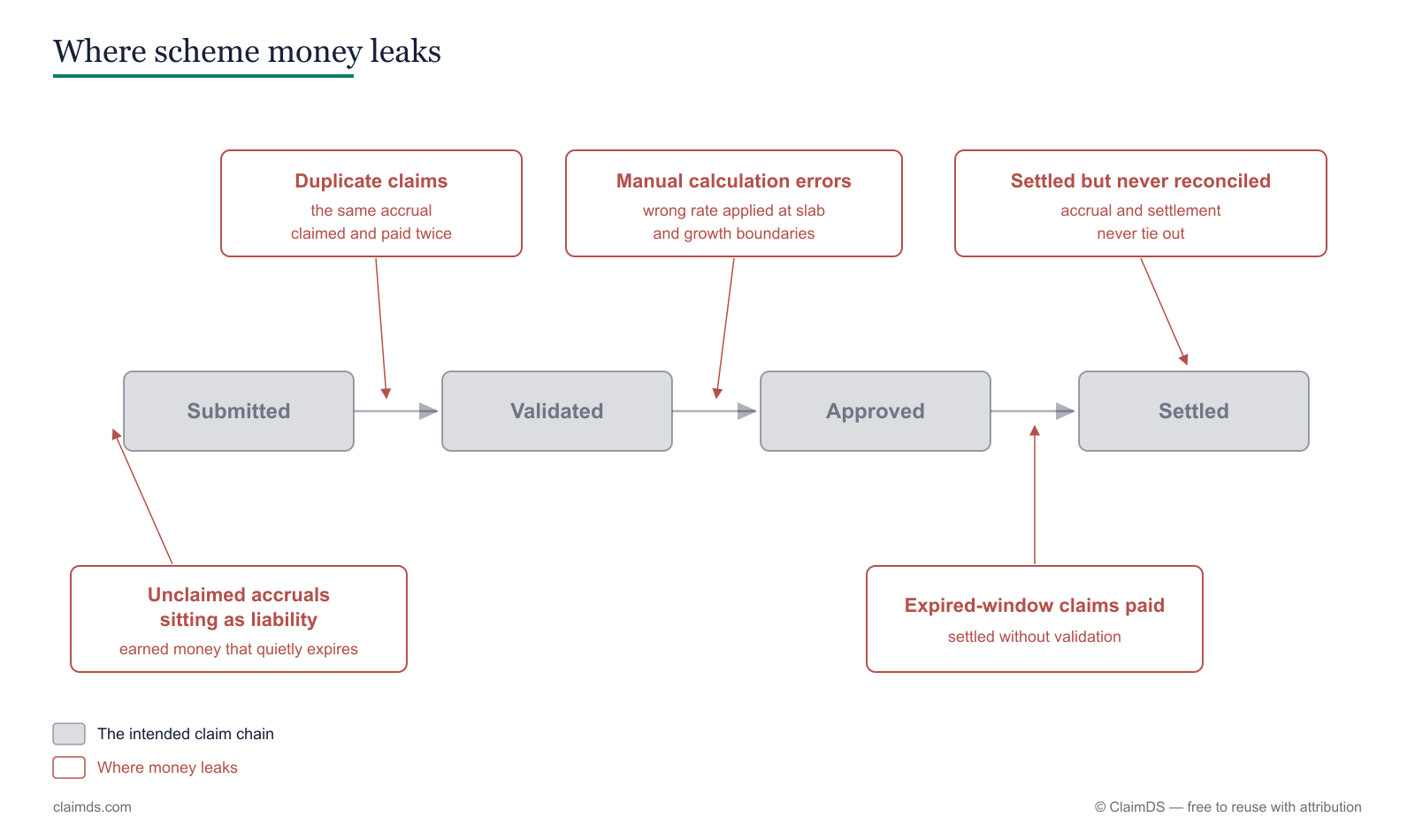
Source: RebateLedger — this diagram is free to reuse with a link back to this article.
A clearly-illustrative example
Illustrative only — not a surveyed figure. A distributor earns a 1.5% slab rebate on ₹80,00,000, but a mis-keyed boundary pays the 2% top rate on the whole turnover: ₹1,60,000 settled against ₹97,500 earned — a ₹62,500 overpayment on one partner, one quarter. The volume rebates mechanics show exactly where that boundary error creeps in.
How automation closes each leak
- Validation — every claim checked against its agreement and the underlying sales/purchase data, so overpayments and unsupported deductions are caught before settlement (the rebate tracking view).
- Duplicate detection — the same accrual can't be claimed twice; the same pattern that stops chargeback fraud.
- Live accrual — earned money is visible and claimable, so nothing expires unclaimed (the forecast, true-up and write-back discipline in rebate accrual management).
- Rule-based slab/growth math — the method is encoded once, so boundaries compute correctly every cycle.
- Accrual-to-settlement reconciliation — the gap between earned and paid surfaces and is resolved before close (rebate accounting).
- Audit trail — every decision is recorded, so leakage becomes measurable, not mysterious (claims ROI benchmark).
Related reading: how overpaid rebates are recovered through clawbacks and scheme cancellations.
Finding your own leakage is measurable, not guesswork. Get a free rebate recovery audit: up to 12 months of scheme data reviewed, with a leakage estimate and a findings call.
GST note: Where leakage involves the wrong credit-note type, the exposure is tax as well as cash. This article is general information, not tax or legal advice; GST positions — including CBIC Circular No. 251/08/2025-GST and the Finance Act 2026 amendments to Section 34 of the CGST Act (assented 30 March 2026, not yet notified into force as of publication) — must be re-verified at publish time with a qualified professional.
Where RebateLedger fits
RebateLedger is India-first, mid-market channel-claim software: multi-tier RTM fidelity, GST credit-note depth and breadth of claim types in one product, at a mid-market price (a RebateLedger-supplied ~₹3–5 lakh/yr figure, positioning not a benchmark). Its realistic peers are Indian DMS/SFA platforms rather than Western revenue suites. The full case is in why RebateLedger.
Frequently asked questions
What is revenue leakage in rebate programs?
Revenue leakage is the money lost between what a rebate or trade-spend program should cost and what it actually costs — through overpayments, duplicate claims, unauthorised deductions, unclaimed accruals, mis-slabbed calculations and reconciliation gaps between channel tiers. It is usually invisible on spreadsheets until it accumulates.
How do rebate programs leak money in Indian channels?
The common leaks are overpaid or double-paid claims, claims settled without validation, accruals nobody claimed, wrong slab or growth math at tier boundaries, deductions taken without support, and mismatches between what was accrued and what was settled — each small, but structural across many schemes and partners.
How do you stop rebate revenue leakage?
Close each leak with a control: validate every claim against the agreement and data, block duplicates, accrue live so nothing goes unclaimed, compute slab and growth math by rule, require evidence for deductions, and reconcile settlement to accrual before close — all on one auditable system rather than spreadsheets.
How does poor master data cause rebate leakage?
Poor master data corrupts entitlement maths before calculation begins. One distributor under three partner codes splits slab achievement, underpaying them, or lets them claim under each code, overpaying. Mismatched SKU codes between ERP and DMS drop eligible sales or admit ineligible ones. Wrong GSTIN mapping breaks credit-note issuance. The fix: one golden partner master, maintained SKU mapping, and every scheme document versioned centrally before it goes live.
What is overpayment leakage and how does it happen?
Overpayment leakage is settling claims for more than true entitlement. It happens when claims are approved without recalculating from source data, when achievement is taken from partner-reported figures, when returns are not netted from qualifying volume, and when quarter-end pressure pushes bulk approvals through. A subtler form pays on GST-inclusive billing the scheme never intended. The control is independent recalculation, matched line by line before settlement.
How much revenue do companies typically lose to rebate leakage?
There is no single reliable figure — published estimates vary widely — but companies auditing their rebate programmes for the first time routinely find leakage worth a meaningful fraction of trade spend. Measure your own number: reconcile one quarter of entitlements against settlements at invoice level, count duplicates, overpayments and unclaimed amounts, and extrapolate. Because trade spend is among the largest lines below gross sales, small percentages translate into crores.
How do you audit a rebate program for leakage?
Reconstruct entitlement independently and compare it to settlements: collect every scheme document including amendments, extract invoice-level sales and secondary data, recalculate what each partner should have earned, match against claims paid, and classify variances as duplicates, overpayments, ineligible or unclaimed. Verify the credit-note treatment and deadlines, check approvals against the authority matrix, and sample deeply on the largest partners and quarter-end settlements, where leakage concentrates.
What is a leakage heat map in rebate analytics?
A visual matrix showing where leakage concentrates: schemes or regions on one axis, leakage types on the other, with cell intensity showing value at risk. Its purpose is prioritisation — leakage is never uniform, and the map directs audit effort to the few cells holding most of the money. Build it from reason-coded rejections and audit findings, refresh quarterly, and track whether hot cells cool after interventions.
See RebateLedger on your own claims data
A 30-minute walkthrough tailored to how your channel actually settles claims.