
Rebate Management Software: The Complete 2026 Guide (India)
What rebate management software does, the rebate types it handles, GST credit-note treatment, and how to choose a system for Indian multi-tier RTM.
In short
Rebate management software automates how a business designs, accrues, claims, validates and settles rebate and incentive programs across its sales channel. It replaces spreadsheets with one auditable record of every scheme, the live accrued amount owed to each partner, and the GST-compliant credit note that finally settles the claim.

Rebate management software is a system that automates how a business designs, accrues, claims, validates and settles rebate and incentive programs across its sales channel. It replaces spreadsheets with one auditable record of every scheme, the live accrued amount owed to each partner, and the GST-compliant credit note that finally settles the claim.
What rebate management software does
Rebates are one of the largest and least-controlled lines of trade spend in Indian distribution. A manufacturer announces a 2% quarterly scheme; a distributor does the sales; months later a credit note arrives that nobody can fully reconcile against what was actually earned. Rebate management software exists to close that gap. It is the system of record for every incentive program — turning informal scheme circulars and manual spreadsheets into structured agreements that calculate themselves.
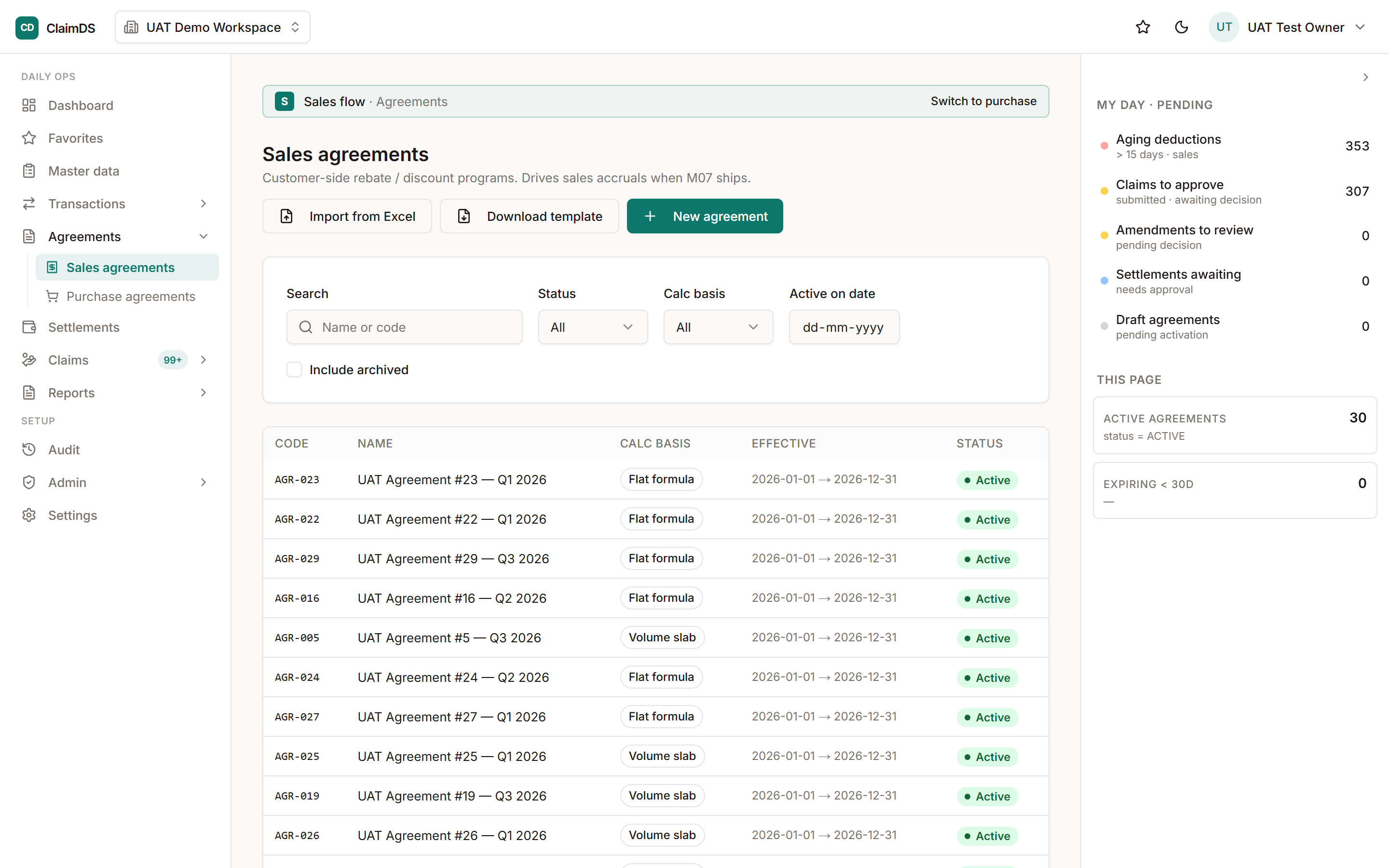
At its core, a rebate management system does four things: it captures the scheme (slabs, targets, eligibility, validity) as structured data; it accrues in real time against actual sales or purchase volume so finance always knows the live liability; it validates and processes claims against the agreement so disputes shrink; and it settles the approved amount through a compliant credit note with a full audit trail. For a broader view of how rebates sit alongside other channel claims, see our pillar on claims management software.
The rebate types it handles
"Rebate" is an umbrella term. A capable system covers the full range used in Indian channels, because a real distributor or manufacturer rarely runs just one kind:
- Volume and slab rebates — the most common: a percentage that rises as a partner crosses defined turnover slabs, settled retrospectively or prospectively.
- Growth and target rebates — paid for beating a prior-period or agreed target.
- Supplier rebates — buy-side rebates a business earns from its suppliers, accrued against purchases.
- Vendor rebates — vendor-funded programs that need accrual accuracy and clean reconciliation.
- Distributor and dealer rebates — sell-side sales rebates paid down the channel, often multi-tier.
- Customer rebates — end-customer programs with their own validation and GST treatment.
- Product-mix and range rebates — paid for stocking or selling the breadth of a range rather than volume of a single SKU, countering the hero-product habit. The mechanism is distinct from a volume rebate: entitlement depends on how many lines (or which mandated lines) the partner carried or sold in the period, so validation needs SKU-level data, not just totals. Illustrative example: a partner earns an extra 1% on the quarter's purchases if at least 8 of 12 catalogue lines each crossed a minimum offtake — the reward attaches to the mix condition, not the total. The full channel incentive spectrum places mix incentives among the alternatives.
If the terms themselves get muddled — supplier incentive, vendor rebate, dealer incentive, trade scheme — the difference between supplier, dealer and trade-scheme incentives is worth getting straight, because the direction the money moves decides how it is booked.
A tool that only handles flat-percentage rebates forces the messiest schemes — exactly the ones that leak the most money — back into spreadsheets.
Designing a B2B rebate program
Before software can manage a program, the program has to be designed well. A workable design fixes six things up front:
- Objective — the behaviour the rebate should buy (volume, growth, mix, loyalty); the objective dictates everything else.
- Structure — percentage, amount, quantity or formula; the trade-offs are in volume rebates.
- Baseline — the prior-period or agreed reference a growth target is measured against.
- Measurement basis — primary purchases or secondary sales, gross or net of returns, over what period.
- Settlement cadence — monthly, quarterly or annual, and by which credit-note type.
- Review loop — a scheduled check that the scheme actually paid for the behaviour it was meant to buy.
Get these six right and the downstream claim process becomes validation rather than negotiation; leave them vague and every settlement turns into a dispute.
The rebate lifecycle: accrual to settlement
Every rebate moves through a defined lifecycle: scheme captured → accrued → claim raised → validated → approved → settled. Making that lifecycle visible — instead of locked in one person's spreadsheet — is most of the value. Accrual is the live, growing liability calculated from real volume. Claiming is the partner's formal request; see how to submit a rebate or claim request. Validation checks the claim against the agreement and sales data. Settlement issues the credit note. The generic version of this flow is in the claim process explained.
How rebates are settled under GST
This is where Indian rebate management diverges from any global tool. Rebates are usually settled by credit note — but not all credit notes are equal under GST.
| Aspect | Tax (GST) credit note — Section 34 | Financial / commercial credit note |
|---|---|---|
| Changes output tax? | Yes — reduces supplier's output GST | No |
| Recipient ITC reversal? | Yes — proportionate reversal required | No reversal required |
| When used | Discount known/agreed before or at supply, linked to invoices | Post-sale commercial discount not meeting Section 15(3)(b) conditions |
Choosing the wrong instrument creates real exposure — either lost tax or an unexpected ITC reversal demand. Read the detail in financial vs. tax credit notes under GST and our guide to CBIC Circular 251 and post-sale discounts. For the accounting mechanics, see rebate accounting.
GST note: This article is general information, not tax or legal advice. GST positions — including CBIC Circular No. 251/08/2025-GST and the Finance Act 2026 amendments to Section 34 of the CGST Act, assented 30 March 2026 but not yet notified into force as of publication — must be re-verified at publish time with a qualified professional.
Why spreadsheets break in multi-tier RTM
Indian route-to-market is rarely two tiers. A typical chain runs manufacturer → super-stockist → distributor → sub-stockist → dealer → retailer, with secondary schemes running below the primary and channel rebates flowing down each tier. Spreadsheets fail here for predictable reasons: no single source of truth, manual slab math that compounds errors, no live accrual, no audit trail, and credit-note type chosen by habit rather than rule. Mid-market businesses commonly estimate 1–3% of channel turnover lost to under-settled or unclaimed rebates (treat that range as an industry rule-of-thumb, not a surveyed figure).
How to choose a system
Run a short, structured evaluation rather than a feature beauty-contest. Map your actual scheme types first; score each tool on claim-type breadth, multi-tier fidelity and GST correctness; pilot on one real quarter of data; and check reconciliation against a credit note you already received. Finance leaders should also read the CFO revenue-leakage playbook. Our best rebate management software buyer's guide turns these into a scored evaluation. And because the same calculation that runs these rebates also runs sales incentives, weigh whether you want one engine for both — our incentive management software guide covers the field-force side.
Related: set up your first rebate agreement walks through building one, and how much rebate and claims software costs in India covers budgeting for it.
Frequently asked questions
What is rebate management software?
It is a system that automates the design, accrual, claiming, validation and credit-note settlement of rebate and incentive programs across a sales channel, replacing spreadsheets with a single auditable record of what is owed and what has been paid.
How is a rebate different from a discount?
A discount reduces the price at the time of sale and appears on the invoice. A rebate is earned after the sale once a condition such as a volume or growth target is met, then settled later, usually through a credit note rather than on the original invoice.
How are rebates settled under GST in India?
Rebates are typically settled by credit note. A tax (GST) credit note under Section 34 reduces the supplier's output tax and requires the recipient to reverse proportionate ITC; a financial or commercial credit note does not change tax and needs no ITC reversal. The correct choice depends on whether the discount was known before supply.
Do small and mid-market Indian businesses need rebate management software?
Yes, when scheme volume, channel tiers or claim disputes outgrow spreadsheets. Mid-market manufacturers and distributors running multiple slab, growth and secondary schemes commonly lose an estimated 1–3% of turnover to calculation errors and unclaimed accruals, which purpose-built software is designed to recover.
When should a company move from Excel to a rebate management system?
Move when any three of these signals appear. Volume: more than roughly 200 claims a month or 50 active partners. Complexity: slab or growth schemes where entitlement depends on cumulative achievement, which spreadsheets miscalculate under retroactive re-rating. Disputes: partners regularly contesting settlements because both sides compute from different files. Finance pain: rebate provisions adjusted materially at year-end, or auditors flagging the process. Any three together mean the spreadsheet has become the risk.
Why is Excel risky for managing rebates and claims?
It fails in predictable ways: formulas break silently when someone inserts a row; version chaos means sales, finance and the distributor each hold different truths; there is no audit trail showing who changed a slab or approved a claim; and duplicate claims across months or files are nearly impossible to catch manually. Accruals maintained in spreadsheets drift from reality, producing provisioning surprises at year-end that auditors increasingly refuse to accept.
What are GPO savings and rebate platforms?
Platforms serving group purchasing organisations and buying groups, which negotiate collective supplier agreements and distribute the resulting rebates to members. The software tracks member purchases across suppliers, calculates each member's share under the negotiated terms, manages supplier billbacks and reports realised savings. The model is most mature in overseas healthcare and food service, but the mechanics — pooled volumes, tiered entitlements, member-level allocation — apply to Indian buying groups as well.
How does rebate software help tyre companies and dealers?
Tyre channel programmes centre on quarterly and annual volume slabs, product-mix incentives pushing premium patterns, and price-protection claims when list prices fall — all cross-invoice and retrospective, which is exactly what spreadsheets miscalculate. Software computes slab achievement with retroactive re-rating, tracks mix conditions at SKU level, matches dealer claims to invoices, and keeps price-protection events separate from volume rebates so each settles against its own evidence.
See RebateLedger on your own claims data
A 30-minute walkthrough tailored to how your channel actually settles claims.