
Supplier Rebates: How to Claim & Manage Rebates From Suppliers
Supplier rebates explained — earning and claiming buy-side rebates, accrual against purchases, supplier incentive programs and reconciliation.
In short
Supplier rebates are buy-side incentives a business earns from its suppliers — volume, growth or program rebates accrued against purchases and claimed back, usually by credit note. They are the mirror image of sell-side rebates: money coming in rather than going out, and just as prone to under-claiming when tracked by hand.
Supplier rebates are buy-side incentives a business earns from its suppliers — volume, growth or program rebates accrued against purchases and claimed back, usually by credit note. They are the mirror image of sell-side rebates: money coming in rather than going out, and just as prone to under-claiming when tracked by hand. How suppliers structure these programs in the first place is covered in supplier incentive programs.
What are supplier rebates?
When a business buys from suppliers, it often earns rebates back — for hitting volumes, for growth, or under marketing-support and program deals. These are real income, but because they arrive after the purchase and settle by credit note, they are easy to leave unclaimed. The same mechanics repeat at every buying relationship across the supply chain — a distributor earns supplier rebates from the brands it stocks just as the brand earns them from its own raw-material suppliers. Supplier rebates sit under the rebate management software pillar and overlap closely with vendor rebate management.
Unlike an on-invoice discount, which reduces the price at the moment of purchase and needs no follow-up, a rebate is conditional and retrospective — earned by behaviour accumulated over a period and settled later, if you claim it. That gap between earning and settlement is where value leaks. What is a rebate covers the basics; purchase incentives frames the wider buy-side family these programs belong to.
How do supplier rebates work across the supply chain?
The earn-side mechanics are identical at every tier; only the counterparties change.
- Manufacturer ← raw-material and packaging suppliers. Annual volume agreements with rebate slabs on cumulative offtake of resin, steel, ingredients or cartons.
- Distributor ← brands. Quarterly volume rebates, growth incentives and scheme payouts from the manufacturers whose lines the distributor carries.
- Retailer / dealer ← distributors. Slab-based and loyalty rebates from the distributors the dealer buys from.
Whatever the tier, the lifecycle is the same five beats: agreement → qualifying purchases → accrual → claim → credit note and reconciliation. Suppliers pay what is claimed and evidenced, not what was theoretically earned — so treat the cycle as a standing finance process, not an annual scramble.
Types of supplier rebate
| Type | Earned for |
|---|---|
| Volume rebate | Crossing purchase-volume slabs |
| Growth rebate | Beating a prior-period baseline |
| Program / marketing support | Participating in supplier programs |
Those three families break down into a wider set of agreement structures, each with its own measurement and payout logic:
| Agreement type | Typical structure | What to watch |
|---|---|---|
| Volume / tiered | Percentage slabs on cumulative purchases | Whether a slab applies to the whole turnover or only the marginal band |
| Growth | Bonus for beating last year's baseline | How the baseline is defined and adjusted |
| Retrospective vs prospective | Whole-turnover vs marginal application | Materially different payouts at the same headline rate |
| Product-mix | Reward for breadth across a basket | Which SKUs count, and substitution rules |
| Early-payment / settlement | Discount for fast invoice payment | Interaction with your working-capital cost |
| Marketing / MDF-linked | Funds tied to program participation | Evidence requirements before payout |
The terms behind each structure — measurement basis, returns treatment, clawbacks — decide whether the headline rate ever becomes cash; that term-by-term scrutiny lives in supplier rebate agreements.
How to claim them
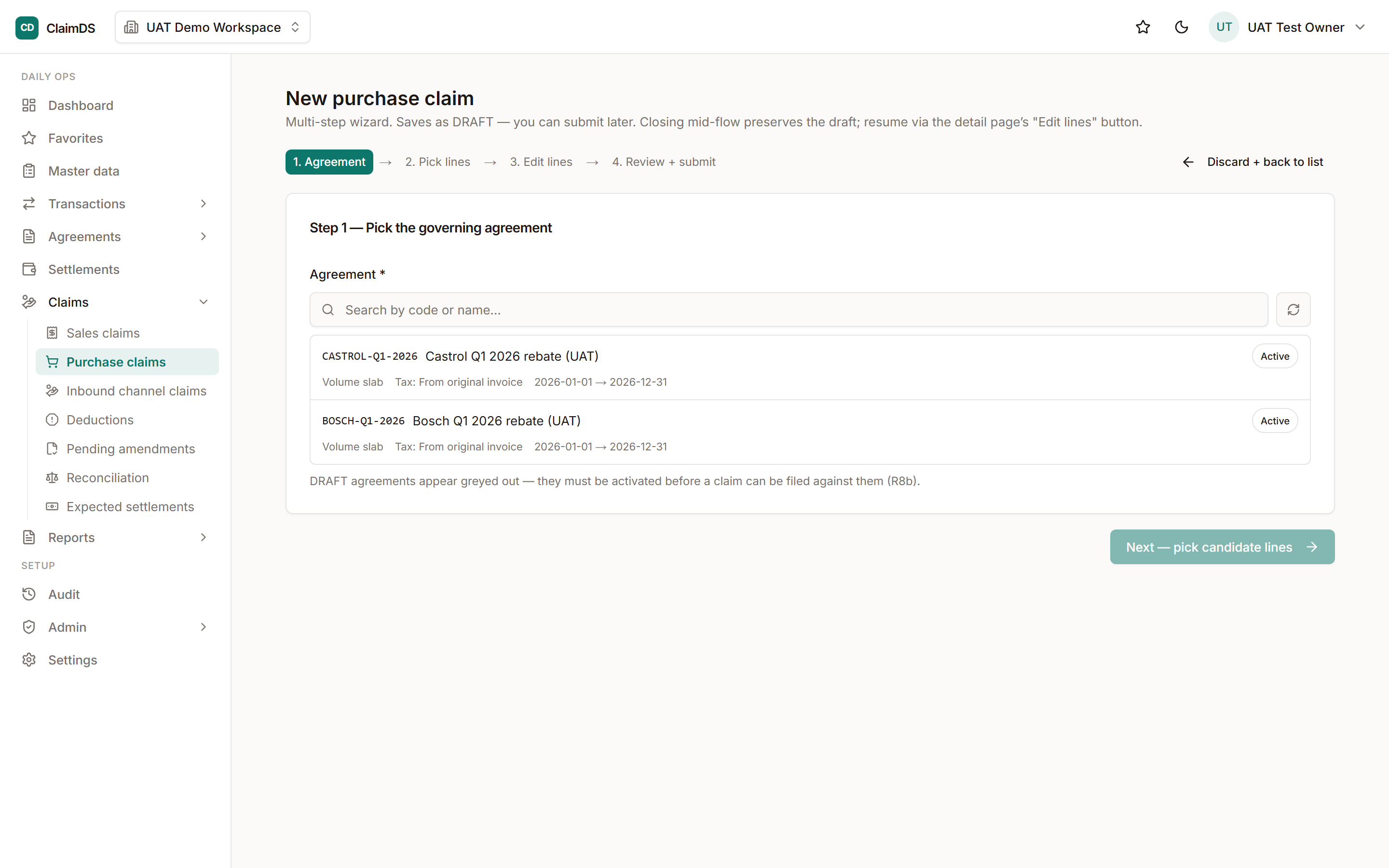
Confirm the agreement, accrue the earned amount against your purchases, raise the claim referencing the relevant purchases, and reconcile the supplier's credit note against your accrual. The live-accrual view is in rebate tracking software.
In practice a clean claim cycle looks like this:
- Confirm the terms in force — the current rate card, slabs, qualification period and measurement basis, not last year's.
- Assemble qualifying purchases for the period, net of returns if the agreement measures net.
- Compute the earned amount at the correct slab, and compare it to your running accrual.
- Raise the claim with evidence — purchase registers, invoice references, and any program proofs the agreement requires.
- Track to settlement — chase the credit note, match it to the claim, and book the difference (if any) as a dispute, not a silent write-off.
Claiming supplier rebates on bulk purchases
Bulk buying is where supplier rebates concentrate. Most volume rebates are structured as thresholds — buy past a slab in the period and a percentage applies — so consolidating purchases into fewer, larger orders often crosses slabs that scattered ordering would miss. The claim steps are the same as above; what changes is the accrual discipline: track cumulative purchase volume against each threshold in real time, so a bulk order placed in the last week of the quarter is claimed at the right slab rate rather than the one below it. The slab math itself is in volume rebates.
Accrual against purchases
Recognise supplier rebates as you earn them, against purchases. A live receivable beats a quarter-end estimate and ensures nothing earned goes unclaimed. The recognition and reconciliation mechanics are in rebate accounting.
A quick illustration (illustrative figures only): suppose a distributor's agreement pays 2% on quarterly purchases above ₹1,00,00,000. By month two, cumulative qualifying purchases stand at ₹80,00,000 — no accrual is booked yet because the threshold is unconfirmed. A ₹35,00,000 order in month three takes the quarter to ₹1,15,00,000, and the accrual becomes ₹2,30,000 (2% of the full base, if the agreement applies retrospectively to whole turnover). Book it when the threshold is crossed, at the basis the agreement actually specifies. The full step-by-step method — measurement basis, attainment estimation, true-up — is in how to calculate supplier rebate accruals.
Reconciling supplier statements
Most suppliers issue periodic rebate or scheme statements showing what they believe you earned. Treat the statement as the supplier's view, not the truth. Reconciliation means rebuilding the number independently:
- Recompute from your own purchase data — qualifying purchases, returns, period cut-offs, slab rate.
- Compare line by line against the statement, not just the total.
- Classify every gap — timing (purchases posted in different periods), basis (gross vs net of returns), rate (a tier applied differently on each side), or omission (a program the supplier didn't credit).
- Dispute in writing, promptly. Disputes raised after the supplier's books close rarely recover full value.
Businesses that skip this step effectively let the payer audit itself — the quiet source of buy-side leakage.
The GST and ITC side of receiving rebates
Pointer-level only, because the detail has its own articles: what happens to your input tax credit depends entirely on which credit-note type the supplier issues. A GST (tax) credit note that reduces taxable value obliges you to reverse proportionate ITC under Section 15(3)(b) — the mechanics are in ITC reversal on post-sale discounts and credit notes. A financial or commercial credit note changes no tax on either side, so no reversal arises — the instrument distinction is unpacked in financial vs. tax credit notes. Two adjacent traps: if rebates are netted against payables in ways that stretch payment beyond 180 days, Rule 37 ITC reversal can bite; and every tax credit note you accept should reconcile through your returns — see reconciling scheme credit notes in GSTR-2B and 3B.
Buy-side vs sell-side
Keep the distinction clear: supplier rebates are buy-side (you earn from suppliers); customer rebates and distributor rebates are sell-side (you pay your channel). Conflating them distorts both the accounting and the GST treatment.
One clarification before the table: a "customer rebate" here means a rebate you pay to a business customer — a distributor, dealer or retailer buying from you. It is not the consumer mail-in rebate a shopper claims from a manufacturer, which is a different instrument with a different audience and is not covered on this site.
| Buy-side (supplier rebates) | Sell-side (channel rebates) | |
|---|---|---|
| Who you are | The buyer | The seller |
| Direction of money | You receive | You pay |
| Who calculates the entitlement | You do, and you claim it | You do, and you validate the claim against it |
| Who has to evidence it | You — purchases, scheme terms, the working | Your partner — but you set what counts |
| Balance-sheet item | Receivable (asset) | Provision / liability |
| Core risk | Under-claiming what you earned | Over-paying what wasn't earned |
| Settlement instrument | Supplier's credit note to you | Your credit note to the partner |
| ITC consequence | You may reverse ITC on a tax credit note | Your buyer reverses; you may reduce output tax |
| What getting it wrong looks like | Entitlement lapses quietly; nobody sends a reminder | You pay a claim twice, or pay one that was never earned |
Capture on one side, control on the other
Read the "core risk" row again, because it is the whole distinction. The two sides are not the same problem seen from opposite ends — they are different problems.
Receiving is a capture problem. Nothing arrives unless you know the scheme existed, track what accrued, and file inside the window with the evidence the terms name. There is no counterparty chasing you to claim; entitlement that lapses does so silently and never appears in your ledger as a loss. What that costs, in margin terms, is worked through in what a distributor actually earns after rebates, and the claim types and their deadlines in distributor claims management.
Paying is a control problem. The claims arrive on their own; your work is deciding which are genuinely owed. That means holding scheme terms authoritatively, validating each claim against the version that applied, catching duplicates before settlement rather than after, and keeping an audit trail that survives a dispute months later.
Because the two need opposite things — one chases money that has not arrived, the other tests money being asked for — tooling built for one often handles the other thinly. That is why the market splits its vocabulary along the same line, and it is worth knowing which side a system was designed for before assuming it covers both.
Most distributors are on both sides at once
Many mid-market businesses sit on both sides — earning from suppliers upstream while paying schemes downstream. In the Indian channel this is the norm rather than the exception: a distributor claims scheme money from the brands it buys from, and funds schemes for the retailers it sells to.
The practical problem is that these are usually run by different people, in different files, with nothing connecting them. Purchase-side entitlement sits with whoever files claims; sell-side liability sits with whoever approves them. Neither view is wrong, and neither is complete — so the business rarely sees its true channel margin in one place, because the number only exists when both halves are read together. The structural view of that full bridge, from list price down to what you actually keep, is the price waterfall.
On the reporting side, note that a supplier rebate reduces the cost of the goods it relates to rather than being other income, and getting that wrong overstates gross margin and misstates closing stock: supplier rebate accounting treatment works through the timing and the journal entries.
GST note: This article is general information, not tax or legal advice. GST positions — including CBIC Circular No. 251/08/2025-GST and the Finance Act 2026 amendments to Section 34 of the CGST Act, assented 30 March 2026 but not yet notified into force as of publication — must be re-verified at publish time with a qualified professional.
Frequently asked questions
What are supplier rebates?
Supplier rebates are buy-side incentives a business earns from its suppliers — volume, growth or program rebates accrued against purchases and claimed back, usually by credit note. They are distinct from sell-side rebates a business pays its own customers or channel.
How do you claim a rebate from a supplier?
Confirm the rebate agreement and its terms, accrue the earned amount against your purchases, raise the claim referencing the relevant purchases, and reconcile the supplier's credit note against your accrual. Software makes the accrual and reconciliation accurate.
How are supplier rebates accounted for?
Supplier rebates are recognised on accrual against purchases as the earning condition is met, recorded as a receivable, then reconciled against the settlement. The GST treatment follows the credit-note rules for the adjustment.
What is the difference between a supplier rebate and a purchase discount?
A purchase discount reduces the invoice price at the moment of purchase — it is visible on the invoice and needs no follow-up. A supplier rebate is earned later, against cumulative behaviour such as quarterly volume or year-on-year growth, and settles retrospectively by credit note. Rebates therefore need accrual, claiming and reconciliation; discounts do not.
How do you reconcile supplier rebate statements?
Rebuild the supplier's claimed figures from your own purchase data — qualifying purchases, returns, the rate applied and the qualification period — then compare line by line. Gaps usually trace to returns the supplier netted that you did not, purchases posted in different periods, or a tier rate applied differently on each side.
Do supplier rebates affect input tax credit (ITC)?
They can. If the supplier settles by a GST (tax) credit note that reduces taxable value, the buyer reverses proportionate ITC under Section 15(3)(b). If the supplier issues a financial or commercial credit note with no GST adjustment, no ITC reversal arises per CBIC Circular 251/08/2025-GST. Confirm the credit-note type before touching the ITC ledger.
Is TDS deducted when a supplier gives gold coins or trips instead of a rebate?
Often, yes. Gold coins, trips and similar in-kind benefits from a supplier are generally treated as benefits or perquisites rather than trade rebates, and can attract TDS in the provider's hands once aggregate value crosses the statutory threshold — a different treatment from cash or credit-note rebates. A rebate credited against purchases is usually cleaner than an in-kind reward. Confirm valuation and applicability with your tax adviser.
Can a supplier settle a rebate by giving free goods instead of money?
Sometimes, but free goods are usually the least efficient settlement route. Free stock arrives without a tax invoice, valuing it in inventory needs care, and free supplies raise input-tax-credit questions on the supplier's side — which is why many suppliers prefer credit notes. An equivalent financial credit note is cleaner on every axis; if offered free goods, ask for the credit-note alternative and confirm treatment with your tax adviser.
See RebateLedger on your own claims data
A 30-minute walkthrough tailored to how your channel actually settles claims.