
Financial vs. Tax Credit Notes Under GST: What Channel Finance Must Know
Financial credit note vs tax credit note under GST — a Section 34 tax credit note reverses ITC; a commercial credit note does not. Worked examples.
In short
A tax (GST) credit note under Section 34 reduces the supplier's output tax and requires the recipient to reverse proportionate input tax credit. A financial or commercial credit note changes neither value nor tax — no reversal required. Choosing the right one is the heart of channel-claim settlement; this is general information, not tax advice.
A tax (GST) credit note under Section 34 of the CGST Act reduces the supplier's output tax and forces the recipient to reverse proportionate input tax credit. A financial or commercial credit note changes neither the transaction value nor the tax — it is a purely commercial adjustment, so no ITC reversal is required. Choosing the right one is the heart of channel-claim settlement.
GST note: This article is general information, not tax or legal advice. GST positions — including CBIC Circular No. 251/08/2025-GST and the Finance Act 2026 amendments to Section 34 of the CGST Act, which were assented on 30 March 2026 but are not yet notified into force as of publication — must be re-verified at publish time with a qualified professional.
Why this distinction matters
Every trade scheme in India ends in a credit note. But "credit note" hides two very different instruments with opposite tax consequences. Getting the choice wrong creates real exposure — either the supplier loses tax it could have reclaimed, or the recipient faces an unexpected ITC-reversal demand at assessment. For finance teams settling rebates, distributor claims and secondary schemes, deciding the credit-note type deliberately — and documenting why — is a core control.
The tax credit note (Section 34, CGST Act)
A tax credit note is issued under Section 34 when a supplier genuinely reduces the taxable value of a supply. It lowers the supplier's output GST liability, and correspondingly the recipient must reverse the proportionate input tax credit they had claimed. To be valid for excluding a post-supply discount from taxable value, the discount must meet Section 15(3)(b): established under an agreement entered into before or at the time of supply, linked to specific invoices, with the recipient reversing the attributable ITC.
The financial / commercial credit note
A financial (commercial) credit note is a pure money adjustment outside the GST mechanism. It does not reduce the original transaction value, so the supplier's output tax is unchanged, and — as clarified by CBIC Circular 251/08/2025-GST — the recipient does not reverse ITC. It is the right instrument for most post-sale commercial discounts that do not meet the strict Section 15(3)(b) conditions.
What is a commercial credit note?
A commercial credit note and a financial credit note are the same instrument — Indian trade usage swaps the two names freely, and non-GST credit note is a third label for the identical document. In one line: a credit note issued without any GST adjustment. It sits outside the Section 34 mechanism, adjusts only the commercial account between supplier and buyer, and because it carries no tax it never appears in GSTR-1 or GSTR-3B — it lives in the accounting ledgers alone.
Businesses issue commercial credit notes wherever money must move but tax must not: post-sale discounts that were never locked into a pre-supply agreement, discretionary scheme settlements where no output-tax adjustment is being taken, quarter-end top-ups and goodwill settlements. In each case the supplier funds the payout from margin rather than reclaiming GST on it. The contrast with the Section 34 instrument is a single line: a GST (tax) credit note reduces the supplier's output tax and flows through the returns; a commercial one does neither.
For the recipient, the buyer's input tax credit stays fully intact — the recipient-side mechanics are unpacked in how ITC behaves on post-sale discounts. Whatever your ERP or your channel partner calls it, the test is identical: if the credit note does not reduce output tax, it is a commercial credit note under GST.
Side-by-side comparison
| Feature | Tax credit note (Sec 34) | Financial / commercial credit note |
|---|---|---|
| Reduces supplier output tax | Yes | No |
| Recipient ITC reversal | Yes, proportionate | No |
| Needs Section 15(3)(b) conditions | Yes (pre-agreement + invoice linkage) | Not applicable |
| Shown in GST returns (tax) | Yes | No (commercial books only) |
| Typical use | Agreed, invoice-linked discounts | Most post-sale scheme discounts |
One-line test: was the discount fixed by a pre-supply agreement and linked to invoices? If yes, a tax credit note is available. If no, use a financial credit note — and reverse nothing.
Which to issue, and when
Decide at scheme-design time, not at settlement. If a scheme is contractually agreed up front and you want the output-tax reduction, structure it to satisfy Section 15(3)(b) and issue a tax credit note. If the discount is discretionary or post-hoc, a financial credit note is cleaner and avoids ITC-reversal disputes for your channel partner — the recipient-side rules are covered in ITC reversal on credit notes and discounts. This decision belongs inside your settlement system — see how it connects to accruals in rebate accounting and to scheme settlement in trade promotion management, and to the wider tax picture in how each channel instrument is taxed in India.
Related reading: how these credit notes sit within the wider GST adjustments to a channel settlement.
As a working decision framework:
- Agreement pre-dated the supply, the discount is linked to specific invoices, and the recipient will reverse the proportionate ITC → issue a credit note under Section 34 of the CGST Act (a tax credit note) and take the output-tax reduction.
- Any one of those three conditions fails → issue a financial credit note; output tax and the recipient's ITC stay untouched.
- Rate difference or price revision that was agreed before supply and can be traced to identified invoices → tax-credit-note territory.
- Discretionary scheme settlement, quarter-end top-up or after-the-fact target incentive → commercial credit note, every time.
- Recipient cannot or will not reverse ITC → use a financial credit note even for an otherwise-eligible discount; the Section 34 route only works when the reversal actually happens on the other side.
- Still unsure → price the GST cost of the commercial route against the dispute risk of the Section 34 route, and record the choice in the scheme document.
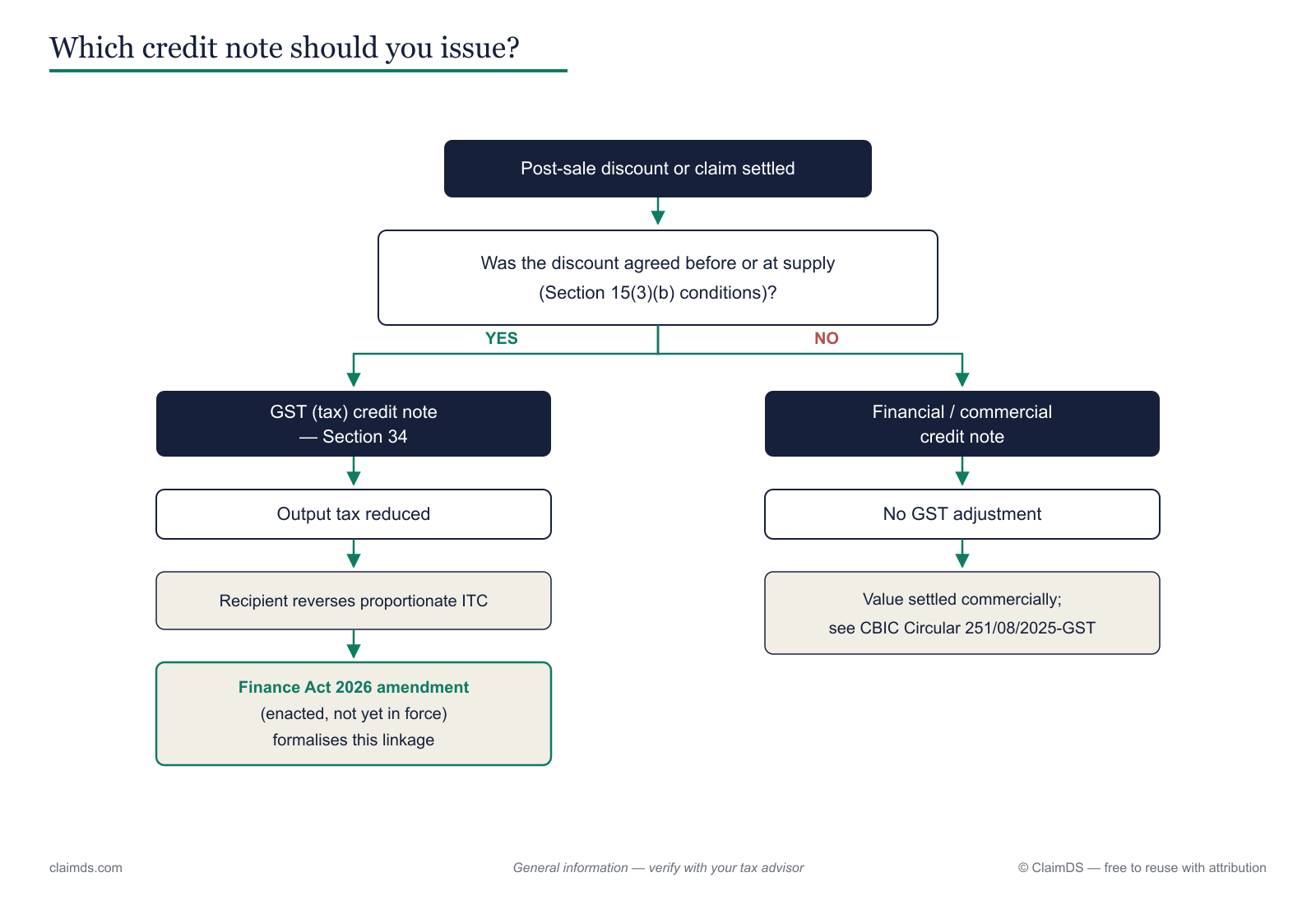
Source: RebateLedger — this diagram is free to reuse with a link back to this article. General information only — not tax advice.
Worked examples
Example 1 — financial credit note. A distributor earns a ₹1,50,000 discretionary quarter-end incentive not tied to a pre-supply agreement. The manufacturer issues a financial credit note. Output tax unchanged; distributor keeps full ITC, reverses nothing.
Example 2 — tax credit note. A scheme is agreed in the annual contract at 3% on invoices above a slab, linked to those invoices. The manufacturer issues a tax credit note under Section 34, reduces output tax on the 3%, and the distributor reverses the proportionate ITC.
Frequently asked questions
What is the difference between a financial credit note and a tax credit note under GST?
A tax (GST) credit note under Section 34 reduces the supplier's output tax and requires the recipient to reverse proportionate ITC. A financial or commercial credit note does not change the transaction value or tax, so no output-tax reduction and no ITC reversal occur — it is a purely commercial adjustment.
Does a commercial credit note require ITC reversal?
No. Because a commercial or financial credit note does not reduce the original transaction value or the supplier's output tax, the recipient is not required to reverse input tax credit, as clarified by CBIC Circular 251/08/2025-GST.
When must a tax credit note under Section 34 be used?
A tax credit note is used when the supplier intends to reduce output tax on a discount that meets the Section 15(3)(b) conditions — established under a pre-supply agreement, linked to specific invoices, with corresponding ITC reversal by the recipient.
What is a financial credit note?
A financial credit note — also called a commercial credit note or non-GST credit note — is a credit note issued outside Section 34 of the CGST Act. It adjusts only the commercial account between supplier and buyer, carries no GST, does not reduce the supplier's output tax and does not trigger ITC reversal for the recipient.
What is a commercial credit note in GST?
A commercial credit note is simply another name for a financial credit note — an adjustment issued without any GST component, outside the Section 34 mechanism. It does not appear in GST returns and, per CBIC Circular 251/08/2025-GST, requires no ITC reversal by the recipient.
Who can issue a credit note under GST?
Only the supplier of the original goods or services can issue a credit note under Section 34 of the CGST Act. A recipient cannot issue a GST credit note against its purchase — a recipient-raised "credit note" is at best a commercial document with no effect on either party's GST position.
Can a financial credit note carry GST?
No — that is the whole point of the instrument. A financial or commercial credit note is issued without any GST component. The moment a credit note reduces output tax, it is a Section 34 tax credit note, and the recipient's proportionate ITC-reversal obligation follows with it.
Is there a time limit for financial credit notes?
No GST time limit applies. The Section 34(2) deadline — declaring the credit note in returns by 30 November following the financial year of supply, or the annual return date if earlier — binds only tax credit notes. Financial credit notes sit outside GST returns entirely, so their timing is governed by commercial agreement and accounting policy.
Is GST applicable on a credit note?
It depends on the type. GST applies only through a Section 34 tax credit note, which reduces the supplier's output tax subject to conditions — a pre-supply agreement, invoice linkage and proportionate ITC reversal by the recipient. A financial or commercial credit note carries no GST adjustment at all. This is general information, not tax advice.
Can a credit note be issued without GST?
Yes — that is precisely what a financial or commercial credit note is. It settles a discount or claim purely in the commercial books, with no GST component, no entry in GST returns and no ITC reversal for the recipient. Only a Section 34 credit note carries a tax adjustment.
See RebateLedger on your own claims data
A 30-minute walkthrough tailored to how your channel actually settles claims.