
GST credit notes for rebates — what Rule 53(1A) actually requires
A plain-English guide to GST credit notes for rebates in India — the particulars Rule 53(1A) requires, and where ITC reversal trips teams up.
In short
Rule 53(1A) of the CGST Rules prescribes what a GST credit note must contain: the supplier's identity and GSTIN, a unique sequential number and date, a reference to the original invoice or invoices, and the taxable value, rate and tax being credited. It is the document-contents rule that sits alongside Section 34, which governs when a credit note may be issued at all.
Rule 53(1A) of the CGST Rules prescribes what a GST credit note must contain — the supplier's identity and GSTIN, a unique sequential number and date, a reference to the original invoice(s), and the taxable value, rate and tax being credited. For rebate settlements, it is the document-contents rule that sits alongside Section 34, which governs when a credit note may be issued at all.
When a rebate or claim is settled in India, the cleanest instrument is usually a GST credit note. It is also where compliance quietly goes wrong, because a credit note is not just an adjustment in your ledger — it is a tax document with required particulars.
This is a practical overview, not tax advice. Confirm specifics with your advisor.
What a credit note is for
Under GST, a credit note reduces the taxable value (and the tax) on a supply you have already invoiced — exactly what happens when a volume rebate or a claim is agreed after the sale. Issued correctly, it lets both sides adjust their tax position cleanly.
How does Rule 53(1A) relate to Section 34?
The two provisions answer different questions, and rebate teams need both answers. Section 34 of the CGST Act governs the when and whether — the circumstances in which a supplier may issue a credit note against an earlier supply and adjust output tax, and the reporting deadline after which that adjustment lapses. Rule 53(1A) governs the what — the particulars the document itself must carry to be a valid tax document.
That division matters for schemes because the Section 34 question is where most rebate settlements fail first: whether a post-supply discount can reduce taxable value at all depends on conditions examined in Section 15(3)(b) on post-supply discounts, and whether the team chooses a tax credit note or a commercial one is the decision framework in financial vs tax credit notes under GST. Only once those questions are answered does Rule 53(1A) take over and dictate the document's contents. And the whole exercise runs against a clock — a credit note declared after the statutory cut-off loses its tax effect, the deadline mechanics covered in GST credit note time limits and reporting. A scheme that settles slowly does not just annoy the distributor; it can run the tax adjustment out of time.
The particulars Rule 53(1A) expects
A compliant credit note carries, among other things:
- The supplier's name, address, and GSTIN
- A unique, sequential document number and the date of issue
- A link back to the original invoice(s) it adjusts
- The taxable value, the rate, and the tax amount being credited
Miss these and the document may not stand up at assessment — even if the rupee amount is correct.
Which particulars does a financial credit note need?
Not every rebate settles on a GST credit note. When the settlement rides on a financial (commercial) credit note — no tax adjustment, invoice value untouched for GST purposes — Rule 53(1A) does not govern the document, because it is not a Section 34 instrument. That is a lighter compliance burden, not a licence for sloppiness. A financial credit note that will survive an audit still carries:
- A unique number and date from its own identifiable series
- The recipient's identity and, for reconciliation, their GSTIN even though no tax moves
- A reference to the claim and scheme it settles, and the invoice(s) or period it relates to
- The reason — scheme name, slab achieved, period — stated on the face of the document
- No tax fields — showing a GST amount on a commercial credit note is the classic drafting error that turns a deliberate no-tax-adjustment decision into an ambiguous document
The reason for the discipline is downstream: financial credit notes are reconciled by the buyer's accounts team, matched to claims by auditors, and examined whenever the tax treatment of a scheme is questioned. How the two instrument types hit the books is covered in rebate accounting with GST credit notes.
How do you keep numbering discipline at scale?
Rule 53(1A)'s "unique, sequential number" reads as trivial until the volume arrives. A mid-market manufacturer settling schemes across a few hundred distributors can plausibly issue thousands of credit notes a year — say, 400 claims a month settling as credit notes is roughly 4,800 documents a year, before returns and rate-difference adjustments (figures illustrative). At that scale, series discipline is an operational design problem:
- One series per GSTIN. A company registered in multiple states issues documents from each registration; each needs its own consecutive series. Mixing them produces duplicate numbers across states or inexplicable gaps within one.
- Separate the instrument types. Keeping GST credit notes and financial credit notes in distinct series means nobody has to open the document to know whether tax moved — and returns preparation can enumerate the tax series completely.
- Gaps must be explainable. Sequential numbering means a missing number is a question an assessing officer can ask. Cancelled documents should be recorded as cancelled, not silently reused or skipped.
- Manual issuance breaks series first. The moment two people can type a credit-note number into a ledger, duplicates and gaps follow. Series integrity is one of the strongest practical arguments for generating credit notes from the settlement system rather than by hand.
How should credit notes link back to claims?
A credit note that cannot be traced to the claim it settles is an orphan — reconcilable only by memory. The clean chain runs scheme → claim → settlement → credit note → return: the scheme circular defines the entitlement, the claim quantifies it, the settlement approves it, the credit note papers it, and the GST return reports it. Two linkage decisions matter in practice:
One credit note per claim, or consolidated? GST law permits a credit note against one or more invoices, so a period's approved claims for a distributor can settle on a single consolidated document. Consolidation cuts document count but raises the stakes on the invoice mapping — the credit note must still identify which invoices it adjusts, so the claim-to-invoice trail has to exist before the document is generated, not be reconstructed after. The evidence pack that makes this trail auditable is the subject of the scheme settlement documentation playbook.
Who reconciles what, afterwards? The buyer will match your credit note against their GSTR-2B and reverse ITC where required — the buyer-side mechanics are in ITC reversal on post-sale discounts — and both sides eventually need the credit note, the claim and the returns to agree, the discipline described in reconciling scheme credit notes with GSTR-2B and GSTR-3B. Every one of those reconciliations is trivial if the credit note was born linked to its claim, and painful if the link lives in a spreadsheet column.
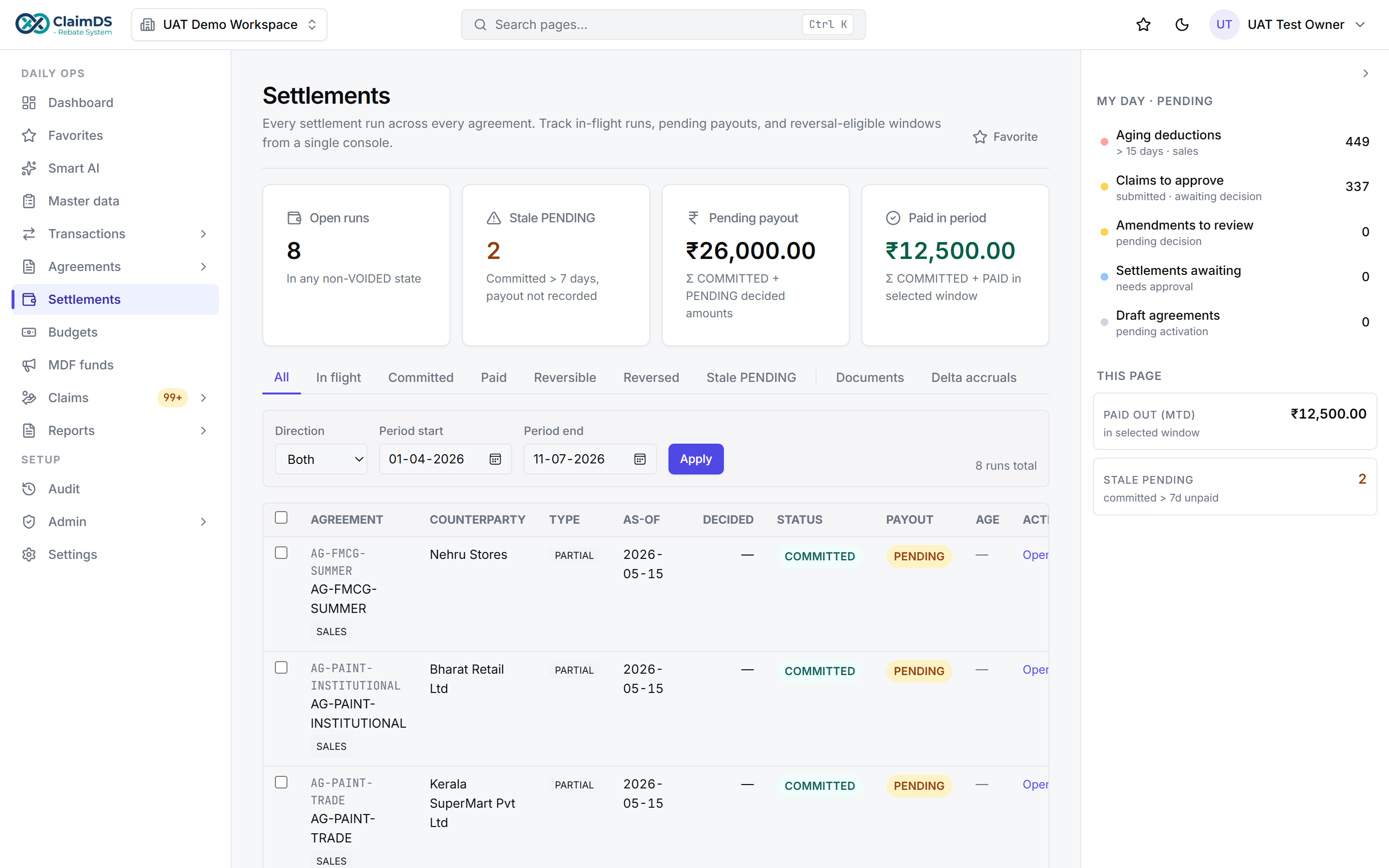
This is easiest to see in a settlement console where runs, payouts and the credit notes they generate stay attached to the agreement that authorised them:
Where ITC reversal trips teams up
The credit note is only half the transaction. When the supplier reduces output tax, the recipient must reverse the corresponding input tax credit. If that reversal is not tracked on both sides, a perfectly valid commercial rebate becomes a mismatch in the GST returns — the kind that surfaces months later as a notice. Whether ITC reversal applies at all depends on the credit-note type: see financial vs. tax credit notes under GST and CBIC Circular 251 on post-sale discounts.
Designing it in, not bolting it on
The teams that stay clean treat GST as part of the settlement, not an afterthought: the credit note is generated from the same agreement and claim that were reconciled, with GSTIN and HSN validated and ITC reversal tracked from the start.
That is the approach behind RebateLedger's GST credit-note reconciliation. You can see how a settlement turns into a compliant credit note in the live demo.
Rule 53(1A) governs the document. What it cannot govern is whether the rebate amount on that document is right. That calculation, traceable back to the agreement version live at the time, is the job of dedicated rebate software.
Frequently asked questions
What is Rule 53(1A) of the CGST Rules?
Rule 53(1A) prescribes the particulars a GST credit note or debit note must carry — including the supplier's name, address and GSTIN, a unique sequential document number and date of issue, a reference to the original invoice or invoices being adjusted, and the taxable value, rate and tax amount being credited. A credit note missing these particulars may not stand up at assessment even if the rupee amount is right.
How does Rule 53(1A) relate to Section 34 of the CGST Act?
They answer different questions: Section 34 governs when and by whom a credit note may be issued and how it adjusts output tax, while Rule 53(1A) governs what the document itself must contain. A rebate settlement needs both — a valid Section 34 basis for the adjustment and a Rule 53(1A)-compliant document recording it.
Does a financial credit note need Rule 53(1A) particulars?
No — Rule 53(1A) applies to GST credit notes issued under Section 34. A financial (commercial) credit note carries no tax adjustment, so it is not a Section 34 document. It should still carry a unique number, date, reason and a reference to the invoice and claim it settles, because auditors and customers reconcile financial credit notes just as hard.
Can one GST credit note cover multiple invoices?
Yes — GST law permits a credit note to be issued against one or more tax invoices, which is how consolidated scheme settlements covering a period's purchases are typically papered. The credit note must still identify the invoices it adjusts, so the claim-to-invoice mapping has to exist before the document is generated.
What happens if a credit note misses required particulars?
The document may fail scrutiny at assessment — the supplier's output-tax reduction can be questioned and the mismatch surfaces in returns reconciliation, often months later as a notice. The commercial settlement itself is not undone, but the tax adjustment riding on it becomes contestable, which is why particulars matter as much as the amount.
Is there a time limit for issuing GST credit notes for rebates?
Yes — a GST credit note must be declared in returns by the statutory cut-off following the financial year of the underlying invoice, after which the tax adjustment is lost even if the commercial settlement is still owed. Late-settling schemes are the usual casualty; the time-limits guide covers the deadline mechanics and reporting flow.
Which HSN code should be used on a scheme discount credit note?
Use the HSN of the originally supplied goods — the discount has none of its own, because it is not a supply. A tax credit note is an adjustment document tied to the original invoices, mirroring their particulars — description, HSN, rate, and the value and tax credited — as Rule 53(1A) contemplates. Commercial credit notes need no HSN at all. Default credit-note HSN from the source invoice in your billing system.
Can a debit note be used to recover an over-credited scheme amount?
Yes. Where a tax credit note exceeded the dealer's actual entitlement — a misread slab, a duplicate claim — the correction is a debit note under Section 34: the supplier's output liability increases in the month of issue and the recipient regains the corresponding credit. Debit notes face no declaration time bar, since they increase tax. Commercial over-credits recover commercially. Root-cause duplicates — frequent reversals erode trust.
What must a GST credit note contain?
A credit note carries prescribed particulars and must reference the original invoice it adjusts — mirroring that invoice's description, HSN, rate and the value and tax being credited, as Rule 53(1A) contemplates. The full list of required particulars is prescribed rather than a matter of practice, so confirm the current requirements against the rule with your chartered accountant.
See RebateLedger on your own claims data
A 30-minute walkthrough tailored to how your channel actually settles claims.