
Volume Rebates: Slab-Based & Volume-Incentive Programs
Volume rebates explained — retrospective vs prospective slabs, growth incentives, true-ups and accrual mechanics, with worked slab examples.
In short
A volume rebate is an incentive paid to a channel partner for reaching defined sales or purchase volumes, usually as a percentage that rises across slabs. It is earned after the sale and settled later — commonly through a credit note rather than on the original invoice — which is why accurate accrual and slab math matter so much.
A volume rebate is an incentive paid to a channel partner for reaching defined sales or purchase volumes, usually as a percentage that rises across slabs. It is earned after the sale and settled later — commonly through a credit note rather than on the original invoice — which is why accurate accrual and slab math matter so much.
What a volume rebate is
Volume rebates — also called slab-based or tiered incentives — are the most common scheme in Indian channels. A manufacturer rewards a partner for hitting volume, with the rate typically rising as turnover grows. Because the reward is earned over a period and settled afterwards, it must be accrued accurately and claimed correctly; this is the engine behind distributor rebate programs and sits under the rebate management software pillar.
What are the four structural types of volume rebates?
Almost every volume scheme in the Indian channel is one of four structures — the wider family of scheme types around them is catalogued in types of trade schemes in India. The structure decides what the payout is sensitive to, how it is verified, and where it goes wrong. All numbers below are illustrative, not benchmarks; your scheme circular always governs.
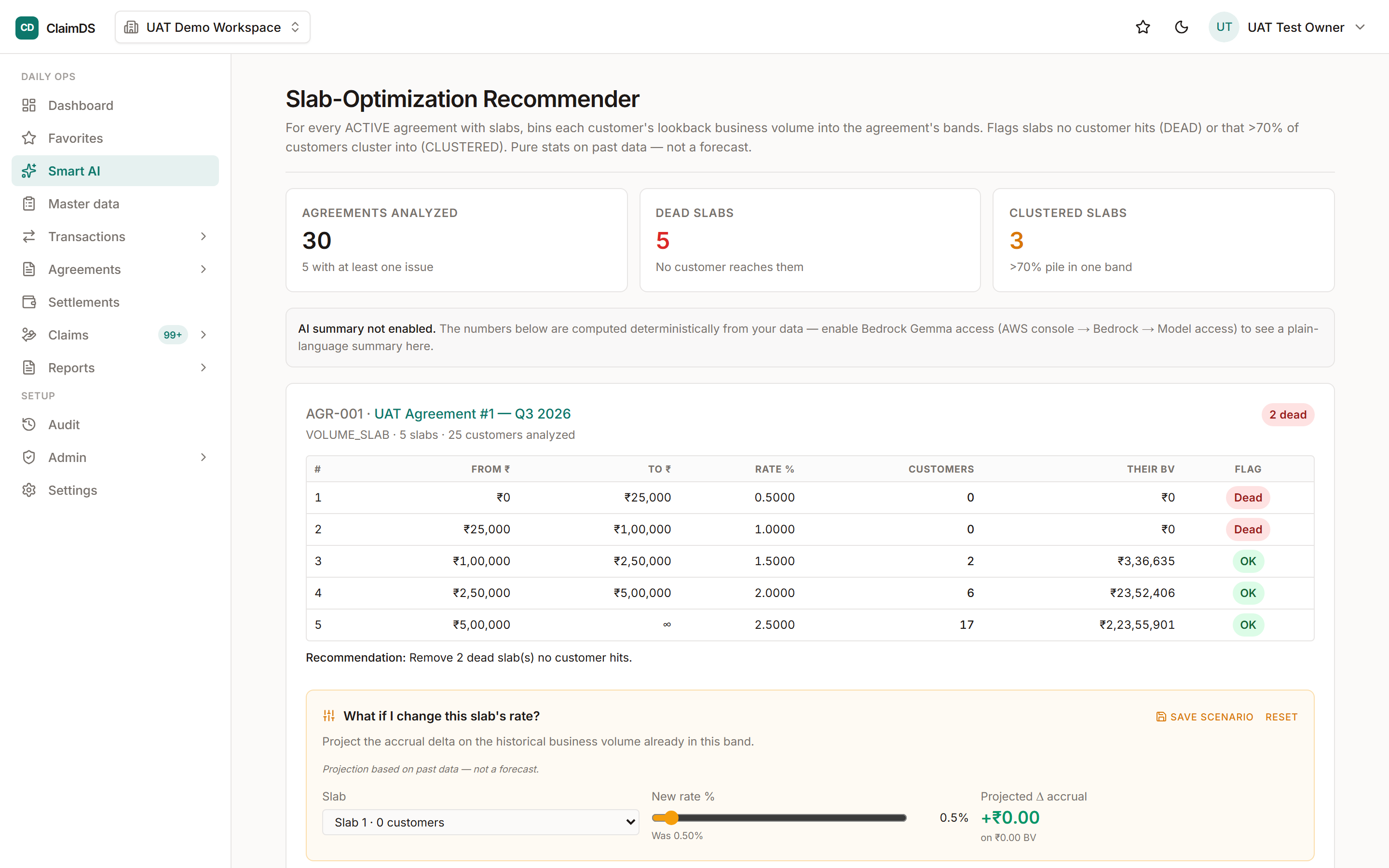
1. Percentage slab. A rate on purchase or sales value that steps up across value slabs. Example: 1% up to ₹15,00,000, 1.5% up to ₹25,00,000, 2% beyond, applied to the whole base. Net monthly purchases of ₹18,00,000 land in slab 2 → 1.5% × ₹18,00,000 = ₹27,000. Sensitive to price changes and to whether the base is gross or net of returns.
2. Fixed amount per slab. A flat rupee payout for reaching each slab, regardless of how far past it the partner goes. Example: cross ₹25,00,000 in the quarter and earn ₹25,000; cross ₹40,00,000 and earn ₹60,000. A distributor at ₹43,00,000 earns ₹60,000 — the same as one at ₹40,00,001. Simple to budget, but creates dead zones where extra volume earns nothing.
3. Quantity milestone. A per-unit payout that unlocks at quantity milestones — the QPS pattern. Example: 1,000+ cases in the quarter pays ₹18 per case; 2,500+ pays ₹25. A distributor at 2,800 cases earns 2,800 × ₹25 = ₹70,000. Immune to mid-period price changes and trivially verifiable against purchase quantities.
4. Formula or growth-linked. The rate is a function of growth over a baseline rather than absolute volume. Example: 1% base rate, plus 0.5% if the quarter grows at least 10% over the same quarter last year. A distributor at ₹30,00,000 with 14% growth earns 1.5% × ₹30,00,000 = ₹45,000. Rewards expansion, but stands or falls on an agreed, frozen baseline.
| Structure | Pays on | Strength | Watch-out |
|---|---|---|---|
| Percentage slab | Value | Tunable, familiar | Whole-base vs per-tier ambiguity |
| Fixed amount per slab | Slab reached | Predictable cost | Dead zones between slabs |
| Quantity milestone | Units | Price-proof, easy to verify | Returns must net off quantity |
| Formula / growth | Growth vs baseline | Rewards expansion | Baseline disputes |
Retrospective vs prospective slabs
The single most consequential design choice is whether slabs are retrospective or prospective. Consider a partner doing ₹1,20,00,000 against slabs of 1% to ₹50L, 1.5% to ₹1cr, 2% above:
| Method | How it applies | Rebate on ₹1.2cr |
|---|---|---|
| Prospective (marginal) | Each rate applies only to volume in its band | ₹50,000 + ₹75,000 + ₹40,000 = ₹1,65,000 |
| Retrospective (whole-turnover) | Top rate reached applies to all volume | 2% × ₹1.2cr = ₹2,40,000 |
Same sales, very different payout. Confusing the two is a frequent, expensive error — exactly the kind software eliminates by encoding the method once. The difference here is ₹75,000 on a single partner in a single period; across a network it is the difference between a scheme that fits its budget and one that blows through it. The circular should name the method explicitly and include one worked example — the full slab arithmetic, including returns netting and edge cases, is worked through in how to calculate FMCG distributor claims.
How do pro-rating and mid-period joins work?
A partner onboarded in week three of a monthly scheme cannot fairly be held to full-month thresholds — but whether the thresholds scale is a circular decision, not a courtesy. Under pro-rating, a ₹15,00,000 monthly threshold for a partner active 12 of 30 days becomes 12/30 × ₹15,00,000 = ₹6,00,000 (illustrative). Without pro-rating, the same partner has effectively no chance of qualifying, and the first claim of the relationship becomes the first dispute of the relationship. The same question arises for partners who exit mid-period, territories that split, and schemes extended mid-flight. The pro-rating mechanics sit alongside the slab math in how to calculate FMCG distributor claims.
Growth incentives and true-ups
Many schemes layer a growth condition — an extra payout for beating a prior-period baseline — on top of the volume slab. These require the system to hold the baseline and the achievement, and to run a period-end true-up that reconciles the running accrual to the final, confirmed entitlement.
Why do slab-boundary disputes happen?
Most volume-rebate disputes cluster at the slab boundaries, and they are nearly all circular defects:
- Gross vs net of returns. The distributor computes on gross purchases, the manufacturer nets off returns, and the partner lands one slab lower than expected. This is the single most common fight.
- Returns booked after period end. A return processed in the first week of the next month — does it reduce this period's base? The circular must say.
- The near-miss. A partner at ₹24,98,000 against a ₹25,00,000 boundary asks for grace. Grace granted once becomes precedent, and precedent becomes an unbudgeted scheme cost.
- Which date counts. Billing date vs dispatch date vs receipt date can move quarter-end invoices across the boundary in either direction.
Every one of these is decided in advance by a well-drafted circular and litigated afterwards by a vague one. Left unmanaged, boundary disputes are one of the quiet channels of revenue leakage in rebate programs.
Dealer vs distributor volume rebates
The mechanics rhyme but the design differs. Distributor volume rebates usually operate on primary purchase volume; dealer volume rebates often tie to sell-through or display conditions and sit lower in the tier structure — see secondary scheme settlement for the cross-tier case.
Accrual mechanics
Volume rebates are accrued as sales post, applying the correct slab rate to the running volume so finance always sees a live liability. Exact-decimal money math matters: on large volumes, a rounding habit compounds into real money. This live accrual is detailed in rebate tracking software and reconciled per rebate accounting.
Timing is the design decision inside accrual. Accruing at the current slab rate understates the liability for partners tracking toward a higher slab; accruing at the expected final slab rate is more faithful but requires a forecast and a disciplined true-up when the forecast misses. Either policy is defensible — switching between them mid-year is not, because the accrual becomes uncomparable across periods. Whichever policy you choose, the accrual should build partner-by-partner and scheme-by-scheme, not as one blended provision; that per-scheme view is what rebate and scheme accrual tracking exists to provide.
How do you design slabs that don't invite gaming?
A slab structure is a set of incentives, and partners respond to the incentives you actually create — not the ones you intended:
- Soften the cliffs. A hard threshold with a large payout jump invites quarter-end loading: stock billed in the last week to cross the boundary, followed by returns in the next period. Stepped rates with smaller jumps reduce the prize for gaming any single boundary.
- Net returns into the base — and say so. If returns don't reduce the base, billing-and-returning is free slab progression.
- Cap the payout per partner per period. A cap converts an open-ended exposure into a budgetable one.
- Consider what the volume measures. Rebates on primary purchases reward stock moved into the godown, not stock sold through; where sell-through data is reliable, basing the incentive further down the chain changes behaviour — the trade-off is unpacked in sell-in vs sell-through rebates.
- Enforce the claim window. Late claims accepted informally make the accrual unclosable; the window, and who may waive it, belong in the approval workflow, not in email threads.
GST settlement
Volume rebates settle by credit note, with the tax-vs-financial choice affecting ITC. See financial vs. tax credit notes. Two practical pointers on the settlement leg: the paperwork that has to line up — circular, claim, computation, credit note — is laid out in the scheme settlement and GST documentation playbook, and tax credit notes carry statutory timing limits that annual retrospective schemes can collide with — see GST credit note time limits and reporting. These are pointers, not positions; the deep articles carry the detail.
GST note: This article is general information, not tax or legal advice. GST positions — including CBIC Circular No. 251/08/2025-GST and the Finance Act 2026 amendments to Section 34 of the CGST Act, assented 30 March 2026 but not yet notified into force as of publication — must be re-verified at publish time with a qualified professional.
Frequently asked questions
What is a volume rebate?
A volume rebate is an incentive paid to a channel partner for reaching defined sales or purchase volumes, usually as a percentage that rises across slabs. It is earned after the sale and settled later, commonly through a credit note rather than on the original invoice.
What is the difference between retrospective and prospective slabs?
In a retrospective slab, once a partner crosses a threshold the higher rate applies to all volume from the start. In a prospective slab, the higher rate applies only to volume above the threshold. The two produce different rebate amounts for the same sales.
How are volume rebates accrued?
Volume rebates are accrued as sales post, applying the correct slab rate to the running volume so finance sees a live liability. Period-end true-ups adjust the accrual once final volumes and any growth conditions are confirmed.
How do you calculate a volume rebate?
Establish the base — purchase or sales value or quantity, net of returns — for the period, find the slab that base lands in, and apply the slab rate the way the circular specifies: to the whole base (retrospective) or only to volume inside each tier (prospective). Then apply caps and any growth condition. The circular's definitions decide the number, not the arithmetic.
What happens if a distributor joins a volume rebate scheme mid-period?
It depends on what the circular says about pro-rating. Some schemes scale slab thresholds to the partner's active days in the period; others hold full-period thresholds regardless of join date. If the circular is silent, the claim becomes a negotiation. Fix the rule before launch — pro-rated thresholds are the fairer and more defensible choice.
Are volume rebates settled through credit notes?
Usually, yes. A rebate agreed before supply and linkable to specific invoices can settle through a GST credit note that reduces taxable value. Rebates finalised after the period — most retrospective annual slabs — settle through financial credit notes with no GST adjustment. The choice affects input tax credit on both sides, so the circular should fix it up front.
What happens when a partner narrowly misses a rebate slab or target?
Under a strictly drafted scheme, a narrow miss earns the lower slab — and ad-hoc waivers set precedents that unravel the structure. Design for near-misses upfront: graded slabs instead of one large cliff, pro-rata payouts above a floor, or a documented tolerance band applied uniformly by policy. Avoid silent field-level adjustments that manufacture achievement; write down any exception and approve it through the standard authority matrix.
How should companies accrue volume rebates in their accounts?
Volume rebates are generally treated as variable consideration: the seller estimates each partner's likely full-period slab and reduces revenue as the underlying sales occur, truing up as purchase data firms. Waiting until settlement overstates revenue during the year and dumps a charge at year-end. On the buyer's side, rebates receivable reduce inventory cost or cost of goods sold. Keep partner-level accrual workings, and confirm treatment with your accountant.
See RebateLedger on your own claims data
A 30-minute walkthrough tailored to how your channel actually settles claims.