
Customer Rebates: Programs & Software
Customer rebate programs explained — structures, claim validation, accrual and GST treatment. Distinct from supplier and distributor rebates.
In short
Customer rebates are sell-side incentives a business offers its customers — volume, growth or loyalty rebates earned on purchases and settled later, usually by credit note. They are distinct from supplier (buy-side) rebates and from distributor or dealer channel rebates.
Customer rebates are sell-side incentives a business offers its customers — volume, growth or loyalty rebates earned on purchases and settled later, usually by credit note. They reward purchasing behaviour and, like all rebates, must be accrued accurately and settled with the correct GST treatment.
What customer rebates are
Customer rebates reward end customers for what they buy — by volume, by growth, or through loyalty programs. They are earned over a period and settled afterwards, which makes accurate accrual and settlement essential. They sit under the rebate management software pillar alongside volume rebates.
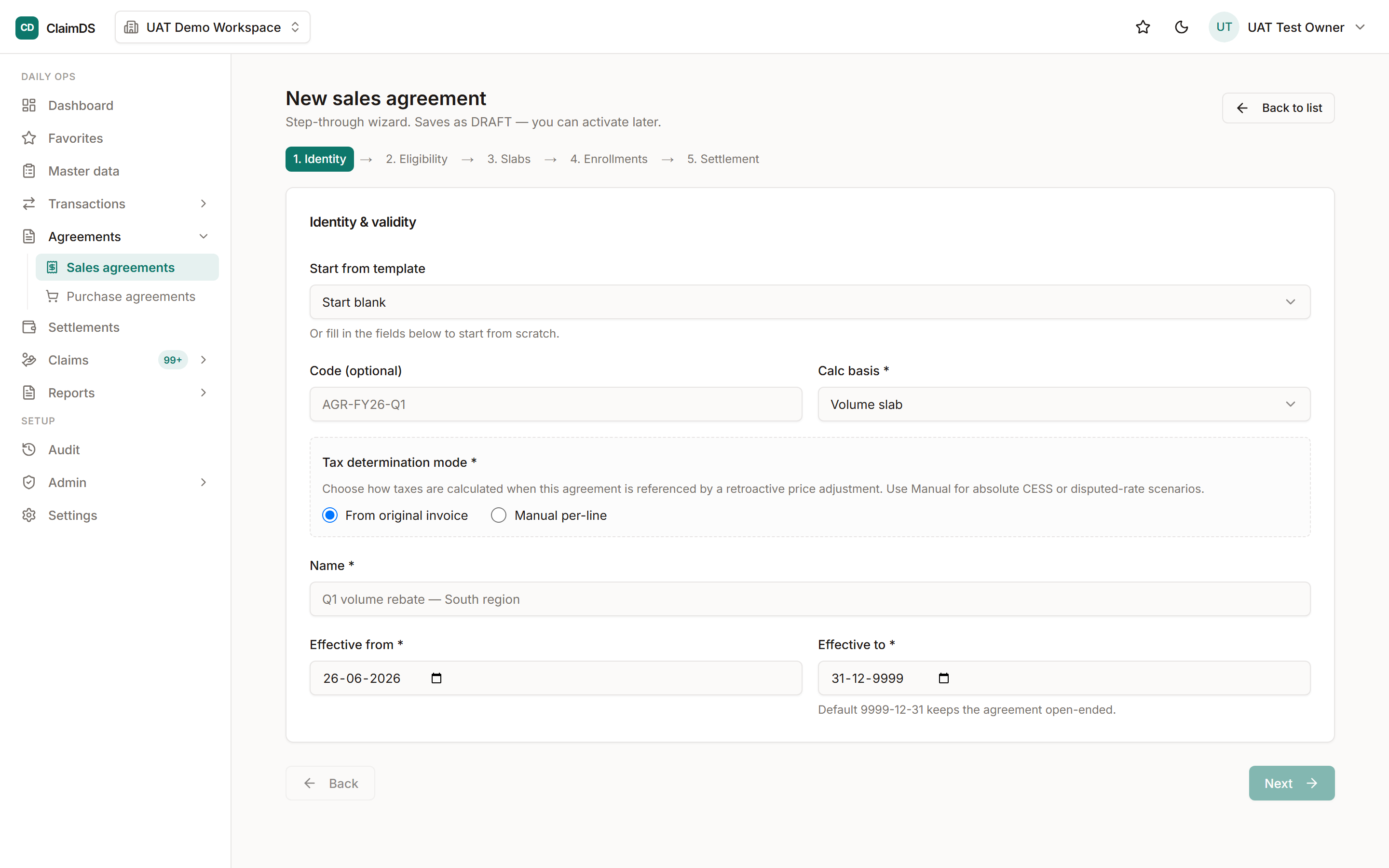
Program structures
| Structure | Rewards |
|---|---|
| Volume / slab | Crossing purchase-volume bands |
| Growth | Beating a prior-period baseline |
| Loyalty | Sustained or repeat purchasing |
Who counts as the "customer" at each tier?
"Customer rebate" is a perspective, not a fixed party — the customer is whoever buys from you, and the same program looks different depending on which seat you occupy:
| Seller | Their "customer" | Typical rebate shape |
|---|---|---|
| Manufacturer | Distributor, super stockist, large direct account | Slab or growth rebate on primary purchases |
| Distributor | Retailer, dealer | Per-unit or loyalty rebate on secondary purchases |
| Brand selling direct (B2B) | Business buyer, institutional account | Annual volume rebate on contracted purchases |
The mirror image is worth keeping in mind: your customer rebate is your buyer's supplier rebate — the same money, booked as a cost of sales on your side and a purchase-cost reduction on theirs. Which tier a partner sits at, and what that implies for the rebate design, is unpacked in distributor vs dealer vs super stockist, and the flow of goods behind these tiers in primary vs secondary vs tertiary sales.
What rebate types can you offer customers?
The structures in the table above are the umbrella; underneath, most sell-side programs borrow from the standard trade-scheme toolkit. A percentage slab steps the rate up as purchase value crosses bands; a per-unit quantity structure pays a fixed ₹ per case above a milestone; a target rebate pays against an individually agreed number; growth structures reward beating last year. The quantity-and-value family is detailed in volume rebates, and the full structural catalogue — including display, festive and secondary variants used when the customer is a channel partner — in types of trade schemes in India.
Illustrative example. An electricals company offers a customer a calendar-year volume rebate: 1% on annual purchases above ₹50,00,000, stepping to 1.5% above ₹80,00,000, whole-base. The customer closes the year at ₹92,00,000 → 1.5% × ₹92,00,000 = ₹1,38,000, settled by credit note in the new year. The design details that prevent disputes — whole-base vs per-tier, gross vs net of returns, caps — belong in the agreement, not in a settlement-time argument.
How do accrual and settlement flow?
A customer rebate moves through the same lifecycle every period:
| Stage | What happens |
|---|---|
| Agree | Terms fixed in writing before the period — base, rate, caps, settlement mode |
| Accrue | Liability builds as qualifying purchases post; the ₹92-lakh customer above shows a growing provision all year, not a year-end surprise |
| Validate | Achievement checked against invoiced purchases net of returns, per the agreement's own definition |
| Approve | The payout sanctioned under an approval matrix with segregation of duties — patterns in claim and rebate approval workflows |
| Settle | The credit note issued (right type by rule) and the accrual knocked off |
The accrual stage is where finance accuracy lives: an unrecorded rebate liability overstates revenue all year and produces a margin shock at settlement.
Validation and accrual
Accrue as the customer earns, validate before you settle. A live accrual against qualifying purchases keeps finance accurate and stops over- or under-payment. Across many customers this is impractical by hand; the live-accrual view is in rebate tracking software and the recognition mechanics in rebate accounting.
GST treatment
Customer rebates settle by credit note, and the tax-vs-financial choice affects ITC — see financial vs. tax credit notes and CBIC Circular 251. At pointer level: a rebate agreed before supply and linkable to invoices is the candidate for a taxable-value reduction, while one computed after the fact — most annual volume rebates — generally settles financially; the statutory conditions are unpacked in Section 15(3)(b) and post-supply discounts.
GST note: This article is general information, not tax or legal advice. GST positions — including CBIC Circular No. 251/08/2025-GST and the Finance Act 2026 amendments to Section 34 of the CGST Act, assented 30 March 2026 but not yet notified into force as of publication — must be re-verified at publish time with a qualified professional.
How they differ from others
Keep the three families distinct: customer rebates are sell-side to end customers; supplier rebates are buy-side from your suppliers; distributor and dealer rebates are channel incentives. Each has its own accounting and GST nuance. And when the customer sells through marketplaces or D2C, the mechanics shift again — see rebate schemes for online sellers in India.
How do B2B and B2C rebates differ?
Everything above assumes a B2B rebate: an identified business buyer, a written agreement, an accrual per customer, and settlement by credit note into their ledger. A B2C rebate — a consumer cashback, a price promotion, a mail-in offer — targets end consumers with no agreement and no per-buyer accrual; it is funded through the pack or the platform and never produces a credit note into a customer account. The two share a word but not a process, and mixing them muddles both the accounting and the GST route. The consumer-facing meaning of the term is covered in what is a rebate; where B2B programs meet online marketplaces and quasi-consumer mechanics, the hybrid ground is mapped in the online-sellers guide linked above.
How should a customer rebate program be governed?
Customer rebates are margin given away by contract, so they deserve the same governance as any other trade spend:
- Written terms before the period. Base (gross or net of returns), calculation logic with one worked example, caps, evidence, settlement mode and timeline — fixed up front, not negotiated at year-end.
- Approval discipline. Program creation approved by whoever owns margin; individual settlements routed through value-banded approvals with segregation of duties.
- Live accrual, reviewed monthly. Finance should see the building liability per customer, and stale accruals — provisioned but never settled — should be investigated, not carried.
- An audit trail. Every rate change, achievement figure and credit note traceable years later.
- Periodic program review. Cost versus objective per period: measurement patterns are in rebate analytics, and the failure modes that ungoverned programs develop — duplicate payouts, retroactive term changes, unclaimed accruals — in revenue leakage in rebate programs.
Run well, a customer rebate is a pricing instrument that buys loyalty and volume with money you would otherwise concede as flat discount; run loosely, it is a leak with a contract attached.
Frequently asked questions
What are customer rebates?
Customer rebates are sell-side incentives a business offers its customers — volume, growth or loyalty rebates earned on purchases and settled later, usually by credit note. They are distinct from supplier (buy-side) rebates and from distributor or dealer channel rebates.
How are customer rebates validated and accrued?
Customer rebates are accrued against qualifying customer purchases as the condition is met and validated against the agreement before settlement. Software keeps the accrual live and the validation consistent across many customers.
How are customer rebates treated under GST?
Customer rebates settle by credit note, and the choice between a tax credit note (with ITC reversal) and a financial credit note (no reversal) depends on whether the rebate meets the Section 15(3)(b) conditions, per CBIC Circular 251/08/2025-GST.
Who counts as the customer in a customer rebate program?
Whoever buys from you: for a manufacturer that is the distributor or a large direct account, for a distributor it is the retailer or dealer, and for a brand selling direct it is the business buyer. "Customer rebate" describes the seller's perspective — the same program is a supplier rebate from the buyer's side.
What is the difference between B2B and B2C rebates?
A B2B rebate runs on an agreement with an identified business buyer, accrues against invoiced purchases and settles by credit note into their account. A B2C rebate targets end consumers — cashbacks, price promotions — funded through the pack or the platform, with no agreement, no accrual per buyer and no credit-note settlement into a ledger.
How should a customer rebate program be governed?
Fix the terms in a written agreement before the period starts — base, calculation, caps, evidence, settlement mode and timeline — then run every payout through an approval workflow with segregation of duties, keep an audit trail of accruals and settlements, and review the program each period for cost versus objective. Ungoverned rebate programs are where margins quietly leak.
See RebateLedger on your own claims data
A 30-minute walkthrough tailored to how your channel actually settles claims.