
Distributor vs. Dealer vs. Super-Stockist: Who's Who in the Indian Channel
A plain-English glossary of the Indian route-to-market — C&F, super-stockist, distributor, wholesaler, dealer, retailer — and how claims flow.
In short
A distributor buys in bulk from the manufacturer and supplies a territory; a dealer sits lower in the channel, closer to the end customer; a super-stockist is an extra tier above distributors. The Indian route-to-market runs manufacturer, C&F agent, super-stockist, distributor, wholesaler, dealer, retailer — and each tier files different claims.
The Indian channel runs through several tiers — manufacturer, C&F agent, super-stockist, distributor, wholesaler, dealer, retailer, and (in pharma) stockist. A distributor buys in bulk and supplies a territory; a dealer sits lower, closer to the customer; a super-stockist is an extra tier above distributors. Knowing who's who is the first step to understanding how claims flow.
The tiers, plain-English
| Tier | What they do | How they earn |
|---|---|---|
| Manufacturer / brand | Makes the product, funds schemes | Margin on sale to channel |
| C&F agent | Holds stock, bills on the brand's behalf | Handling fee/commission |
| Super-stockist | Supplies distributors across a region | Margin + schemes |
| Distributor | Buys in bulk, supplies a territory | Margin, slab/growth schemes |
| Wholesaler | Bulk reseller to smaller trade | Trading margin |
| Dealer | Sells/services to end customers | Margin, incentives, warranty |
| Retailer | Sells to the shopper | Retail margin, display schemes |
| Stockist (pharma) | Distributor equivalent in pharma | Margin, schemes, chargebacks |
Terms vary by sector: FMCG says "distributor", pharma says "stockist/C&F", electricals and building materials often say "dealer" or "channel partner".
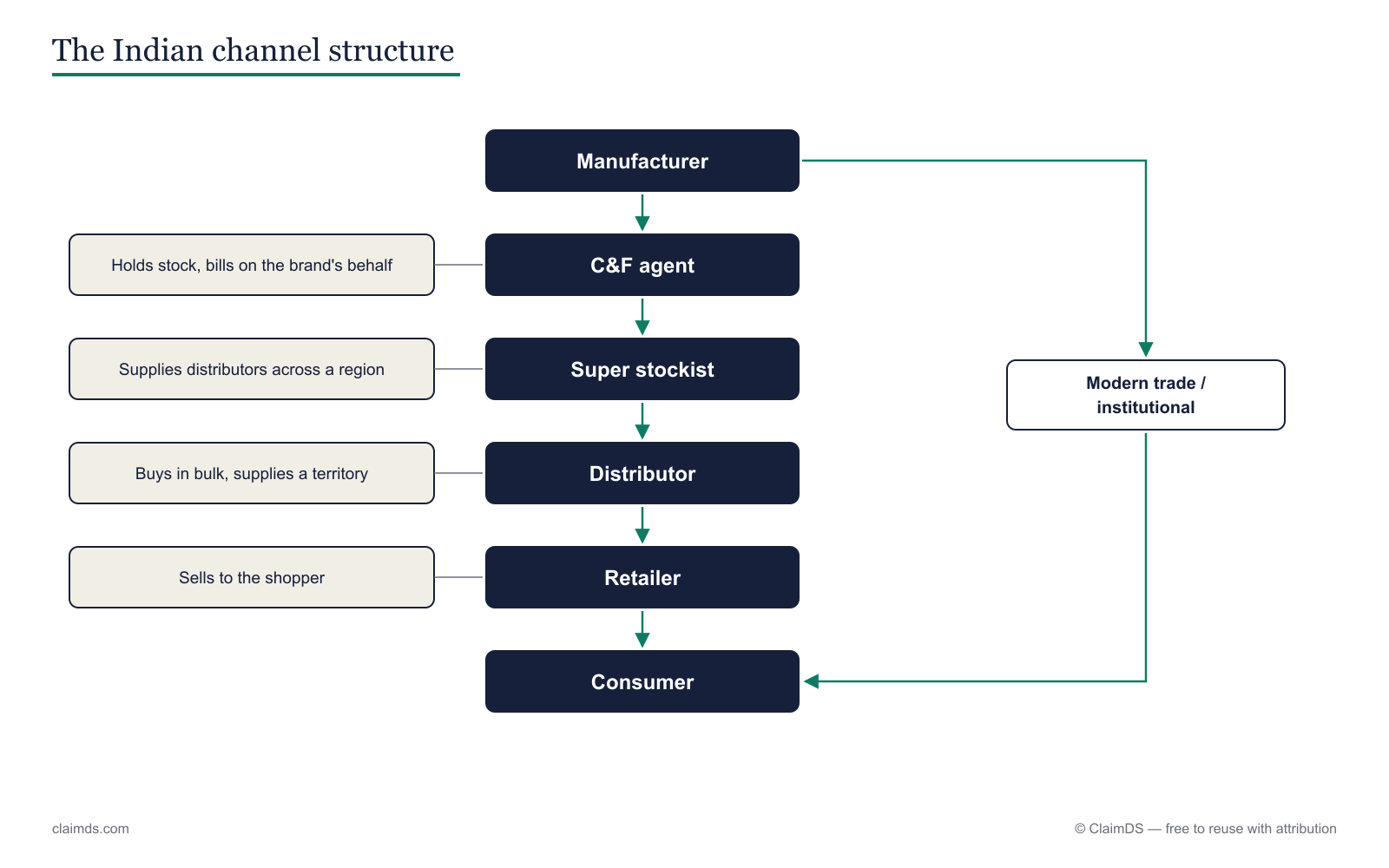
Source: RebateLedger — this diagram is free to reuse with a link back to this article.
How is a C&F agent different from a super-stockist?
They sit at similar heights in the chain but are opposite in kind — confusing them scrambles both margin math and claim types.
A C&F (carrying and forwarding) agent never owns the stock. It warehouses the manufacturer's goods and invoices on the manufacturer's behalf, earning a handling fee or commission. The sale a C&F bills is still the manufacturer's own primary sale — the C&F is an extension of the brand's logistics and billing, typically used where the brand needs an in-state stocking and billing presence (the GST mechanics are a subject of their own — a pointer only; verify with a qualified professional). A fuller walkthrough of what a C and F agent does sits behind this summary.
A super-stockist does own the stock. It buys from the manufacturer (or through the C&F), takes title, carries the working-capital burden, and resells to distributors at a trading margin. Because it owns what it sells, it also raises trade claims of its own — scheme claims, rate-difference claims, stock compensation when prices fall on inventory it is holding.
| C&F agent | Super-stockist | |
|---|---|---|
| Owns the stock? | No — holds it for the brand | Yes — buys and resells |
| How it earns | Handling fee / commission | Trading margin + schemes |
| Whose sale is billed | The manufacturer's (still primary) | Its own sale to distributors |
| Raises trade claims? | Rarely — expense reimbursements at most | Yes — schemes, rate difference, stock compensation |
The practical test is one question: who carries the inventory risk? If the brand does, it is a C&F arrangement. If the partner does, it is a super-stockist.
What does a super-stockist actually do?
The super-stockist is Indian FMCG's answer to geography: one bulk-buying tier that serves many small-town distributors the manufacturer could not economically bill and service directly.
| Profile | Super-stockist |
|---|---|
| Role | Buys in bulk from the brand, redistributes to distributors across a region |
| Margin model | Thin trading margin plus volume, growth and slab schemes |
| Data they own | Purchases from the brand, sales to each distributor, regional godown stock |
| Claims they raise | Scheme and slab claims, rate difference, bulk-storage damage, stock compensation on price drops |
Because a super-stockist inserts a whole tier between the brand's invoice and the distributor's, it widens the distance between primary and secondary sales — the visibility gap primary, secondary and tertiary sales unpacks in full: every extra tier is one more set of books between the manufacturer and the market.
What does a distributor actually do?
The distributor is the workhorse tier: it buys stock, runs the delivery beat, extends retail credit, and executes schemes on the ground in a defined territory.
| Profile | Distributor |
|---|---|
| Role | Buys from the brand or super-stockist, supplies retailers in a territory, runs the beat |
| Margin model | Trading margin plus slab, growth and secondary schemes |
| Data they own | Purchase records, retailer-wise secondary sales in billing software or DMS, closing stock |
| Claims they raise | Scheme claims, damage and expiry, price and rate difference, stock compensation |
The distributor's data matters more than any other tier's, because most schemes settle on it — the distributor's retailer-wise sales are the qualifying quantity for secondary schemes, and its stock statements anchor damage, expiry and expired and damaged goods credit-note claims. Worked distributor-level claim arithmetic is in how to calculate FMCG distributor claims.
What does a dealer actually do?
The dealer sits closest to the end customer, and in many sectors — automotive, electricals, consumer durables — sells and services the product.
| Profile | Dealer |
|---|---|
| Role | Sells (and often services) to end customers from a counter or showroom |
| Margin model | Front margin on sale plus back-end incentives, warranty reimbursements |
| Data they own | End-customer invoices, service and installation records, local stock |
| Claims they raise | Warranty claims, incentive and target claims, price protection on stock when prices fall |
The dealer's claim mix is distinctive: warranty and service reimbursements barely exist higher up the chain, and price protection matters most here because dealers hold priced stock closest to a falling market.
What is a channel partner?
Channel partner is the umbrella term for all of the above: any third-party business that sells or distributes on a brand's behalf rather than being owned by it. A super-stockist, distributor, wholesaler, dealer, retailer and pharma stockist are all channel partners — the word says nothing about which tier, only that the business sits in the brand's route-to-market.
That's also why the vocabulary gets used loosely: an electricals brand may call its dealers "channel partners" while an FMCG company reserves the word for distributors. When a scheme circular or agreement says "channel partner", check which tier it actually means — the margins, schemes and claim types differ by tier exactly as the table above shows.
Do the tier names change by region and sector?
Yes — and the variation trips up anyone reading agreements across industries. FMCG says "distributor" and "super-stockist"; pharma says "stockist", "sub-stockist" and "C&F"; automotive and durables say "dealer"; electricals and building materials often say "dealer" or simply "channel partner". None of this changes the underlying economics — a pharma stockist is a distributor by another name, with the same scheme, expiry and chargeback mechanics in pharma distribution. When in doubt, ignore the label and ask the three profile questions from the tables above: who owns the stock, how do they earn, and which claims do they raise?
How goods and claims flow
Goods flow down the tiers — manufacturer → super-stockist → distributor → dealer/retailer. Claims flow up — the rebates, chargebacks, price-protection and buyback amounts each tier is owed travel back toward the manufacturer, as claims map across India's multi-tier channel. The gap between primary sales (brand → distributor) and secondary sales (distributor → retailer) is where secondary scheme settlement lives, and where most complexity concentrates.
A simple (illustrative) money ladder makes it concrete. Take a product with an MRP of ₹100: the brand bills the super-stockist at ₹78, the super-stockist bills the distributor at ₹80, the distributor bills the retailer at ₹85, and the retailer sells at ₹100. Those gaps are each tier's trading margin — thin in the middle, which is why schemes exist: a ₹2-per-unit secondary scheme can matter more to a distributor's economics than its base margin. The full landscape of those schemes is in types of trade schemes in India.
Now run the flow in reverse. When that ₹2-per-unit scheme pays on the distributor's sales to retailers, the qualifying quantity is a secondary number — data that sits in the distributor's billing system, not the brand's ERP (the tier-by-tier data-ownership picture is in primary, secondary and tertiary sales). So the claim travels up as a document: the distributor submits sales data and a claim, the brand verifies and approves it, and the settlement — typically a GST credit note — travels back down. Every tier boundary is a handover where evidence can go missing — why the lifecycle discipline in the claim process explained matters at each rung of the ladder.
Which claims each tier raises
Each tier raises the claim types that fit its position: distributors raise scheme, damage, expiry and price-difference claims (distributor claims management); dealers raise warranty, incentive and price-protection claims (dealer claims management); all of it settles under the claims management software umbrella. New to the terminology of the money itself? Start with what is a rebate.
Where RebateLedger fits
RebateLedger models these tiers natively — because flattening the Indian channel to two parties is exactly where claims get lost. It settles the claims each tier raises, GST-correctly, in one India-first product. See why RebateLedger and the pillar rebate management software.
Frequently asked questions
What is the difference between a distributor and a dealer?
A distributor buys in bulk from a manufacturer and supplies a territory, usually higher up the channel on primary purchase volume. A dealer sits lower, closer to the end customer, often selling and servicing a product. The mechanics rhyme, but their position, margins and claim types differ.
What is a super-stockist?
A super-stockist sits between the manufacturer (or its C&F agent) and distributors, holding stock and supplying distributors across a larger region — an extra tier common in Indian FMCG that widens the gap between primary and secondary sales.
What is a stockist in pharma?
In pharma, "stockist" is the equivalent of a distributor — the tier that buys from the C&F agent and supplies retailers and institutions. The claim mechanics (schemes, chargebacks, expiry returns) rhyme with FMCG distribution but use pharma terminology.
What is a channel partner?
A channel partner is any third-party business that sells or distributes a brand's products on its behalf — the umbrella term covering super-stockists, distributors, wholesalers, dealers, retailers and pharma stockists. The word says nothing about tier; the specific tier determines the margins, schemes and claim types involved.
What is a C&F agent?
A carrying-and-forwarding (C&F) agent warehouses the manufacturer's stock and invoices on the manufacturer's behalf, earning a handling fee or commission rather than a trading margin. The defining feature: a C&F agent never takes ownership of the goods — the sale it bills is still the manufacturer's own primary sale.
What claims does a distributor typically raise?
The distributor tier raises the widest mix of claims in the Indian channel: scheme and slab incentive claims, damage and expiry claims, price-difference and rate-difference claims, and stock-compensation claims when prices drop. Each settles against evidence that originates in the distributor's own records, which is why verification is central to distributor claims.
Why do channel tier names vary across India?
Because each sector evolved its own vocabulary — FMCG standardised on distributor and super-stockist, pharma on stockist and C&F, automotive and durables on dealer, electricals and building materials on dealer or channel partner. The reliable way to read any agreement is by its economics — who owns the stock, what margin they earn, which claims they raise — rather than by the label a region or sector attaches to the tier.
What is a channel business model?
A channel business model sells through a multi-tier network — super-stockists, distributors, wholesalers, dealers and retailers — rather than direct to the end customer. Each tier owns stock, earns a trading margin plus schemes, and raises its own claims, so goods flow down the tiers while claims flow back up toward the manufacturer.
How does the super stockist margin and claim process work?
A super stockist's economics are base trading margin plus scheme income — and their claim complexity is double, because the flow is two-directional: they submit claims upward to the company for their own schemes, and settle claims downward from the sub-distributors they service. That creates three ledgers that must agree — the company's, the super stockist's, and each sub-distributor's — which is why reconciliation discipline matters more at this tier than at any other. Margin percentages vary by category and are contractual; no authoritative published benchmark exists.
See RebateLedger on your own claims data
A 30-minute walkthrough tailored to how your channel actually settles claims.