
Credit Notes for Expired and Damaged Goods Returns (Pharma and FMCG)
Expiry and damage returns under GST for pharma and FMCG — the two Circular 72/46/2018 routes, credit notes, ITC reversal, e-way bills and documentation.
In short
Under GST, expired or damaged goods come back from the channel in exactly two ways per CBIC Circular 72/46/2018: the returning party sends the stock back as a fresh supply on its own invoice or delivery challan, or the original supplier issues a Section 34 credit note with tax adjustment only inside the statutory window. This is general information, not tax advice.
Under GST, expired or damaged goods can come back from the channel in exactly two ways. CBIC Circular 72/46/2018-GST (26 October 2018, still operative) lets the returning party either send the stock back as a fresh supply on its own invoice — or delivery challan if unregistered — or return it against a credit note issued by the original supplier, with tax adjustment only inside the Section 34(2) window. If the manufacturer destroys what comes back, Section 17(5)(h) forces an ITC reversal. This guide walks pharma and FMCG teams through both routes, the transport paperwork, and the claim file that keeps the physical, financial and GST trails aligned.
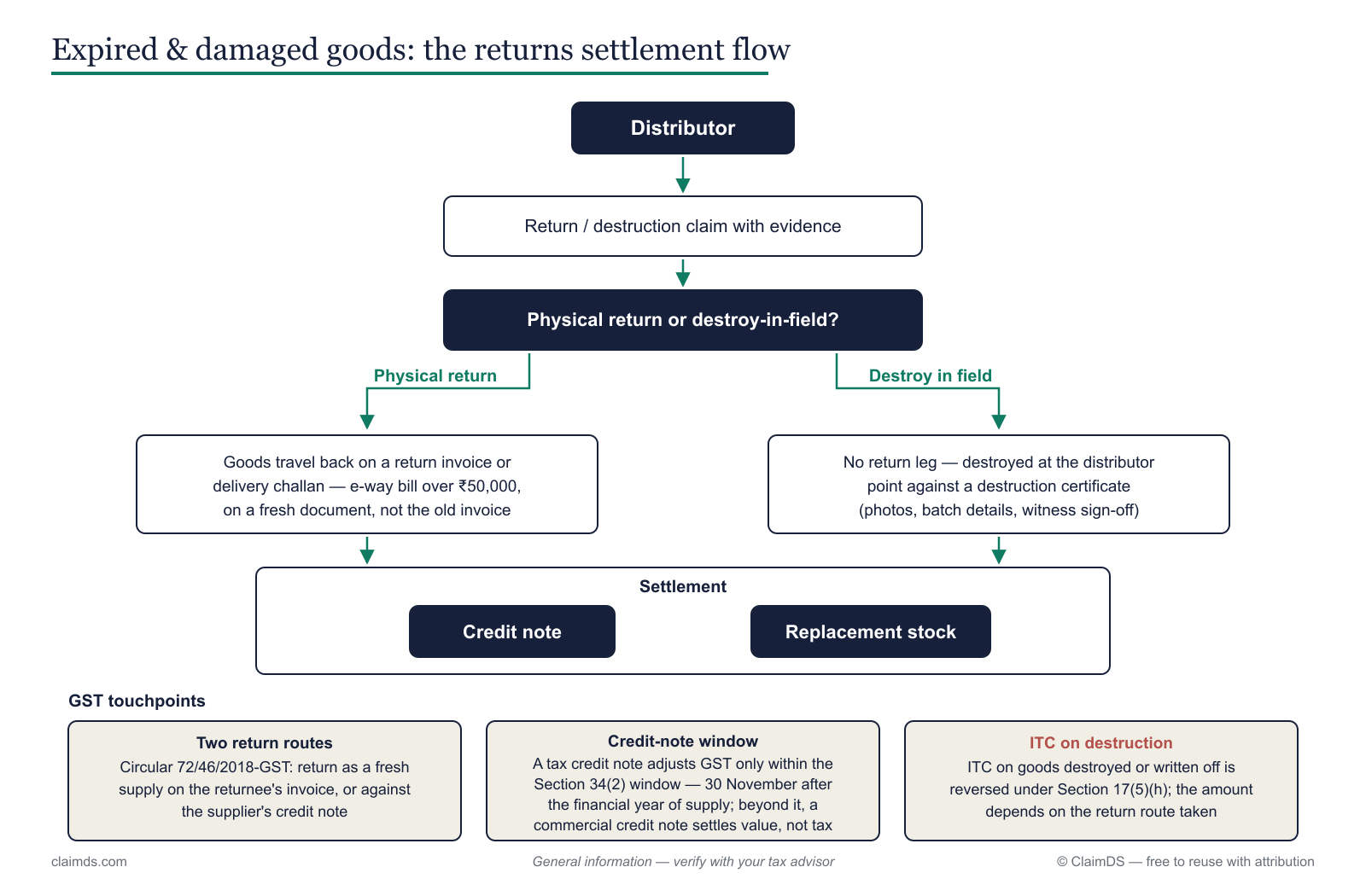
Source: RebateLedger — this diagram is free to reuse with a link back to this article. General information only — not tax advice.
Why are expiry and damage claims the messiest channel claims?
Most channel claims are arithmetic disputes: did the distributor hit the slab, is the rate right. Expiry and damage claims add three layers scheme claims never have:
- Physical verification. Someone must confirm the stock exists, is genuinely expired or damaged, and is the batch claimed — before it moves, after it arrives, or via a destruction certificate if it never moves.
- Valuation disputes. Last year's price list or this year's? Net of scheme or gross? Full value, part value per policy, or nil because the window closed?
- GST paperwork. Every return leg needs the right document (invoice, delivery challan, credit note), e-way bill and ITC treatment — and the choices interact.
The result is a claim where the physical event, the commercial settlement and the tax documents can each be fine yet mutually inconsistent — the classic audit finding. The broader discipline is in distributor claims management; this article is the expiry/damage layer. The operational side — who physically collects the stock, who bears the cost, and what the return policy has to specify — is covered separately in expiry and breakage returns: who collects, who pays.
What are the two GST routes for returning expired goods?
Circular 72/46/2018-GST was written for time-expired drugs and medicines but states that its clarifications apply to goods returned for other reasons too — which is why FMCG teams run the same playbook.
Route A — return as fresh supply. The returning wholesaler or retailer treats the return leg as its own outward supply. A registered returnee issues a tax invoice (the circular allows the original supply-invoice value as the value of the return supply); a composition taxpayer issues a bill of supply; an unregistered returnee returns the goods on a commercial document — in practice a delivery challan — without charging tax. The manufacturer or wholesaler receiving the return can avail ITC of the tax on that return supply, subject to Section 16 (no ITC arises on composition or unregistered returns, since no tax is charged).
Route B — return against a credit note. The original supplier issues a credit note under Section 34. Whether GST moves depends on timing: within the Section 34(2) window, the supplier may reduce its output tax liability — provided the returnee has not availed the ITC, or has reversed it. Beyond the window, the circular is explicit that a credit note may still be issued, but the tax liability cannot be adjusted — a commercial credit note that settles money, not tax. The window is now 30 November following the end of the financial year of supply (or the annual-return date, if earlier) — the circular says September because it predates the Finance Act 2022 amendment. Full timing detail: GST credit-note time limits and reporting.
| Route A — fresh supply | Route B — credit note | |
|---|---|---|
| Who documents the return | Returnee issues invoice (registered) / bill of supply (composition) / delivery challan, no tax (unregistered) | Original supplier issues the credit note; goods move on a delivery challan |
| Tax effect | Tax charged on the return leg; manufacturer avails ITC (registered returnee only) | Within window + ITC condition met — supplier reduces output tax. Beyond window — no tax adjustment |
| ITC reversed on destruction | ITC availed on the return supply | ITC attributable to the manufacture of the goods |
| When it fits | Registered returnee; high-value returns where the manufacturer wants ITC symmetry | Unregistered or composition returnees; returns after the CN window; supplier-controlled paper trail |
Choosing between a tax and a commercial credit note is the same decision every post-sale adjustment faces — the framework is in financial vs. tax credit notes under GST, and the current CBIC position on commercial credit notes and ITC is in Circular 251 and post-sale discounts. For the wider tax map, see how returns and other channel settlements are taxed by instrument.
How are damage and breakage claims different from expiry returns?
Damage and breakage claims often involve no physical return at all. Freight rarely justifies trucking broken bottles back to a depot, so field practice is destruction at the distributor point against a destruction certificate — countersigned by the company salesperson or a third-party verifier, with photographs and batch details — followed by settlement via credit note.
Two consequences follow. First, with no return leg there is no Route A: the settlement instrument is a credit note, and the within-window/beyond-window logic above decides whether it carries tax. Second, whoever availed ITC on goods destroyed or written off must reverse it under Section 17(5)(h) — the blocked-credit clause covers goods "lost, stolen, destroyed, written off". Where insurance or a carrier claim covers the loss, the survey report joins the claim file and the compensation flow changes — treatments vary, so keep that lane with your tax advisor. Damage-adjacent programs like stock compensation on price changes and replacement-in-kind (valuation questions in GST on free goods and BOGO schemes) sit next to this in most trade-scheme policies.
One vocabulary trap: a rejection note (or goods-return note) is the buyer-side commercial record of what is sent back and why — useful where no e-way bill is needed. It moves no tax. Only the supplier's credit note adjusts value, and only a Section 34 credit note within the window adjusts GST.
What happens to ITC when returned goods are destroyed?
Expired medicines cannot be resold; they are destroyed. The circular ties destruction to Section 17(5)(h), and which ITC gets reversed depends on the route taken, per its own illustration:
- A manufacturer availed ₹10 of ITC while manufacturing a batch.
- The batch expires and the wholesaler returns it as a fresh supply (Route A), charging ₹15 tax on the return invoice, which the manufacturer avails as ITC. On destruction, the manufacturer reverses ₹15 — the ITC availed on the return supply.
- Had the batch come back against a credit note (Route B), the manufacturer on destruction reverses ₹10 — the ITC attributable to its manufacture.
Same batch, same incinerator, different reversal. At portfolio scale that gap is real money — one reason route selection belongs in the returns policy, not in ad-hoc branch decisions. Wider reversal mechanics: ITC reversal on post-sale discounts and credit notes.
What transport documents does the return leg need?
A return is movement of goods, so e-way bill rules apply exactly as on the outward journey: required when the consignment value exceeds ₹50,000 (several states set different intra-state thresholds). The registered person causing the movement generates it — the returnee on Route A against its return invoice, either party on Route B against the delivery challan under which the goods travel; failing both, the transporter must. An unregistered returnee can enrol on the portal as a citizen.
A detail that bites expiry returns specifically: since 1 January 2025, an e-way bill can only be generated against a base document dated within 180 days. Expired stock traces to invoices months or years old — so the return leg must ride on a fresh document (return invoice or delivery challan dated now), never the original sale invoice.
What does a compliant expiry-return claim file contain?
(For the pricing side — banding each returned line by age and applying the banded rate — see building a buyback and expiry return simulator in Excel.)
- The claim — batch numbers, expiry dates, quantities, original invoice references, priced per the return policy.
- Physical proof — goods-received verification at the CFA/depot, or a destruction certificate (photos, witness sign-off) for field destruction.
- Transport document — return invoice or delivery challan, plus the e-way bill where the threshold is crossed.
- The credit note, typed correctly — tax CN (within window, ITC condition evidenced) or commercial CN (beyond window, or by policy), cross-referenced to the claim.
- GST reporting — tax CNs in GSTR-1, flowing to the returnee's GSTR-2B for ITC reversal; commercial CNs off the portal but on the ledger.
- ITC reversal entry — the manufacturer's Section 17(5)(h) reversal on destruction, per the route taken.
How does automation keep the three trails aligned?
Every expiry claim lives in three systems at once: a warehouse trail (what came back or was destroyed), a financial trail (what was credited), and a GST trail (what was reported). Manual processes let them drift — a credit note for stock never verified, a destruction never matched to an ITC reversal, a tax CN issued past the window. A claims platform like RebateLedger ties each claim to its verification record, selects the credit-note type against the Section 34(2) clock, and keeps the CN–claim–GSTR linkage auditable — the same settlement discipline covered in calculating FMCG distributor claims.
Related reading: how returns and reversals are handled after settlement.
Pharma notes. Returns run up the stockist–CFA chain with hard batch and expiry discipline: claims are validated batch-wise against original supplies, near-expiry and post-expiry windows differ, and destruction of expired drugs carries regulatory handling on top of GST. Sector mechanics: expiry and breakage returns in pharma and buyback in pharma.
FMCG notes. The volume problem is secondary-market damage — breakage, crushed shippers, leaking packs discovered at retail and claimed through the distributor. Physical return is rare; field destruction and photographic proof dominate, making verification standards and sampling policy the control point. See buyback in FMCG.
Returns are only one of the reasons a credit note gets raised in a channel business. Where expiry credits, scheme payouts and rate differences all settle through the same document stream, the useful question becomes which entitlement each note discharges — which is the record rebate management software is built to keep.
Disclaimer: This article is general information, not tax or legal advice. Positions reflect CBIC Circular 72/46/2018-GST (operative as of July 2026), Section 34(2) as amended (30 November window), Section 17(5)(h), and e-way bill rules as of writing; the Finance Act 2026 amendment to Section 34 (s.154) is enacted but awaiting a commencement notification as of early July 2026. Verify current provisions on cbic-gst.gov.in and with a qualified professional before acting.
Frequently asked questions
How are expired goods returns treated under GST?
CBIC Circular 72/46/2018-GST gives two routes. Either the returning party sends the goods back as a fresh supply — on its own tax invoice if registered, or on a commercial document such as a delivery challan without charging tax if unregistered — or the original supplier issues a credit note under Section 34. On the credit-note route, the supplier can adjust its output tax only if the credit note falls within the Section 34(2) window and the returnee has not availed the ITC or has reversed it. If the manufacturer then destroys the returned goods, it must reverse ITC under Section 17(5)(h). Verify current positions with a qualified professional.
Is an e-way bill needed for a sales return?
Generally yes, when the consignment value exceeds ₹50,000 (some states set different intra-state thresholds). A return is movement of goods, so the same rules apply as on the outward leg. On the fresh-supply route the return invoice backs the e-way bill; on the credit-note route the goods move under a delivery challan. The registered person causing the movement — supplier or recipient — generates it, failing which the transporter must. Note that since 1 January 2025 the underlying document must be dated within 180 days of e-way bill generation, so old invoices cannot back the return leg.
How do I handle GST on damaged goods claims?
It depends on what happens to the goods. If damaged stock is returned, the two Circular 72/46/2018 routes apply. If it is destroyed in the field against a destruction certificate — common for breakage — there is typically no fresh supply back, and the supplier compensates by credit note; a commercial credit note changes no GST, while a Section 34 tax credit note needs the time-window and ITC conditions met. ITC attributable to goods that are destroyed or written off is blocked under Section 17(5)(h) and must be reversed by whoever availed it. Insurance recoveries add their own treatment — take professional advice.
Can a credit note be issued for expired goods after the time limit?
Yes — but without tax adjustment. The circular is explicit that a credit note may still be issued after the Section 34(2) window lapses; the supplier simply cannot reduce its output tax liability against it, and such a note is not reported on the portal. In practice this means a commercial (financial) credit note that settles the claim value while the original GST stands. Within the window — now 30 November following the financial year of supply, or the annual return date if earlier — a tax credit note with adjustment is possible if the returnee has not availed or has reversed the ITC.
What happens to ITC on stock destroyed in a warehouse fire or flood?
Credit on goods lost or destroyed must generally be reversed, supported by stock records, FIR or brigade reports, insurer surveys and the write-off working. On insurance, check whether the policy covers the tax element: where credit is being reversed, that tax becomes a real cost, and many businesses insure stock at values excluding it. Align the insurance claim and the GST working, and confirm the position with your adviser.
Why do shortage and damage remarks on the lorry receipt matter so much?
Because the lorry receipt and proof of delivery are the contemporaneous record of condition at handover — the moment liability crystallises. A clean POD is treated by transporters, insurers and suppliers as acceptance that the consignment arrived intact, making later claims nearly impossible. Specific remarks — package shortages, wet cartons, broken seals — preserve the transporter claim, support the survey, and justify the credit note. Train receiving staff to itemise.
Does the expired-goods return framework apply beyond pharma to FMCG and agro-inputs?
Yes, in practice. Though issued for time-expired medicines, its framework — return as a fresh supply by the dealer, or return against the supplier's credit note on a delivery challan — reflects general GST principles and is applied to expired foods, personal care, agrochemicals and other date-sensitive goods, with credit reversal on destruction travelling with it. Mirror the circular's documentation in returns policies and confirm sector nuances with your adviser.
What is a restocking fee?
A restocking fee is an amount a supplier deducts when taking back goods that are saleable but unwanted — covering the cost of inspecting, repackaging and returning them to stock. It typically applies to non-defective returns rather than to expired or damaged goods, and its rate and applicability should be set out in the supply or returns terms the parties agree.
What is the GST treatment when expired sales returns are destroyed?
When returned goods are destroyed rather than resold, the GST question usually involves whether the input tax credit attributable to that stock must be reversed. The treatment depends on the facts and on how the return and the destruction are documented — confirm the position for your case with your CA.
What happens when damaged or expired goods are replaced instead of credited?
Replacement and credit-note settlement are commercially different routes with different documentation — a credit note adjusts money owed, while replacement restores stock with no cash moving. How a replacement supply is treated for tax depends on how it is structured and documented, so the route your policy chooses should be confirmed with a chartered accountant before the first return settles.
See RebateLedger on your own claims data
A 30-minute walkthrough tailored to how your channel actually settles claims.