
Buyback in FMCG: Expired-Stock & Damaged-Goods Programs
FMCG buyback in India — expired, near-expiry and damaged-stock return programs, eligibility windows, valuation and credit-note settlement.
In short
FMCG buyback is a program where a manufacturer takes back expired, near-expiry or damaged stock from distributors and compensates them, usually by credit note. Eligibility windows and valuation rules keep the cost predictable while keeping shelves fresh and the distributor relationship protected.
Buyback in FMCG is a program where a manufacturer takes back expired, near-expiry or damaged stock from distributors and compensates them, usually by credit note. It keeps shelves fresh and protects the distributor relationship — governed by eligibility windows and valuation rules that keep the cost predictable.
Why does FMCG buyback exist?
FMCG products move fast but not all of them sell before expiry, and damage in transit and storage is routine. Buyback lets distributors return that stock so they keep ordering confidently and shelves stay fresh. It is the FMCG view of the buyback hub and pairs with FMCG chargebacks on the deduction side.
Verify at publish: Indian distributor-body advocacy on expired/damaged stock — confirm current positions and any figures before citing; do not fabricate.
The structural reason is the depth of the chain. FMCG stock sits at the distributor, the wholesaler and tens of thousands of retail counters — the primary, secondary and tertiary tiers — and the further down the chain a problem is discovered, the harder it is to verify and the longer it takes to surface. A distributor who eats expiry losses silently does not stay a distributor; one who claims freely without rules turns buyback into an open tap. The program exists to hold that line.
What return types does FMCG buyback cover?
| Type | Covers |
|---|---|
| Expiry / near-expiry | Stock at or approaching its use-by date |
| Damage | Goods damaged in transit or storage |
| Unsold / slow-moving | Stock taken back by agreement |
Each row hides distinctions that the claim must state explicitly:
Near-expiry vs expired. Near-expiry stock — inside a company-defined band before the use-by date; each company sets its own — is still saleable, and many policies push liquidation first: sell it through faster outlets or with a markdown before it becomes a return. Expired stock has exactly one destination, destruction against a certificate. The two carry different windows and different values, so a claim that says only "expiry" is underspecified.
Damage in transit vs in storage. Transit damage should be discovered and claimed at receipt, tied to the consignment and often to a carrier claim. Storage and handling damage surfaces later, has no carrier behind it, and needs photographic evidence and a stated discovery date. Merging the two lets old storage damage ride on fresh consignments.
Seasonal and festive unwind. Festive packs, gift assortments and season-specific SKUs are a scheme-driven surge on the way out — see types of trade schemes — and a returns problem on the way back. When the season ends, residual seasonal stock has no natural buyer, so agreements often carry a post-season return or repack window: a hard calendar, agreed valuation, and verification that the claim is genuinely the seasonal SKU.
Secondary-market returns. Damage and expiry discovered at retail and claimed up through the distributor are the hardest to verify — the stock rarely travels back, so field destruction with photographs and sign-off dominates, and the sampling and verification standard becomes the real control.
How do eligibility windows work?
Windows make buyback predictable. They define how close to expiry stock can be returned and the timeframe to raise a claim — without them, buyback cost runs open-ended. Clear windows also keep the claim verifiable, which is the difference between a managed program and a perpetual dispute — see the buyback process.
In practice a window has three parts: the band (how close to or past expiry the batch must be to qualify), the claim-by date (how long after entering the band the claim may be raised), and the condition rule (intact packs, saleable condition, original cases). All three should test against system dates — the batch's printed expiry and the claim's submission timestamp — never against narrated ones.
Why does batch tracking make or break FMCG buyback?
Every window test above assumes you know which batch the stock is. That is the fragile assumption. Retail shelves mix batches; distributor godowns break FIFO under pressure; wholesaler stock crosses territories. Without batch data on the claim, three questions become unanswerable: is this stock actually inside the band, was it supplied by us to this distributor, and has this batch already been claimed once? The claims that go wrong are almost never arithmetic errors — they are traceability failures. This is why claim lines must carry batch, expiry and original invoice reference at submission, the same grounding discipline behind calculating FMCG distributor claims.
What does a worked example look like?
Illustrative numbers, one distributor, one biscuit SKU bought at ₹800 per case:
| Claim line | Cases | Status after verification | Value |
|---|---|---|---|
| Near-expiry, inside band, claimed in window | 180 | Approved at 100% of invoice | ₹1,44,000 |
| Expired, field-destroyed against certificate | 70 | Approved at 100% of invoice | ₹56,000 |
| Claimed as near-expiry, batch still outside band | 50 | Rejected — outside window | ₹0 |
Claimed: ₹2,40,000. Approved: ₹2,00,000. The ₹40,000 difference is not a negotiation — it is a window rule applied to a batch date, visible to both sides. That transparency is what keeps the distributor relationship intact even when claims are cut.
How are FMCG buyback claims tracked and settled?
After eligibility and valuation are confirmed and the physical return logged, the value is settled to the distributor, usually by GST credit note, with the claim linked to the return. The supplier-side coordination is in supplier buybacks; the value-loss-without-return case is stock compensation.
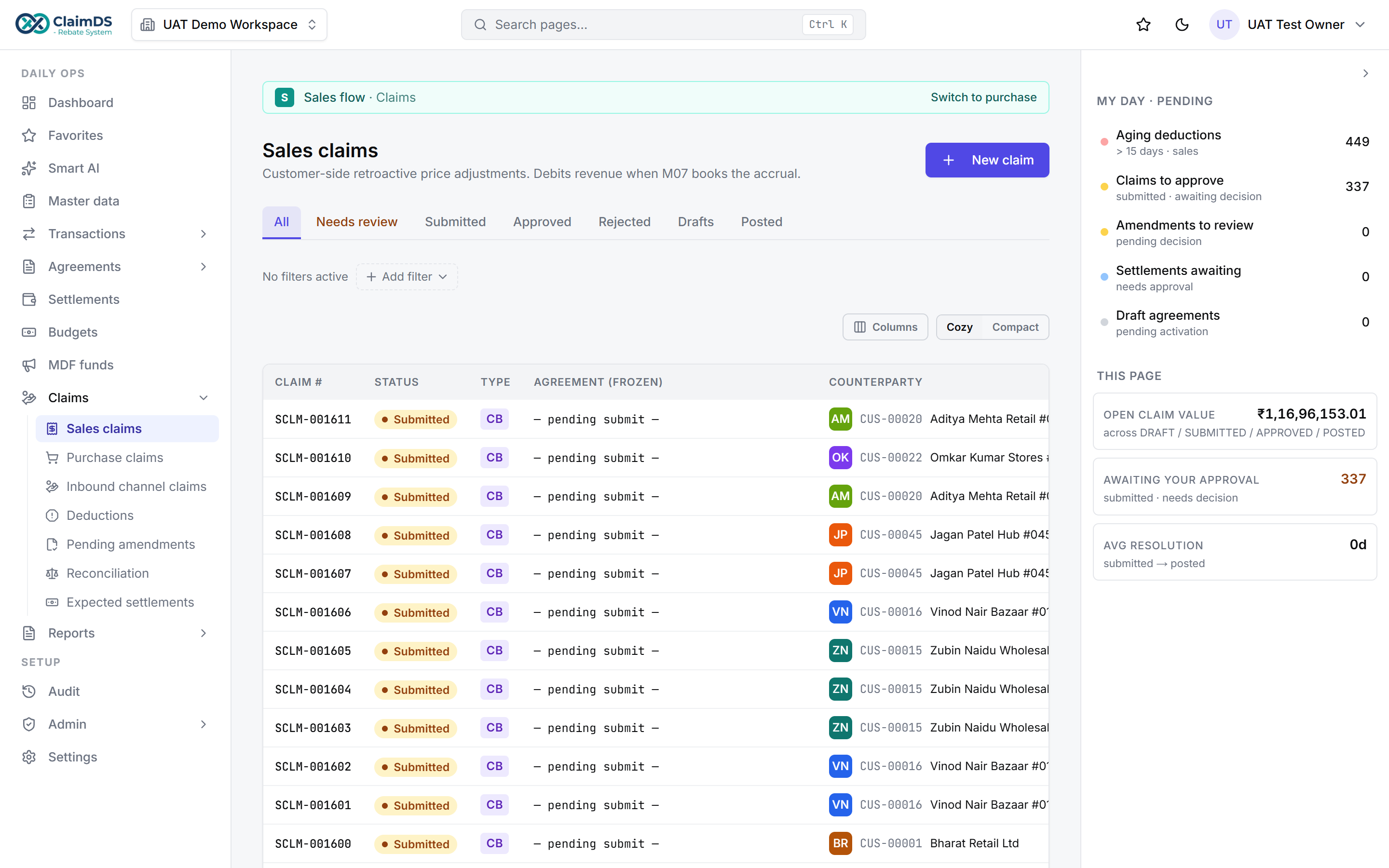
At FMCG volumes the operational problem is the queue: hundreds of return and damage claims a month, each at a different stage, each ageing against a settlement expectation. The disciplines are the standard ones from distributor claims management — status visibility, ageing alerts, approval routing — plus the buyback-specific evidence checks, which is why buyback belongs inside the same claims platform rather than a side spreadsheet (the wider feature view is rebate software features for FMCG). This is what that queue looks like when every claim carries its status and age in one view.
On the tax side, the settlement credit note has a GST route decision behind it — the two Circular 72/46/2018 routes and the destruction/ITC consequences are covered in credit notes for expired and damaged goods returns, and the tax-vs-commercial credit-note choice in financial vs. tax credit notes under GST. Keep those decisions with your tax advisor; keep the record of which was used with the claim.
A buyback programme is trade spend with a returns process attached — budgeted, approved and settled like any other scheme. Managing it that way, rather than as an exception, is what software that plans and settles trade spend enables.
GST note: This article is general information, not tax or legal advice. Credit notes on returns and other GST positions — including CBIC Circular No. 251/08/2025-GST and the Finance Act 2026 amendments to Section 34 of the CGST Act, assented 30 March 2026 but not yet notified into force as of publication — must be re-verified at publish time with a qualified professional.
Frequently asked questions
What is buyback in FMCG?
FMCG buyback is a program where a manufacturer takes back expired, near-expiry or damaged stock from distributors and compensates them, usually by credit note. It keeps shelves fresh and protects the distributor relationship, governed by eligibility windows and valuation rules.
How do FMCG expiry-return windows work?
Expiry-return windows define how close to (or past) expiry stock can be returned and within what timeframe a claim must be raised. Clear windows keep buyback cost predictable and the claim verifiable.
How is FMCG buyback settled?
After eligibility and valuation are confirmed and the physical return logged, the value is settled to the distributor, usually by GST credit note, with the financial claim linked to the return.
What is the difference between near-expiry and expired stock in buyback?
Near-expiry stock is still saleable — inside a company-defined band before the use-by date — and can often be liquidated through discounting or faster-moving outlets, so policies may take it back at a different value or push liquidation first. Expired stock cannot re-enter the chain at all and is destroyed against a certificate. The two carry different eligibility windows, valuation and handling, so a claim must state which it is, batch by batch.
How does seasonal and festive stock unwind through buyback?
Festive packs, gift assortments and season-specific SKUs lose their market when the season ends, so agreements often include a post-season return or repack window for residual stock. It behaves like an unsold-stock buyback with a hard calendar: a defined claim window after the season, agreed valuation, and verification that the stock is genuinely the seasonal SKU and quantity claimed.
How is GST handled on FMCG expiry and damage returns?
Returns of expired or damaged goods follow CBIC Circular 72/46/2018-GST — return as a fresh supply or against a credit note, with tax adjustment on the credit-note route only inside the Section 34 window, and ITC reversal where destroyed goods are involved. The claim system's job is to record which route and credit-note type each settlement used; verify the tax positions with a qualified professional.
Can expired FMCG products be diverted to animal feed or scrap instead of destruction?
Only where law and safety permit, and the distinction has tax consequences. Some expired or off-spec products are lawfully diverted to animal feed or industrial use — that is a sale, taxed on the sale value, arguably outside the credit block that applies to destroyed goods. Products that cannot lawfully be diverted must be destroyed, with credit reversal. Document the diversion approval and confirm treatment with your tax adviser.
Fixed damage allowance or actual claim reimbursement — which works better?
A fixed allowance wins on simplicity: automatic credit, no verification cost, predictable expense — but it overpays the careless and underpays anyone hit by a genuine spike. Actual reimbursement is fairer and accountable, but demands evidence, verification effort and slower settlement. Most FMCG companies blend the two: a modest fixed allowance for routine breakage plus a documented claim route above a threshold. State the model in trading terms and audit patterns annually.
See RebateLedger on your own claims data
A 30-minute walkthrough tailored to how your channel actually settles claims.