
Stock Compensation Software & Claims (Channel)
Channel stock compensation software for price drops, damage, expiry and slow-moving stock — not employee equity. Claim types and settlement.
In short
Stock compensation software, in the channel sense, automates claims that compensate distribution partners for affected inventory — price drops, damage, expiry and slow-moving stock — managing eligibility, valuation and GST credit-note settlement. It is not about employee equity or ESOPs.

Stock compensation software, in the channel sense, automates claims that compensate distribution partners for affected inventory — price drops, damage, expiry and slow-moving stock. It manages eligibility, valuation and GST credit-note settlement, keeping a process that is otherwise scattered across returns paperwork in one auditable system.
Channel inventory compensation, not employee equity. "Stock compensation" here means compensating channel partners for inventory that lost value — not employee equity, ESOPs or share-based compensation. We cover the channel meaning only.
What it is
Channel partners sometimes end up holding stock that has lost value through no fault of their own — a price cut, damage, approaching expiry, or a line that simply will not move. Stock compensation makes the partner whole, protecting the relationship and keeping the channel willing to stock. It sits inside the buyback family and the broader claims management hub.
Compensation claim types
| Type | Compensates for | Related |
|---|---|---|
| Price-drop compensation | Value lost on a price cut | Price protection |
| Damage compensation | Damaged/breakage stock | Buyback process |
| Expiry compensation | Expired/near-expiry stock | Pharma buyback |
| Slow / non-moving | Stock that won't sell through | Scheme design |
Validation and settlement
The controls are eligibility and valuation — the same discipline as buyback. Loose rules turn compensation into an open-ended cost. Software confirms the stock qualifies under the program rules, values it consistently, and settles by the correct GST credit note with an audit trail, instead of negotiating each case from scratch.
Relation to buyback and price protection
Stock compensation overlaps with both: a price-drop case looks like price protection; an expiry/damage case looks like buyback. Keeping them in one claim ledger avoids double-claiming and gives finance a single view — the core benefit of a platform over point tools.
Buyer's checklist
- Configurable eligibility rules per compensation type.
- Consistent valuation logic.
- Duplicate-claim prevention across price protection, buyback and compensation.
- GST-correct credit-note settlement and audit trail.
What features should stock compensation software include?
The checklist above compresses what is really six working parts. Expanded, the feature set that separates a genuine compensation system from a shared claims inbox looks like this:
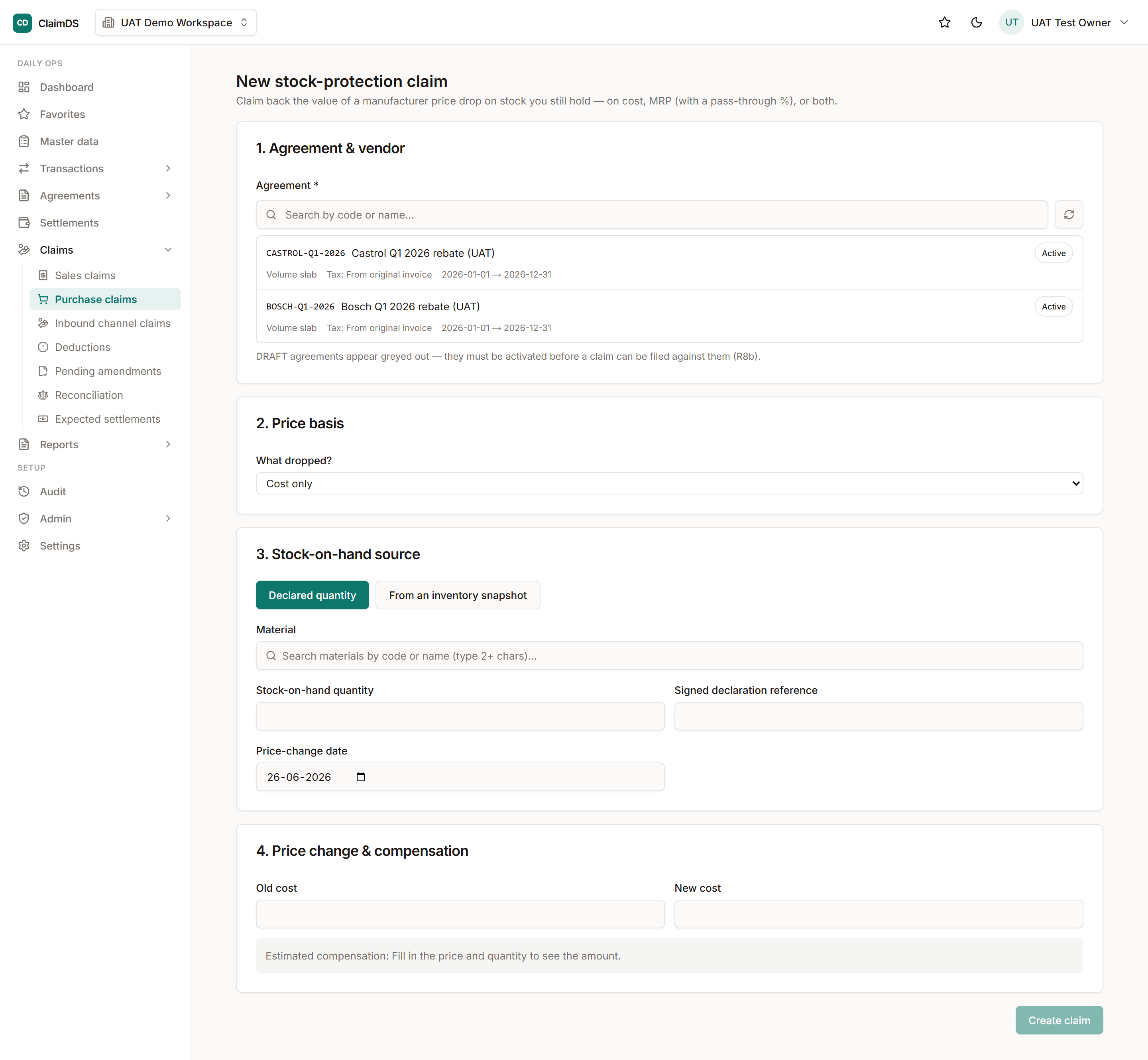
- Price masters with effective dates. Every price-drop compensation event starts from a price — the old dealer price, the new one, and the exact date the change takes effect. The software should hold price lists per SKU with effective-date history, so the per-unit difference is computed from the master, not retyped into a spreadsheet where one wrong date quietly changes every claim in the event.
- Stock-on-hand snapshots and declarations. The event needs each partner's stock position at the cutoff. Best case, that comes from imported stock data (DMS feeds, distributor uploads); at minimum, structured dealer declarations the system can later verify against recorded purchases and sales. Free-text emails are how disputes start.
- Per-dealer computation. One price circular can touch hundreds of partners. The system should compute every partner's entitlement from the same rule — units × per-unit difference, capped and windowed per program — rather than each area manager doing local arithmetic. It is the same discipline as distributor claim calculation: one rule, applied uniformly, per partner.
- Claim windows. A defined period in which claims can be lodged after the event, enforced by the system rather than by memory. Open-ended windows are open-ended liability — a claim that can arrive any time is a provision that can never be released.
- Evidence capture. Stock statements, countersigned declarations, photographs for damage cases, batch and expiry details for expiry claims — attached to the claim record itself, not scattered across inboxes.
- Settlement with an audit trail. A proper approval workflow, the correct credit-note type per claim, and a trail from price circular to claim to credit note that survives an audit two years later.
What does a compensation event look like with numbers?
Illustrative only. A brand cuts the dealer price of a SKU by ₹350 per unit effective the 1st of the month, and runs a compensation event with a 10-day claim window:
| Partner | Declared stock at cutoff | Verified stock | Compensation @ ₹350 |
|---|---|---|---|
| Dealer A | 240 units | 240 | ₹84,000 |
| Dealer B | 410 units | 380 | ₹1,33,000 |
| Dealer C | 95 units | 95 | ₹33,250 |
Dealer B declared 410 units but records supported only 380 — the claim settles on the verified number and the 30-unit gap is queried rather than paid. Across a national event, that verification step is the difference between a controlled program and an open cheque. The event anatomy from the partner's side — cutoffs, declarations, verification — is walked through in price drop protection.
How do you evaluate stock compensation software?
| Criterion | Why it matters | "Good" looks like |
|---|---|---|
| Stock position at a date | The whole claim rests on it | Sourced from imported stock data, locked at the cutoff |
| Price-master discipline | Wrong effective date = wrong event | Per-SKU price history with effective dates |
| Multi-tier coverage | Distributors and dealers need different evidence | Both tiers native, per-tier rules |
| Cross-claim dedupe | Same units, multiple programs | One ledger across compensation, buyback and protection |
| GST settlement | Wrong note type = tax exposure | Correct credit-note type selected by rule |
| Rebate interplay | Compensated stock inflates slabs | Automatic adjustment of the rebate-eligible base |
How does stock compensation settle under GST?
At pointer level: compensation settles by credit note, and the type — commercial, or Section 34 with tax adjustment — depends on whether the support was agreed before supply and is invoice-linked. The instrument mechanics are in financial vs tax credit notes, and the full price-protection treatment — including what the September 2025 GST rate change did to rate-difference support on dealer stock — is in price protection and rate-difference credit notes under GST. This page stays at the claim layer; that one owns the tax depth.
How does compensation interact with rebates?
Compensated stock usually should not keep counting toward rebate-qualifying purchases — otherwise the partner is effectively paid twice on the same units. A compensation claim can therefore shrink the eligible purchase base and drop a partner below a slab threshold, changing the rebate itself. The sequencing rules and worked slab mathematics live in the process companion, how stock compensation interacts with the rebate process; the contractual side of price-drop coverage — clauses, windows, caps — is in price protection in sales.
GST note: This article is general information, not tax or legal advice. Where settlement involves GST credit notes, positions — including CBIC Circular No. 251/08/2025-GST and the Finance Act 2026 amendments to Section 34 of the CGST Act, assented 30 March 2026 but not yet notified into force as of publication — must be re-verified at publish time with a qualified professional.
Frequently asked questions
What is stock compensation software?
In the channel context, stock compensation software automates claims that compensate channel partners for affected inventory — price drops, damage, expiry and slow-moving stock. It manages eligibility, valuation and GST credit-note settlement. It is not about employee equity or ESOPs.
Is channel stock compensation the same as employee stock compensation?
No. Employee stock compensation (ESOP/equity) is a HR and accounting concept for granting shares to employees. Channel stock compensation is compensating distribution partners for inventory that lost value. This guide covers channel inventory compensation only.
How are stock compensation claims settled?
After eligibility and valuation are confirmed, the compensation is settled to the channel partner, usually by GST credit note, with an audit trail. Software validates eligibility and computes the amount consistently.
What features should channel stock compensation software have?
The core set: price masters with effective dates, stock-on-hand snapshots or declarations at the event cutoff, per-dealer computation, configurable claim windows, evidence capture, duplicate-claim prevention across claim types, and GST credit-note settlement with a full audit trail.
How is a price-drop compensation event calculated?
Eligible stock-on-hand at the effective date multiplied by the per-unit price difference, computed per dealer and per SKU. The multiplication is trivial — establishing a defensible stock number at the cutoff is the hard part, which is why software anchors the event on stock data rather than negotiation.
Does stock compensation affect rebate calculations?
It can. Compensated stock often should not count toward rebate-qualifying purchases, so a compensation claim can shrink the eligible base and move a partner into a lower rebate slab. Running both in one ledger keeps the adjustment automatic instead of becoming a reconciliation dispute.
What role does DMS data play in stock compensation and price protection claims?
DMS data is the evidentiary backbone: because it records purchases, secondary sales and live inventory, it can produce a system-timestamped closing-stock snapshot at the exact cut-off — the single most credible input to a claim. Verification becomes largely automatic — declared quantities tested against opening plus purchases minus sales — and mismatches surface instantly. Mandating DMS-based declarations measurably cuts both cycle time and leakage, and platforms can ingest the feed directly.
What audit trail should a stock compensation program maintain?
A complete trail lets any credited rupee be traced from trigger to settlement: the compensation circular with rates and cut-off; every partner declaration with source and timestamp; validation workings showing the purchase-sales arithmetic; audit reports where partners were physically verified; approval records including overrides; the credit notes issued, classified by type; and reconciliation to the GST returns. Retain the pack per the record-retention rules.
See RebateLedger on your own claims data
A 30-minute walkthrough tailored to how your channel actually settles claims.