
Price Drop Protection: How Channel Price-Protection Claims Work
How price-drop protection claims work — identify eligible stock-on-hand at the price-change date, compute the protection and settle by credit note.
In short
Price-drop protection compensates a channel partner when a manufacturer cuts the price of a product the partner already holds, so stocking up is not punished by a later price cut. The claim equals the per-unit price drop times the eligible stock-on-hand at the price-change date, validated against records and settled by GST credit note.

Price-drop protection compensates a channel partner when a manufacturer cuts the price of a product the partner already holds — so stocking up is not punished by a later price cut. The claim equals the per-unit price drop times the eligible stock-on-hand at the price-change date, validated against records and settled by GST credit note.
What price-drop protection is
When prices fall in fast-moving categories — electronics, IT, mobile — partners holding old-cost stock are suddenly carrying over-valued inventory. Price-drop protection bridges that gap so the channel keeps stocking confidently. It is the claim-mechanics view of the price protection software hub; the contractual view is price protection in sales.
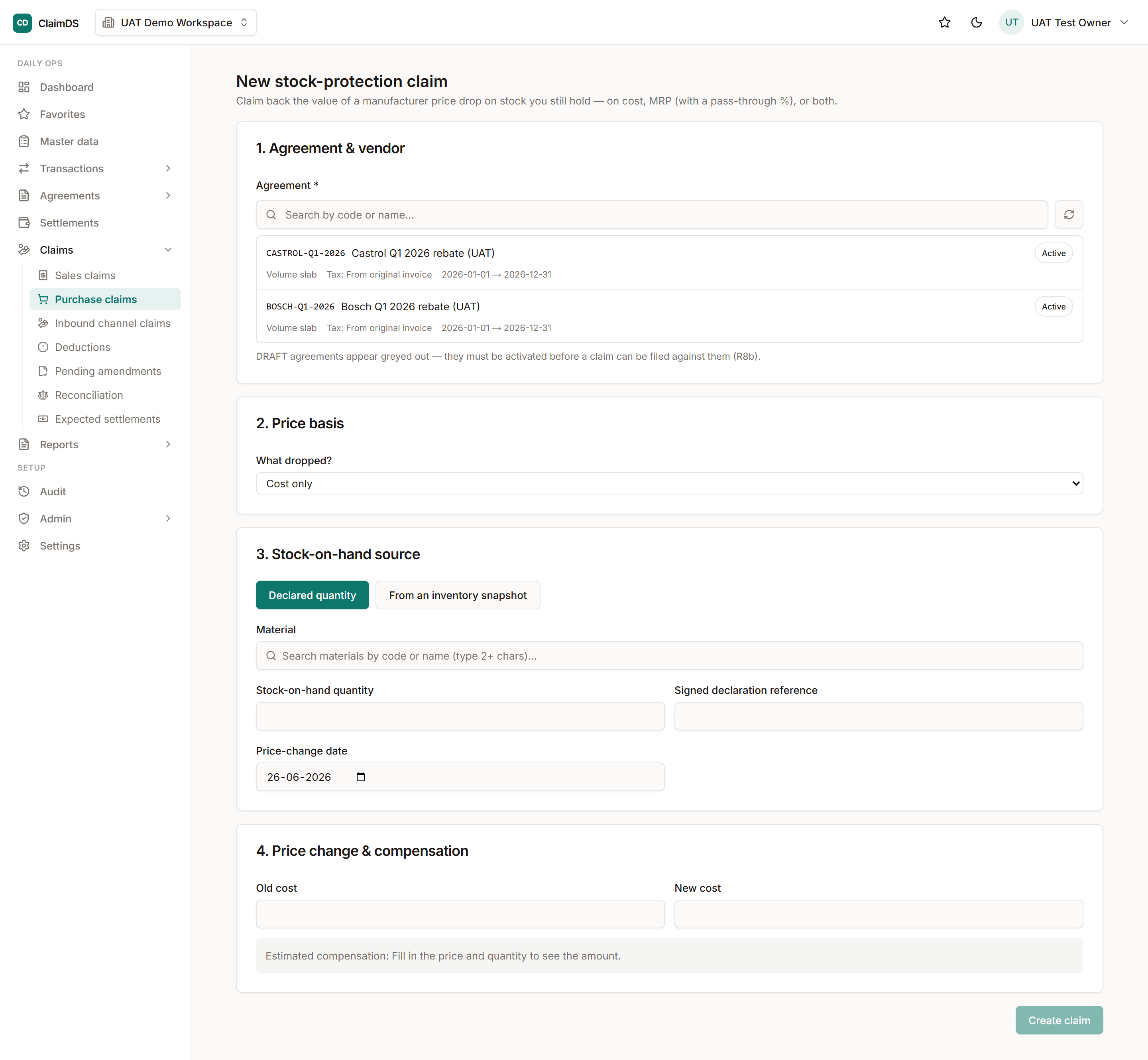
The five steps
- Declare the price change. The manufacturer sets the new price and an effective date — the anchor for everything that follows.
- Identify eligible stock-on-hand. Establish how many units of the affected SKU each partner held at the change date.
- Compute the protection. Per-unit drop × eligible stock-on-hand.
- Validate. Check the claimed stock against records and the eligibility window; reject what does not reconcile.
- Settle. Settle the amount, usually by GST credit note, with an audit trail.
The eligible-stock problem
Everything hinges on the stock number at the change date. Get it right and the claim is arithmetic; get it wrong and you over-pay or invite disputes. This is why price-drop protection is a data problem: it needs a defensible inventory-on-hand position per partner per SKU at a precise moment, ideally from imported stock data rather than self-declaration. For the dealer-facing version see dealer claims management.
A worked example
A model drops ₹800. A dealer held 150 units at the change date. Protection = 150 × ₹800 = ₹1,20,000, validated against the dealer's stock records and settled by credit note. Multiply across SKUs and dealers and only software keeps it accurate at speed.
What does a full price-protection event look like?
The five steps compress a timeline that, run properly, has a clear owner at every stage:
| Stage | What happens | Typical owner |
|---|---|---|
| Announcement | Price circular names the SKUs, new price, effective date and support terms | Sales / product |
| Cutoff | Stock positions frozen as at the effective date | System |
| Stock verification | Declarations collected and checked against recorded flows | Claims / finance |
| Computation | Per-partner, per-SKU entitlement at the published difference | System |
| Claim | Partner lodges (or confirms) the claim inside the window | Partner |
| Settlement | Approved amount settles by credit note; ledger updated | Finance |
The announcement decides everything downstream. A circular that names the exact SKUs, the per-unit support and the cutoff date produces clean claims; a vague "we will support the channel" note produces a negotiation. The generic pipeline this event rides on — submission, validation, approval, settlement — is the claim process explained; a price-protection event is that pipeline run for hundreds of partners against one date.
How does coverage differ for dealers vs distributors?
Distributors and dealers sit at different distances from the brand's data, and the program design should reflect it:
- Distributors buy directly from the brand, so invoice-level purchase history — the primary leg of primary, secondary and tertiary sales — and often DMS stock feeds already exist. Distributor claims can be computed largely from records; declarations confirm the number rather than establish it.
- Dealers buy through distributors, so the brand may see their stock only through declarations or secondary-sales feeds. Dealer coverage therefore leans on tighter eligibility windows, caps linked to recent purchases, and heavier verification — the brand is compensating stock it never directly invoiced.
Same formula, different evidence standards. Programs that apply distributor-grade trust to dealer-grade data are the ones that end up over-paying. In practice many brands run the two as one event with two rule sets — distributor claims computed from records and auto-confirmed, dealer claims declaration-driven with verification before settlement — so the event closes on one date even though the evidence paths differ.
How do you keep stock declarations honest?
Declared stock is a claim on money, so it needs the same controls as any other claim:
- Bounded plausibility. Opening stock + recorded purchases − recorded sales caps what a partner can plausibly hold; a declaration above that bound is queried automatically.
- Cutoff-dated, countersigned declarations. A declaration "as at the 31st", signed, beats a round number in an email — and becomes evidence if the claim is ever audited.
- Spot physical verification. Full stock audits for every event do not scale; targeted checks where claim value concentrates do.
- Caps tied to recent purchases. Limiting eligible stock to, say, the last 45 days of buying both bounds exposure and removes the incentive to inflate.
- Settle only the verified number. Pay what reconciles, query the gap — the same discipline stock compensation software applies across damage and expiry claims too.
What does the math look like across an event?
Illustrative only. A model drops ₹600, with eligibility capped at 45 days of purchases:
| Partner | Stock at cutoff | Cap (45 days' purchases) | Eligible | Protection @ ₹600 |
|---|---|---|---|---|
| Distributor P | 800 | 1,000 | 800 | ₹4,80,000 |
| Dealer Q | 260 | 200 | 200 | ₹1,20,000 |
| Dealer R | 140 | 180 | 140 | ₹84,000 |
Dealer Q holds more than the cap allows, so 60 units fall outside protection — the cap doing exactly its designed job of bounding exposure to recent, good-faith stocking. Event total: ₹6,84,000 across three partners; a real event multiplies this across dozens of SKUs and hundreds of partners, with the same per-partner computation discipline as calculating FMCG distributor claims.
Which GST route settles the claim?
Pointer level only: most price-protection settlements travel as commercial credit notes with no GST adjustment, because the exact drop and date were not fixed at the time of the original supply; a Section 34 tax credit note applies only where the strict pre-agreement conditions hold — see financial vs tax credit notes for the instrument and price protection and rate-difference credit notes under GST for the full treatment, including why a government GST-rate cut is a different event from a brand price cut.
Price protection is one deduction among several sitting between list price and what you actually realise. Seeing them in sequence rather than one at a time is the whole point of a gross-to-net price waterfall.
GST note: This article is general information, not tax or legal advice. Where settlement involves GST credit notes, positions — including CBIC Circular No. 251/08/2025-GST and the Finance Act 2026 amendments to Section 34 of the CGST Act, assented 30 March 2026 but not yet notified into force as of publication — must be re-verified at publish time with a qualified professional.
Frequently asked questions
What is price-drop protection?
Price-drop protection compensates a channel partner when a manufacturer reduces the price of a product the partner already holds, so the partner is not penalised for stocking inventory that has lost value. It is calculated on eligible stock-on-hand at the price-change date.
How is the protection amount calculated?
The protection amount is the per-unit price drop multiplied by the eligible stock-on-hand at the price-change date. The hard part is establishing accurate inventory-on-hand, which is why software is used.
How is a price-drop protection claim settled?
After the eligible stock is validated against records, the protection amount is settled to the partner, usually by GST credit note. The credit-note type depends on the GST treatment of the adjustment.
Who is covered by price-drop protection — dealers, distributors, or both?
Program design decides. Distributor coverage is usually computed from primary purchase and stock data the brand can see directly; dealer coverage depends on secondary data or declarations, so dealer programs lean harder on verification, caps and tighter windows. Many brands protect both tiers with different evidence standards.
How do you stop partners from inflating stock declarations?
Verification against recorded flows: opening stock plus purchases minus recorded sales bounds what a partner can plausibly hold. Add cutoff-dated countersigned declarations, spot physical checks where value concentrates, claim caps tied to recent purchases, and settlement only on the verified number.
Which GST credit note settles a price-drop protection claim?
Usually a commercial credit note with no GST adjustment. A Section 34 credit note with tax adjustment applies only where the protection was agreed before or at the time of supply and is linked to specific invoices. The full GST treatment, including the September 2025 rate change, is a separate topic covered in our GST guide.
What happens if a dealer has already discounted stock before a price protection event?
Protection generally compensates the difference between old and new billing prices on unsold stock — stock already sold at a discount before the effective date earns no claim, because protection covers inventory on hand, not past sales. Hence a familiar dynamic: dealers slow sales ahead of expected cuts to preserve claimable stock, and brands keep revision dates confidential. Some agreements disallow claims on stock purchased abnormally close to a revision.
What are the most common mistakes in filing price protection claims?
The common mistakes: declaring stock after the cut-off so quantities no longer match the effective-date position; including ineligible inventory — grey-market, over-age or demo units; computing the difference on MRP instead of billing price; missing the submission window; omitting purchase invoice references; and double-claiming units already covered by a liquidation scheme. On the manufacturer side, settling without reconciling against sell-in and DMS data invites inflated declarations.
Is price drop compensation on dealer stock required by law in India?
No — no Indian statute obliges a company to compensate dealers when it cuts prices; the entitlement is purely contractual. Even the September 2025 Consumer Affairs advisory that permitted revised-MRP stickering on unsold stock after the GST rate changes governs only the label — it says nothing about who bears the price difference. If your agreement is silent on price protection, the dealer bears the loss by default, which is why the clause matters more than the practice.
See RebateLedger on your own claims data
A 30-minute walkthrough tailored to how your channel actually settles claims.