
Price Protection in Sales: Clauses, Claims & Settlement
Price protection in sales and distribution agreements — typical clauses, triggers, eligibility windows, caps, claim documentation and settlement.
In short
Price protection in sales is a contractual commitment in a distribution agreement to compensate a channel partner if the supplier later cuts prices on products the partner already holds. The clause defines the trigger, the eligibility window, the basis (eligible stock-on-hand), any cap, the documentation, and how the claim settles — usually a credit note.
Price protection in sales is a contractual commitment in a sales or distribution agreement to compensate a channel partner if the supplier later cuts prices on products the partner already holds. The clause defines the trigger, the eligibility window, the basis (eligible stock-on-hand), any cap, the documentation, and how the claim settles — usually a credit note.
Anatomy of a price-protection clause
Price protection lives first in the contract and only then in a claim. A well-drafted clause removes ambiguity before any price ever moves, which is what keeps later settlement clean. The downstream calculation is in price drop protection and the system view in price protection software.
| Element | What it defines |
|---|---|
| Trigger | A supplier price reduction on covered SKUs |
| Eligibility window | The period of stock-on-hand that qualifies |
| Basis | Eligible stock-on-hand at the change date |
| Cap | Any ceiling on compensation |
| Documentation | Stock proof and claim format |
| Settlement | Method and timeline (usually credit note) |
Triggers and windows
The trigger is normally a list-price reduction on covered products; the window defines which inventory qualifies — often stock received within a set period before the change, still on hand at the change date. Tight windows keep the claim verifiable; loose ones invite disputes over what "in stock" meant and when.
Caps and exposure
Caps protect the supplier; windows protect both sides. Together they convert an open-ended liability into a bounded, predictable one. From a finance perspective, the clause is a risk-management tool: it lets the supplier cut prices to stay competitive without an uncapped compensation bill. The leadership view of managing this exposure is in the CFO revenue-leakage playbook.
From clause to claim
When a price drops, the clause's terms drive the claim: eligible stock is identified, the protection computed, validated against records, and settled. Because the terms were fixed in advance, the claim is a calculation rather than a negotiation — the contractual counterpart to price-protection software doing the math. In a claims system, that calculation is visible end to end — each claim carries its stock evidence and price basis through validation to settlement.
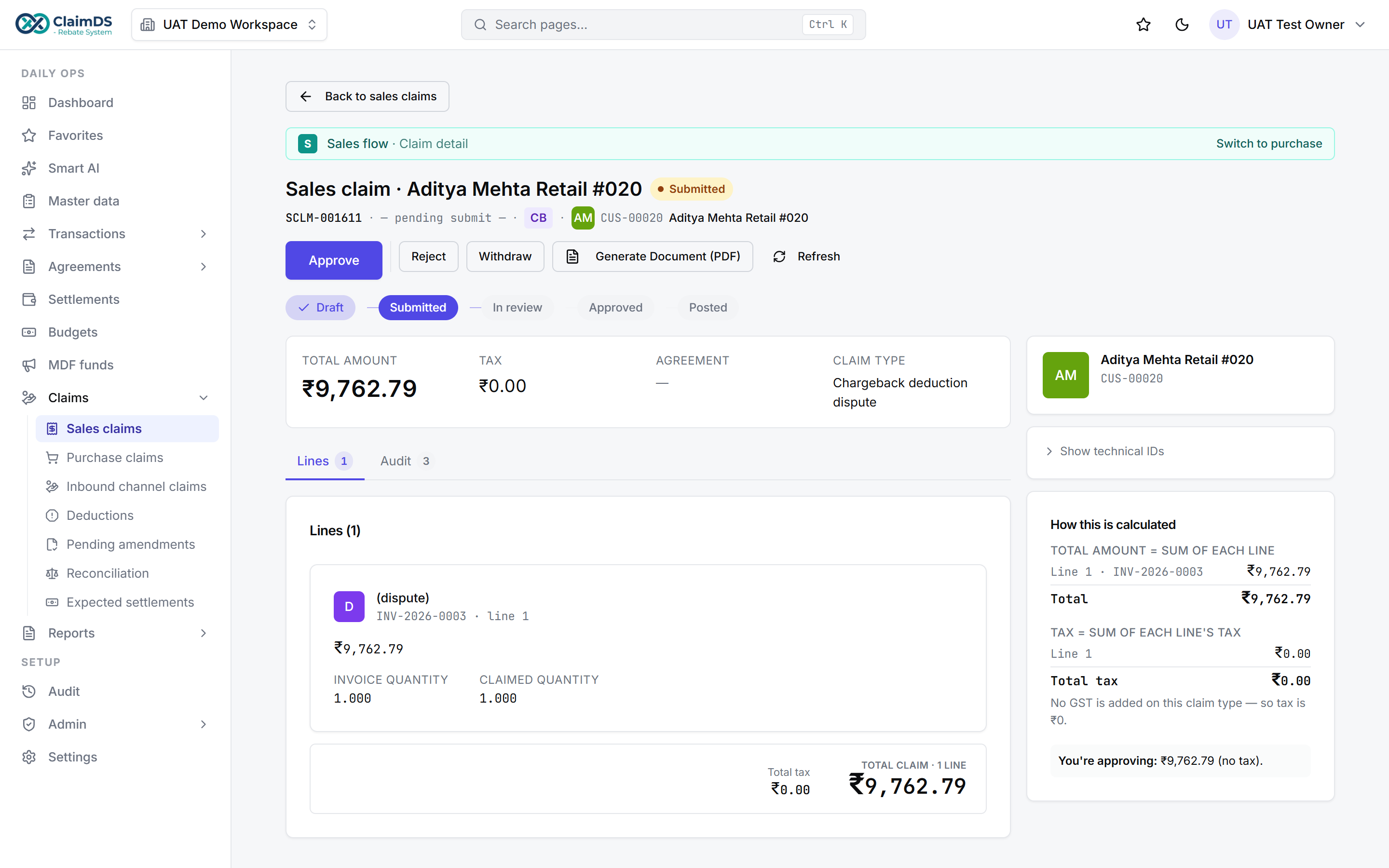
The settlement instrument is a credit note, and which type — commercial, or Section 34 with tax adjustment — depends on whether the clause was agreed before supply and is invoice-linked; the full GST treatment is in price protection and rate-difference credit notes under GST, kept at pointer level here.
Why does price protection preserve sell-in?
This is the clause's real job from a sales lens. Around every planned transition — a new model, a generational refresh, a known price move — partners face a simple bet: stock now and risk holding over-valued inventory, or wait and stock after the dust settles. Without protection, rational partners wait, and sell-in stalls exactly when the brand needs the channel loaded for the transition.
Illustrative only: a dealer who normally carries three weeks of a ₹20,000 model thins down to one week on rumour of a price cut. Across 200 dealers each deferring just 10 units, that is 200 × 10 × ₹20,000 = ₹4,00,00,000 of sell-in parked until the uncertainty resolves — a stalled quarter-end, empty shelves at launch, and a competitor happy to fill the gap. A credible protection clause is almost always cheaper than the stall it prevents, because the payout applies only to the bounded stock actually held at the cutoff, while the stall applies to everything the channel didn't order.
The distinction matters most for schemes that pay on purchases rather than on offtake — the sell-in vs sell-through split — because a purchase-driven scheme plus stocking fear is how channels whipsaw between over-stocking and drought.
What are the economics of channel confidence?
Price protection is best read as insurance the supplier sells to its own channel at a price of roughly zero in normal times. Partners keep ordering through the primary leg at normal depth; the supplier keeps production smooth and launch shelves full; the cost only crystallises when a price actually moves, and even then only on eligible stock-on-hand. Compare that with the alternatives a nervous channel forces — deeper launch discounts, emergency trade schemes to restart ordering, or margin support negotiated dealer by dealer after the fact — and the clause is usually the cheapest instrument on the list. It also compounds: partners who have seen one protection event settle cleanly stock confidently through the next transition, the same trust dividend that channel loyalty programs spend money to build.
How do you design the protection window?
| Window design | What it protects | Exposure profile |
|---|---|---|
| All stock on hand at cutoff | Everything, including old stock | Highest — rewards over-stocking |
| Purchases in the last 30–60 days, still on hand | Recent, good-faith stocking | Bounded — the most common design |
| Named SKUs / transition models only | The specific transition | Narrowest — targeted protection |
Most programs land on the middle row: a purchase-linked window rewards the behaviour the clause exists to encourage (recent ordering) without underwriting stock that should have sold long ago. Tier matters too — distributors and dealers hold different depths of stock and produce different-quality evidence, so windows and caps are often set per tier.
How should a price change be communicated?
The clause sets the terms; the communication cadence determines whether the event runs clean:
- Before announcement — discipline. Leaked price moves trigger exactly the de-stocking the clause exists to prevent, plus opportunistic last-minute buying.
- On the effective date — the circular. SKUs, new price, per-unit support, cutoff date, evidence required, claim window. Everything a partner needs to compute their own claim.
- During the window — reminders. Chase declarations before the window closes, not after.
- At settlement — confirmation. A settled, documented claim is the message that makes the next transition orderable.
How do you control abuse?
- Exclude post-announcement purchases. Stock bought after the circular was never at risk and never qualifies.
- Cap by recent purchases. Eligibility limited to, say, 45 days of buying removes the incentive to inflate declarations.
- Verify against recorded flows. Opening stock + purchases − recorded sales bounds any plausible declaration. Building that reconstruction in Excel — and reconciling it against what the partner declared — is a model in its own right.
- Enforce the window in the system. Late claims fail by rule, not by argument.
- Settle only validated numbers. Pay what reconciles, query the gap — the standard claim-process discipline applied to a price event.
A price-protection clause is one of several things standing between the price on the contract and the revenue you eventually keep. Laying all of them out in order — discounts, rebates, protection, deductions — is what a price waterfall is for.
Rate difference and price protection in practice
Price protection and rate difference are the same recovery under two names. These cover the settlement side:
- Price drop protection — how a channel price-protection claim is calculated and capped.
- Rate-difference and damage claims in paints — the two claim types that dominate that channel.
- Price protection and rate-difference credit notes under GST — the tax treatment of the settlement document.
- Rate difference credit notes under GST — a working template.
- Price protection in consumer electronics — the category where price drops are routine rather than exceptional.
GST note: This article is general information, not tax or legal advice. Where settlement involves GST credit notes, positions — including CBIC Circular No. 251/08/2025-GST and the Finance Act 2026 amendments to Section 34 of the CGST Act, assented 30 March 2026 but not yet notified into force as of publication — must be re-verified at publish time with a qualified professional.
Frequently asked questions
What is price protection in sales?
Price protection in sales is a contractual commitment in a sales or distribution agreement to compensate a channel partner if the supplier reduces prices on products the partner already holds. It defines the trigger, eligibility window, cap and claim process.
What does a price-protection clause typically contain?
A typical clause defines the trigger (a price reduction), the eligibility window after the change, the basis (eligible stock-on-hand), any cap on the compensation, the documentation required, and the settlement method, usually a credit note.
Why do price-protection caps and windows matter?
Caps and windows limit the supplier's exposure and define which stock qualifies. Without clear windows and caps, price-protection liability becomes open-ended and disputes multiply, which is why these terms are central to the clause.
Why does price protection matter to a sales team?
Because fear of a price cut freezes ordering. When partners suspect a price move, they run stock down and sell-in stalls exactly when the brand needs the channel loaded. A credible protection clause removes that fear, so ordering continues through price and model transitions.
How long should a price-protection window be?
Long enough to cover the stock a partner reasonably holds, short enough to bound exposure. Common designs tie the window to recent purchases — for example, stock received in the 30 to 60 days before the change and still on hand — rather than protecting unlimited inventory.
How do suppliers prevent abuse of price protection?
With controls in the clause and the process: caps tied to recent purchases, verification of declared stock against recorded flows, a defined claim window, exclusion of stock bought after the announcement, and settlement only on validated numbers.
Can distributors claim price protection on old or slow-moving stock?
Usually only within a defined stock-age limit — most programmes restrict claims to inventory billed within the last 30, 60 or 90 days, because protection covers normal stocking cycles, not accumulated slow movers. Older stock is the distributor's buying-decision risk, addressed instead through aged-stock liquidation support or returns. Age is verified from invoice dates against declared quantities. Monitor stock ageing continuously — past the window, a protected asset becomes unprotected.
Which clauses decide your unsold-stock exposure in a distributorship agreement?
Five: buyback or repurchase on termination; price protection on revisions; expiry and damage return rights; stock-rotation rights; and the claim windows attached to each. Most Indian SMB distributor agreements are silent on at least three of the five — and silence means the distributor bears the loss. Reading your own agreement against those five clauses is the fastest exposure audit available.
See RebateLedger on your own claims data
A 30-minute walkthrough tailored to how your channel actually settles claims.