
Sell-In Rebate Strategy: How to Incentivize Channel Partners Without Channel Stuffing
How sell-in rebates motivate channel partners — and how to design one without channel stuffing, using sell-through conditions, caps and growth terms.
In short
A sell-in rebate rewards partners for stocking and committing working capital — useful for launches and pre-season loading. To avoid channel stuffing, pair it with sell-through conditions, growth-over-baseline structures, caps, healthy-inventory clauses, and secondary-data monitoring so over-ordering that never sells through does not earn full rebate.

A good sell-in rebate strategy rewards channel partners for stocking and committing working capital — without tipping into channel stuffing. The way to do that is design: pair sell-in with sell-through conditions, use growth-over-baseline structures, cap the reward, add healthy-inventory clauses, and monitor secondary data so over-ordering that never sells through doesn't earn full rebate.
How sell-in rebates motivate partners
Sell-in rebates reward the partner for buying: they relieve working capital, reward carrying depth, and pull new SKUs into the channel. That makes them powerful at launch or ahead of a season. But the incentive rewards buying, not selling — which is the whole design challenge. The distinction is set out in sell-in vs. sell-through rebates, under the rebate management software pillar.
The failure modes
Channel stuffing, quarter-end loading, and the returns boomerang. Push a pure sell-in scheme and partners over-order to hit a tier; the loaded stock then returns next period as returns, expiry or price-protection claims — so the "growth" was borrowed from the future and paid for twice. This is a classic source of revenue leakage in rebate programs.
The anatomy, step by step: the scheme window closes in ten days and the partner is 400 cases short of the slab; the salesperson needs the number; the order goes in. The primaries look great. Then the loaded stock ages in the godown, next month's order shrinks, and by the following quarter the surplus is coming back as expiry, damage or stock compensation claims — each of which the brand funds after having already paid rebate on the original purchase. The scheme bought a spike and paid for it twice — a predictable response to a reward that stops at the purchase order.
How to design a balanced sell-in scheme
- Anchor on growth, not raw volume. Reward beating a baseline, so the scheme funds incremental movement rather than one-time loading.
- Add a sell-through condition. Release the full rebate only when a share of the sell-in actually sells through — the mechanics are in volume rebates.
- Cap the reward and the eligible stock. Caps bound the exposure; eligible-stock limits stop warehouse loading.
- Include a healthy-inventory clause. Tie eligibility to inventory staying within agreed norms, not ballooning.
- Monitor secondary data. Watch sell-through against sell-in so over-ordering is visible before it's rebated — the discipline behind distributor claims management.
- Settle cleanly, with an audit trail. Validate each claim against the agreement and settle by GST credit note.
How do growth-over-baseline structures work?
A raw-volume sell-in rebate pays on every case — including the volume the partner would have bought with no scheme at all. A growth structure pays only above a baseline, so the budget funds incremental behaviour.
Illustrative only. A distributor's average quarterly purchases are ₹40 lakh. Compare two designs:
| Raw volume | Growth over baseline | |
|---|---|---|
| Structure | 1% on all purchases | 4% on purchases above ₹40 lakh |
| Quarter at ₹40 lakh (no growth) | ₹40,000 paid | ₹0 — nothing incremental to reward |
| Quarter at ₹50 lakh | ₹50,000 | 4% × ₹10 lakh = ₹40,000 |
| What it rewards | Buying at all | Buying more than history |
The raw-volume design spends ₹40,000 a quarter rewarding the status quo; the growth design pays only when behaviour changes. Baselines need care: anchor them on the partner's own history (same period last year, or a trailing average), reset them periodically, and document how new outlets or territory changes adjust them — otherwise the baseline itself becomes the dispute.
What should a healthy-inventory clause actually say?
A healthy-inventory clause makes rebate eligibility conditional on the partner's stock staying inside agreed norms. To be enforceable rather than decorative it needs three parts:
- A measurable norm — typically days of stock cover (say, 21–30 days for a fast-moving range), not a vague "reasonable inventory".
- An evidence mechanism — periodic stock statements, DMS stock positions, or the closing-stock line of the standard claim submission, so the norm can actually be tested.
- A defined consequence — rebate held back, stepped down, or released only once stock returns to norm.
A quiet benefit: the clause forces stock visibility into the scheme's data flow.
How do you monitor secondary data during the scheme?
A sell-in scheme without secondary monitoring is flying blind — you see what the partner bought, never whether it moved. The loop is simple: track the sell-through ratio (reported secondary sales ÷ scheme-window sell-in) per partner, and read the primary-to-secondary gap as stock building in trade. Where each tier's data lives — and how distributor-reported secondary data is verified with the stock equation — is covered in primary, secondary and tertiary sales; the settlement mechanics of schemes that pay on that tier are in secondary scheme settlement.
Two thresholds do most of the work: flag any partner whose sell-through ratio drops below an agreed floor mid-window, and any whose stock cover exceeds the healthy-inventory norm. Both are visible before quarter close — monitoring after settlement is an audit; during the window it is a control.
How do you control quarter-end loading?
Quarter-end loading is the specific habit of concentrating sell-in into the final days of the window. Four design controls:
- Phase the window. Measure monthly with a quarterly true-up, so a dead first month cannot be rescued by a loaded third.
- Cap late-window eligibility. Limit the share of scheme volume that can qualify in the final weeks.
- Watch the skew. The final month's share of quarterly billing is the single best loading indicator.
- Tie the last tranche to movement. Release the final portion of the rebate only after the sell-through condition is evidenced.
What does a balanced sell-in scheme look like?
Illustrative only. Pulling the pieces together for a quarterly distributor scheme:
- Base reward: 2% on purchases above the partner's same-quarter-last-year baseline.
- Split release: 60% of earned rebate on billing; 40% released when reported sell-through reaches 75% of scheme-window purchases.
- Healthy-inventory clause: stock cover stays under 30 days at each month-end statement; a breach freezes further accrual until cured.
- Cap: total rebate capped at 3% of baseline value, bounding the exposure.
- Loading control: no more than 40% of qualifying volume may bill in the final month.
- Settlement: claim submitted with stock statement attached, validated against the agreement, approved through a defined path (claim and rebate approval workflows), settled by GST credit note.
A distributor with a ₹40 lakh baseline who bills ₹50 lakh evenly, sells through 80% and holds 24 days of stock earns 2% × ₹10 lakh = ₹20,000 — all of it released. A distributor who hits the same ₹50 lakh by loading month three and selling through only 55% earns the same headline accrual but has ₹8,000 held back and accrual frozen. The scheme itself enforces the behaviour.
What belongs on the scheme-design checklist?
| Check | Question to answer before launch |
|---|---|
| Basis | Sell-in, sell-through or hybrid — and is it written down? |
| Baseline | What history sets it, and how does it reset? |
| Caps | What bounds the total exposure per partner? |
| Inventory clause | Norm, evidence, consequence — all three defined? |
| Data | What secondary reporting is required, in what format, by when? |
| Loading control | Phasing or late-window caps in place? |
| Returns interplay | Are returns, expiry and buyback tracked against the same partner? |
| Settlement | Claim format, validation rules, approval path, credit-note type? |
The scheme taxonomy this slots into is in types of trade schemes in India; keeping the accruals live across all of it is the rebate tracking discipline.
Watch the returns interplay
Loaded stock that comes back is a buyback or price-protection cost — so a sell-in scheme designed in isolation from returns understates its true cost. Keeping schemes and returns in one ledger is how you see the real number.
Where RebateLedger fits
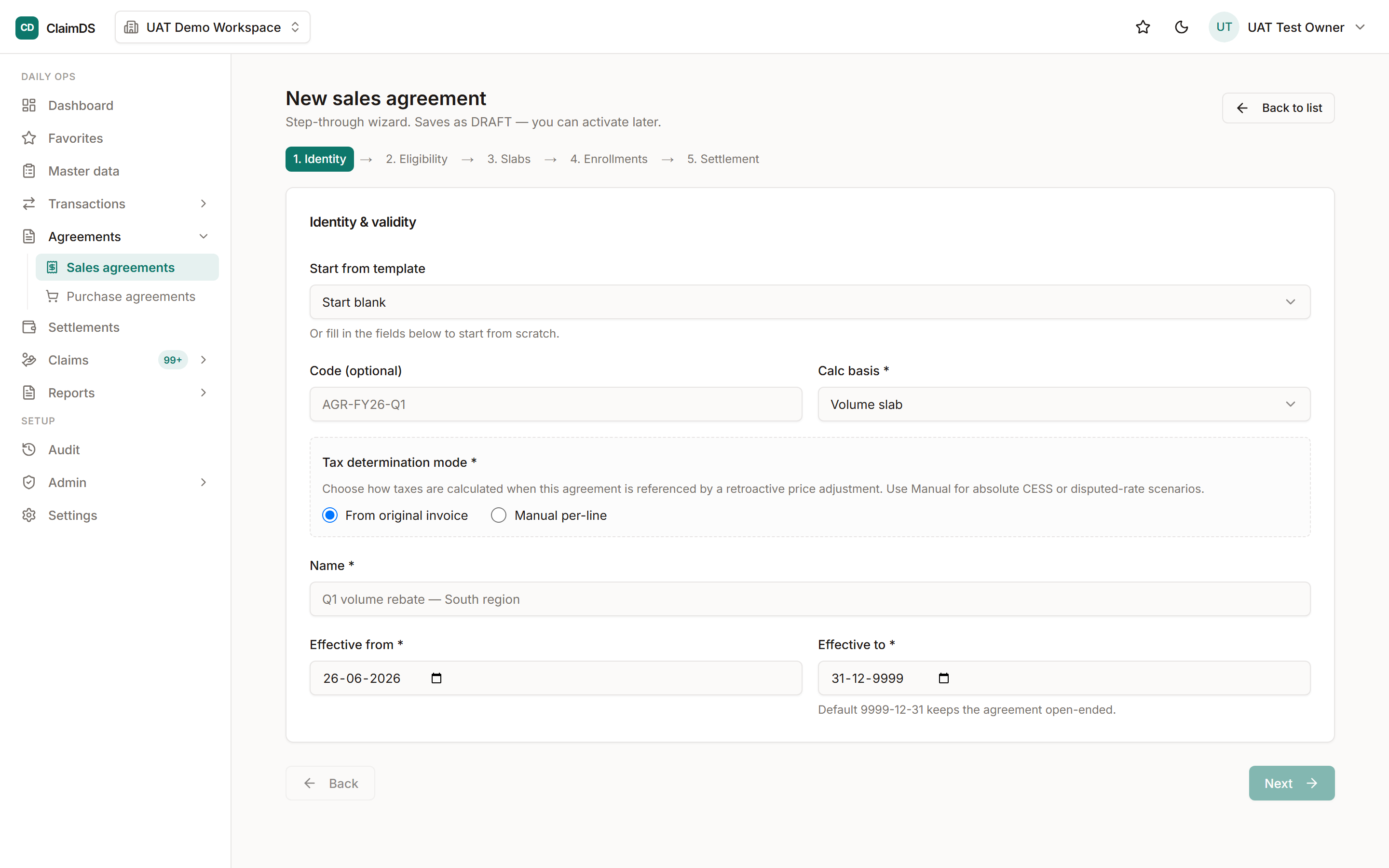
RebateLedger lets you design sell-in schemes with sell-through conditions, caps and baselines, and keeps schemes and returns in one claim ledger so the true cost is visible — India-first, at a mid-market price (a RebateLedger-supplied ~₹3–5 lakh/yr figure, positioning not a benchmark).
GST note: Sell-in rebates settle via credit notes with ITC consequences — see financial vs. tax credit notes. General information, not tax advice.
Frequently asked questions
How do sell-in rebates incentivize channel partners?
Sell-in rebates reward partners for buying from the brand — relieving working capital, rewarding stocking depth, and encouraging new-SKU adoption. They are effective for launches and pre-season loading, but because they reward buying rather than selling, they must be designed carefully to avoid channel stuffing.
How do you design a sell-in rebate without channel stuffing?
Pair the sell-in reward with sell-through conditions or healthy-inventory clauses, use growth-over-baseline structures rather than raw volume, cap the reward, and monitor secondary sales so over-ordering that never sells through is visible and doesn't earn full rebate.
What are the failure modes of a sell-in rebate program?
Channel stuffing (over-ordering to hit a tier), quarter-end loading, and the returns boomerang — where loaded stock comes back as returns, expiry or price-protection claims next period. Each is a design failure, avoidable by tying the incentive to real movement, not just purchases.
What is a growth-over-baseline sell-in rebate?
A structure that pays only on purchases above an agreed baseline — usually the partner's own history, such as the same quarter last year or a trailing average. Because the rebate funds only incremental volume, it cannot be earned by simply re-buying business the partner would have placed anyway.
What should a healthy-inventory clause include?
Three things: a measurable norm (typically days of stock cover), the evidence that tests it (periodic stock statements or DMS positions), and a defined consequence for breaching it (rebate held back or stepped down). Without all three, the clause is a sentiment, not a control.
How do you control quarter-end loading in a sell-in scheme?
Phase the scheme window so a loaded final month cannot rescue a dead quarter, cap the volume eligible in the last weeks, watch the final month's share of period billing, and read primary spikes against secondary movement. Loading shows up as a widening primary-to-secondary gap before it shows up as returns.
What is channel inventory days monitoring and why does it matter?
Channel inventory days — closing stock divided by average daily secondary sales — converts the abstract risk of loading into a trackable number per partner. Rising days alongside strong primary billing is the signature of stuffing; stable days with growing billing indicates genuine demand. Set category-appropriate bands, review monthly, gate sell-in rebate eligibility when ceilings breach, and investigate sharp drops too. The metric needs trustworthy stock and secondary data.
How does expiry risk in pharma relate to sell-in rebate design?
In pharma, loaded stock that fails to sell does not just sit — it expires and comes back, with return routes and input-tax-credit reversal on destruction adding real cost. Aggressive loading of date-sensitive SKUs is directly self-defeating. Keep sell-in incentives modest on short-dated lines, tie payouts to stock-freshness conditions, monitor channel inventory days against shelf life, and prefer sell-through triggers for slow molecules. Expiry-return analytics reveals where past schemes overloaded.
See RebateLedger on your own claims data
A 30-minute walkthrough tailored to how your channel actually settles claims.