
Benefits of Automating Rebate Calculations for Channel Partners
The benefits of automating rebate calculations — accuracy, speed, leakage control and audit for the brand; transparent statements for the partner.
In short
Automating rebate calculations gives the brand accuracy, speed, leakage control and a defensible audit trail, and gives the channel partner transparent statements, faster settlement and fewer disputes. The same automation that protects margin also strengthens the partnership.
Automating rebate calculations benefits both sides of the relationship: the brand gets accuracy, speed, leakage control and a defensible audit trail; the channel partner gets transparent statements, faster settlement, fewer disputes and more trust. The same automation that protects the brand's margin also strengthens the partnership.
Benefits for the brand
- Accuracy — scheme logic encoded once, applied the same way every cycle (no slab-boundary drift).
- Speed — claims validated and settled in a fraction of the manual time.
- Leakage control — overpayments, duplicates and unclaimed accruals caught before settlement (revenue leakage in rebate programs).
- Accrual visibility — finance sees the live liability, not a quarter-end guess (rebate tracking software).
- Audit trail — every number is defensible at assessment or dispute.
Benefits for the channel partner
Automation is not just a brand-side win. The partner gets a clear statement of what they earned and why, settled faster, with fewer disputes — because both sides work from the same agreement and data. That transparency is what converts a quarterly argument into trust, and it is why the operational view in distributor claims management matters to partners as much as to finance.
Before vs after
| Manual | Automated | |
|---|---|---|
| Calculation | Re-keyed each cycle, error-prone | Rule applied consistently |
| Accrual | Quarter-end estimate | Live |
| Settlement | Slow, dispute-heavy | Fast, provable |
| Statements | Contested | Transparent |
| Audit | Reconstructed | Always available |
Any quantified benefit should be your own measured result — treat the contrasts above as illustrative, not surveyed statistics. The problem this replaces is detailed in the key challenges in manual rebate processing; the ROI method is in claims management ROI benchmark.
The rest of this article opens up each benefit as a mechanism — what automation actually changes in the work — because "more accurate and faster" is an adjective until you can see where the error or the delay used to live.
How does automation eliminate calculation errors?
Manual rebate errors are not random typos; they cluster at the points where the scheme rule is ambiguous and a human has to interpret it. Two recur everywhere:
- Slab-boundary math. A scheme pays 2% up to ₹50 lakh and 3% above. A partner bills ₹62 lakh. Is the payout 3% of ₹62 lakh (₹1.86 lakh) or 2% of ₹50 lakh plus 3% of ₹12 lakh (₹1.36 lakh)? The gap is ₹50,000 per partner per cycle, and in a manual process the answer depends on which analyst built the sheet. The tier mechanics are unpacked in volume rebates.
- Proration math. A dealer joins a quarterly scheme five weeks into a thirteen-week window. Is the target prorated by weeks, by working days, or not at all? Do returns net against eligible volume before or after the slab test? Each interpretation produces a defensible-looking number; only one matches the circular.
Before: each analyst answers these questions independently, per file, per cycle — and the full claim arithmetic inherits the drift. After: the rule is encoded once, ambiguities resolved once at scheme setup, and every partner's payout is computed from the same encoding. The error class does not shrink — it disappears, because the interpretation step no longer exists at calculation time.
How does automation compress the accrual-to-claim cycle?
The manual cycle is slow because it is sequential and each step waits for the previous one: quarter closes → sales extract pulled → analyst computes entitlements → partner independently computes their version and submits a claim → the two versions get argued into agreement → approval crawls through an inbox → settlement. Illustratively, a ₹9 lakh quarterly claim can spend a week in extract-and-compute, three weeks in claim-versus-entitlement argument, and two more in approvals — most of the elapsed time being waiting, not work.
Automation collapses the sequence: the accrual updates as sales post, the entitlement exists before the quarter even closes, the claim is generated from (or validated against) that same number, and approval routing moves it by rule instead of by follow-up email. What remains for humans is the exception queue — the handful of claims that genuinely need judgment.
How does automation keep hundreds of partners consistent?
At ten partners, one careful analyst can hold the scheme rules in their head. At three hundred partners across two or three tiers — the normal shape of an Indian primary/secondary channel — consistency becomes structurally impossible to maintain by hand: different analysts own different regions, treat returns differently, round differently, and apply the mid-window joiner rule differently. Every inconsistency a partner discovers ("the distributor in the next district got 3% on the full value, I got the incremental rate") converts directly into a dispute and a trust deficit.
Before: consistency depends on training, review and luck, degrading with every new analyst and every scheme variant. After: one rule engine applies one encoding to all three hundred partners, and consistency is a property of the system rather than a hope about people. Sequencing that transition well is its own discipline — see rebate automation implementation best practices.
What does an automated audit trail change?
Before: at audit or dispute time, someone reconstructs how a two-year-old payout was derived from spreadsheet versions, email threads and the memory of an analyst who may have left. Each reconstruction takes days and still produces "our best understanding" rather than evidence. After: every computed number carries its derivation — the scheme version applied, the sales data used, the slab that fired, who approved it and when. The claim file exists the moment settlement completes, which is precisely the property that makes rebate numbers safe to carry into financial reporting. For sell-through schemes, where the data comes from a tier away, that trail is the difference between a settlement and an argument — the operational detail is in secondary scheme settlement.
What capacity does automation free?
The least-discussed benefit is what the team stops doing. A manual rebate operation spends its cycle re-keying data, rebuilding formulas, chasing evidence and refereeing claim disputes — production work that consumes the people who best understand the schemes. Automated, the same team's week shifts to the work that compounds: analysing which schemes pay back, redesigning slabs nobody reaches, nudging partners sitting just below a tier, and clearing unclaimed accruals before they age into write-offs. Illustratively: a three-person team that spent four person-weeks per quarter producing settlements now spends four person-days reviewing exceptions — the reclaimed time is where scheme ROI actually improves, because analysis finally has owners.
Where RebateLedger fits
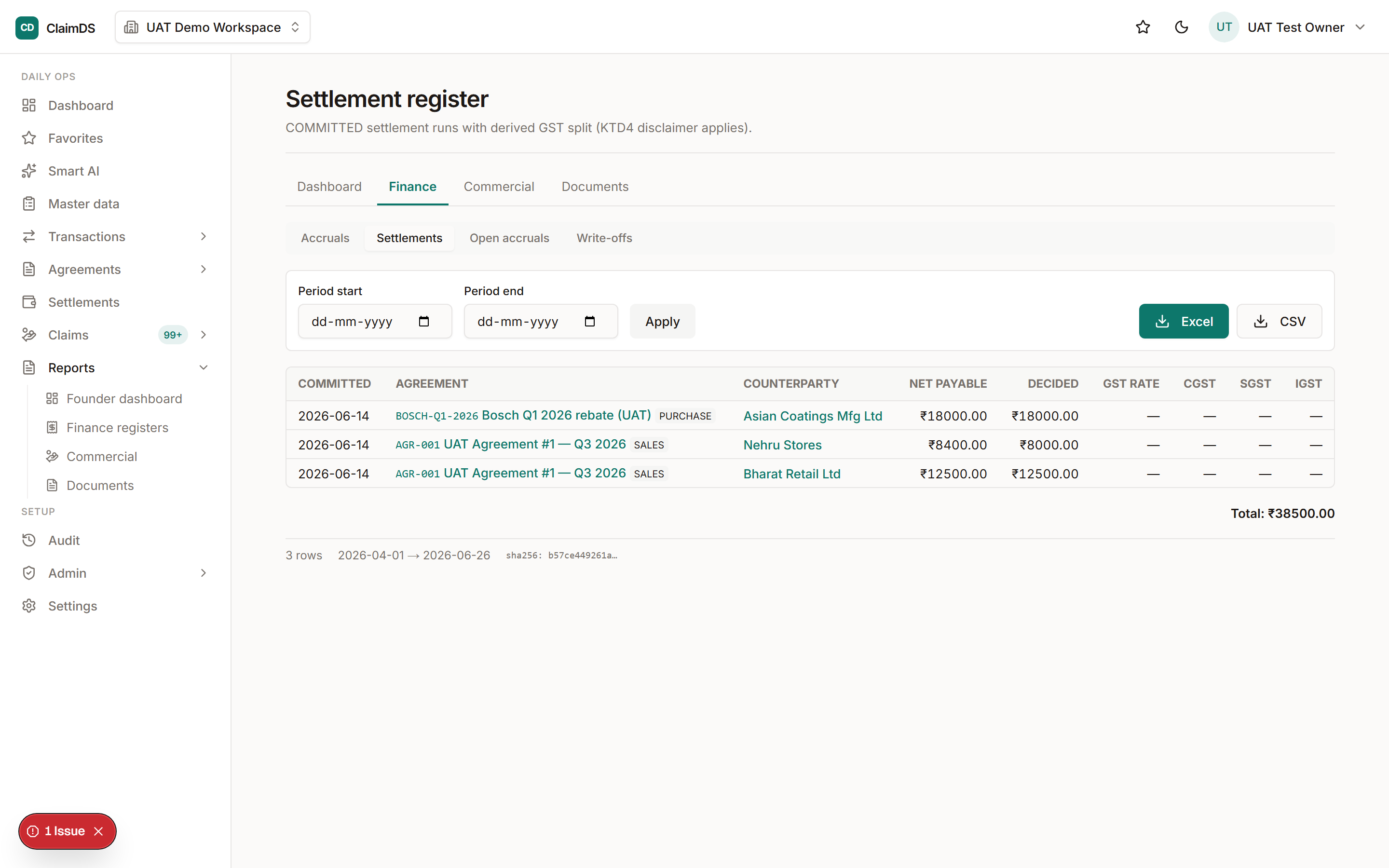
RebateLedger computes rebate math by rule, accrues live, settles by GST-correct credit note and keeps a full audit trail — giving both the brand and its partners a number they can trust, India-first at a mid-market price (a RebateLedger-supplied ~₹3–5 lakh/yr figure, positioning not a benchmark). It sits under the rebate management software pillar.
Frequently asked questions
What are the benefits of automating rebate calculations?
For the brand — accuracy, speed, leakage control, live accrual visibility and a defensible audit trail. For the channel partner — transparent statements, faster settlement, fewer disputes and more trust. Automation replaces a slow, error-prone, dispute-heavy process with one both sides can rely on.
How does rebate automation help channel partners specifically?
Partners get a clear statement of what they earned and why, settled faster and with fewer disputes, because the numbers are computed from the same agreement and data both sides can see. Trust rises when a partner no longer has to argue their own claim every quarter.
Is automated rebate calculation more accurate than manual?
Yes, when the scheme logic is encoded once and applied consistently. Manual calculation re-introduces slab-boundary and formula errors every cycle; automation applies the rule the same way every time and keeps an audit trail of how each number was derived.
How does automation prevent slab-boundary errors?
The scheme rule is encoded once — including the ambiguous cases: whether a higher slab rate applies to the full value or only the increment, how mid-window joiners are prorated, and how returns net against eligible volume. Every partner's payout is then computed from that single encoding, so the interpretation cannot drift between analysts or cycles.
How does automation shorten the accrual-to-claim cycle?
By removing the waiting built into the manual sequence. The accrual updates as sales post instead of being computed after quarter-end; the claim is generated from the same live number instead of being rebuilt by the partner; and validation compares the claim against an entitlement the system already computed — turning weeks of extract-compute-email-verify into a review of exceptions.
What does the rebate team do after automation?
The work shifts from producing numbers to improving the program — analysing which schemes pay back, redesigning slabs that partners never reach, chasing unclaimed accruals before they become disputes, and answering partner queries from a live record instead of reconstructing history from files.
How much can automation reduce rebate processing time?
Companies moving from manual to automated processing commonly compress settlement cycles from a quarter or more to two to four weeks. Automation removes three delays: calculation time, matching time and queue time — rules engines compute entitlements in minutes, auto-matching clears routine lines, and workflow routing stops claims sitting in inboxes. It cannot fix incomplete submissions, so pair it with portal intake that validates at entry. Measure baseline cycle times first.
How quickly does claims and rebate automation pay back?
Most mid-market implementations see payback within the first year, often within two or three quarters, because the largest benefit — leakage prevention — starts the moment duplicate checks and independent recalculation go live. Cycle-time compression follows in the first quarter, processing-cost reduction after, and scheme-design gains as analytics accumulate. Payback stretches when master data is poor, so budget the cleanup upfront and pilot one division first with measured baselines.
See RebateLedger on your own claims data
A 30-minute walkthrough tailored to how your channel actually settles claims.