
How Rebate Software Improves Financial Reporting Accuracy
How manual rebates corrupt financial reporting — under- or over-accrued liabilities, close surprises, misstated margins — and how software fixes each.
In short
Rebate software improves financial reporting accuracy by replacing estimated quarter-end rebate numbers with a live accrual computed from actual sales, applying the correct credit-note classification, and reconciling to settlement on one auditable record — so reported liabilities, margins and provisions reflect reality rather than a spreadsheet guess.
Rebate software improves financial reporting accuracy by replacing estimated, quarter-end rebate numbers with a live accrual computed from actual sales, applying the correct credit-note classification, and reconciling to settlement on one auditable record. The result: liabilities, margins and provisions that reflect reality instead of a spreadsheet guess.
GST note: This article is general information, not tax, accounting or legal advice, and touches GST and financial-statement matters that carry real consequences. GST positions — including CBIC Circular No. 251/08/2025-GST and the Finance Act 2026 amendments to Section 34 of the CGST Act (assented 30 March 2026, not yet notified into force as of publication) — and any accounting treatment must be re-verified at publish time with a qualified professional (CA/CMA). Professional review pending.
Why this is a reporting problem, not an admin one
Rebates are one of the largest variable costs in a channel business, accrued over time and settled later. If that accrual is wrong, the financial statements are wrong — the liability, the margin, and the provision. This is the accuracy argument that complements the mechanics in rebate accounting: that page is how to account; this one is how good the numbers are.
How manual rebates corrupt reporting
| Symptom | What causes it |
|---|---|
| Under/over-accrued liability | Estimated, not computed from real volume |
| Period-close surprises | The true number lands late, after books look done |
| Misstated margins | Scheme cost unallocated to the products it funded |
| Audit findings | Accrual and settlement never reconcile |
| GST mismatch | Wrong credit-note classification on settlement |
Each is a reporting-quality failure with the same root cause: the number was guessed, not calculated.
How software fixes each
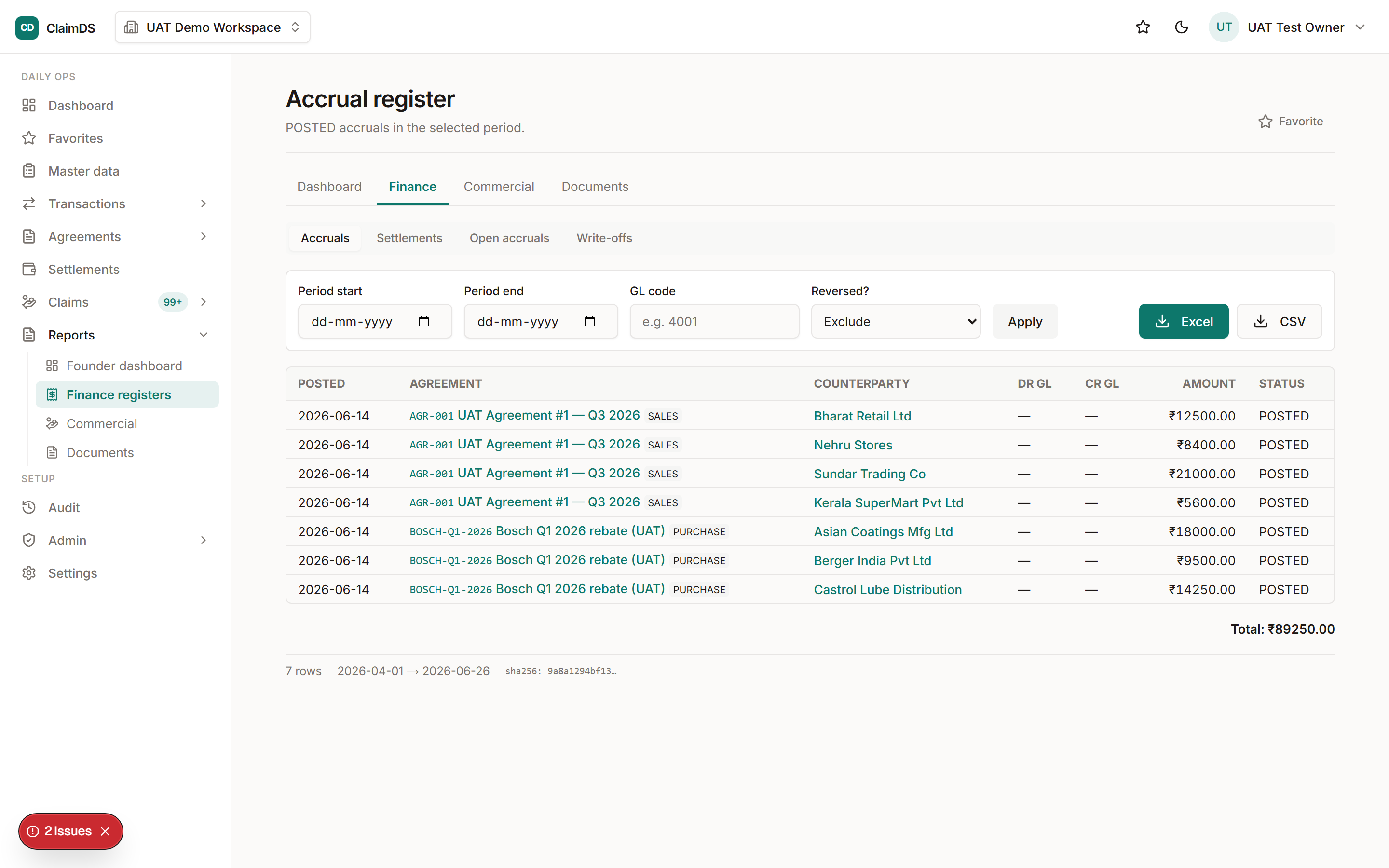
- Real-time accruals from actual sales replace the quarter-end estimate, so the liability is right all period — the rebate tracking view.
- Single source of truth ends the "sales sheet vs finance sheet" divergence, so margins are stated on one reconciled number.
- Correct credit-note classification by rule keeps the GST and financial treatment aligned — see financial vs. tax credit notes.
- Audit trail + reconciliation close the accrual-to-settlement gap before period-end, removing audit findings.
The leadership framing — what to measure and demand — is in the CFO revenue-leakage playbook, and the specific loss quantified in revenue leakage in rebate programs. The reporting layer that surfaces it is rebate analytics.
Why does accrual completeness decide reporting quality?
An accrual can be precisely computed and still wrong — because a scheme is missing from it entirely. Completeness means every commitment that creates a liability is in the register: the national slab scheme, yes, but also the regional top-up a zonal manager announced, the display payout agreed for the festive quarter, and the price-support commitment made when a competitor cut rates. Illustratively: a company accrues ₹3.6 crore across the schemes finance knows about, while a ₹40 lakh regional scheme lives only in a sales manager's file — the books are understated by ₹40 lakh, and the error surfaces months later as an "unexpected" claim finance has no provision against.
The fix is structural, not heroic: schemes cannot create liability unless they exist in the same system that computes the accrual. When scheme creation and accrual computation share one master, completeness stops depending on anyone's memory. The computation mechanics themselves follow the method in calculating supplier rebate accruals.
Why do period cutoffs go wrong?
Rebate activity refuses to respect month-ends, and manual processes handle that badly in three recurring ways:
- Claims straddle periods. A claim for March volume arrives in May. Without a live accrual, the cost lands in the period the claim was processed, not the period the liability was created — flattering March and punishing May.
- Secondary data reports late. Sell-through schemes depend on distributor-reported data that arrives days or weeks after period-end. If the books close before the data lands, the accrual is a guess with a decimal point.
- Credit notes issue in the next period. A liability accrued in P, settled by credit note in P+1, must reverse against the accrual — not hit P+1 as fresh cost. Manual trackers routinely double-count exactly here.
Software fixes cutoff by anchoring every claim and credit note to the scheme period it belongs to, so the period is attributed by rule rather than by when someone got to the paperwork.
How do credit-note ledgers tie out?
The settlement side of reporting accuracy is a three-way tie-out: the credit-note register (every CN, its claim, its classification, its invoice linkage), the general ledger (the rebate liability account those CNs relieve), and the GST returns (where tax credit notes reduce output liability). Each pair must reconcile:
- CN register ↔ GL — every issued credit note relieves the accrual it settles; orphan CNs with no approved claim behind them are both a control failure and an audit flag.
- CN register ↔ GSTR — tax credit notes reported in the right return period, within the statutory time limits for credit notes, with the recipient's ITC reversal evidenced where taxable value was reduced.
- Your ledger ↔ the partner's ledger — the counterparty booked the same credit note, which is where the working method in reconciling scheme credit notes against GSTR-2B and 3B takes over.
The accounting entries underneath are covered in rebate accounting; the reporting-accuracy point is that these tie-outs should be a by-product of settlement, not a quarterly reconstruction.
What do auditors expect from rebate reporting?
Auditors do not expect zero rebates; they expect a defensible number. In practice that means five things: a computation basis (the accrual re-derivable from scheme rules and sales data, not a value typed into a cell), completeness evidence (a scheme register that provably captures every commitment), cutoff discipline (period-straddling items attributed by rule), settlement reconciliation (paid ties to accrued, with variances explained), and method consistency (the same estimation approach period over period, with changes disclosed). The document trail that satisfies the GST side of the same questions is laid out in the scheme settlement documentation playbook.
What restatement risks come from spreadsheet drift?
Spreadsheet-run rebates accumulate error the way an unreconciled bank account does — quietly, in one direction at a time, until the balance is checked. Formulas drift as files are copied quarter to quarter; a slab boundary edited for one scheme silently applies to another; sales and finance each hold a "final" version that diverged in week three. Illustratively: a proration formula copied forward with a hard-coded 90-day divisor overstates the accrual of every 92-day quarter by roughly 2% — small enough to survive review, cumulative enough that four quarters later the liability is misstated by tens of lakhs on a multi-crore program. When the error finally surfaces — at audit, at diligence, or when a new controller rebuilds the file — the correction may be too large to absorb in the current period, and prior-period figures have to be revisited. That conversation with the audit committee is the true cost of "the spreadsheet was free."
The rebate close checklist
| # | Close step | What it proves |
|---|---|---|
| 1 | Scheme register complete — every live commitment present | Completeness |
| 2 | Accrual recomputed from period-end actual sales | Computation basis |
| 3 | Received-but-unsettled claims reviewed for period attribution | Cutoff |
| 4 | CNs issued in period tied to approved claims and to the GL | Settlement integrity |
| 5 | CN register tied to GST returns for the period | Books-to-returns consistency |
| 6 | Movement in rebate liability account explained line by line | Explainability |
A close that runs this list from a live system finishes in hours; one that runs it from spreadsheets either takes days or quietly skips rows — and the skipped rows are where unresolved deductions and audit findings incubate.
Where RebateLedger fits
RebateLedger keeps rebate accrual live, classifies the credit note by rule, and reconciles settlement to accrual with a full audit trail — India-first, at a mid-market price (a RebateLedger-supplied ~₹3–5 lakh/yr figure, positioning not a benchmark). It sits under the rebate management software pillar; the deeper positioning is in why RebateLedger.
Frequently asked questions
How does rebate software improve financial reporting accuracy?
It replaces estimated, quarter-end rebate numbers with a live accrual computed from actual sales, applies the correct credit-note classification, keeps a single source of truth reconciled to settlement, and holds an audit trail — so reported liabilities, margins and provisions reflect reality rather than a spreadsheet guess.
How do manual rebates distort financial reporting?
Manual rebates under- or over-accrue the liability, produce period-close surprises when the real number lands, misstate product margins because scheme cost is unallocated, and create audit findings when accrual and settlement don't reconcile — all symptoms of estimating rather than computing the number.
Does rebate accrual affect GST reporting?
It can. The credit-note type used to settle a rebate determines whether output tax changes and whether the recipient reverses ITC. Misclassifying it distorts both the financial statements and the GST return, which is why classification should be by rule and documented.
What should a rebate close checklist include?
Six ties per period: every live scheme present in the accrual register; accrual recomputed from period-end actuals; claims received but unsettled reviewed for cutoff; credit notes issued in the period tied to approved claims and to the GL; the credit-note register tied to the GST returns; and the movement in the rebate liability account explained line by line. A close that skips any of these is carrying an unquantified error.
What do auditors check on rebate accruals?
The computation basis (can the accrual be re-derived from the scheme rules and sales data), completeness (is every committed scheme accrued), cutoff (are period-straddling claims in the right period), settlement reconciliation (does what was paid tie to what was accrued), and consistency of method period over period. An accrual that exists only as a spreadsheet value with no derivation fails the first test immediately.
Can spreadsheet rebate tracking cause a restatement?
It creates the classic conditions for one — formula drift as files are copied forward, version forks where sales and finance hold different "finals", and silent overwrites with no change history. When the cumulative error surfaces, often at audit or during diligence, the correction can be large enough to require restating prior-period figures rather than absorbing it in the current period.
Why are vendor rebates considered a high-risk audit area?
Because rebate receivables rest on estimates of target achievement and interpretation of vendor agreements, they are an easy lever for profit manipulation — as restatement history shows. Auditors focus on existence (a signed agreement behind each accrual), cut-off (does the rebate relate to this period's purchases), valuation (is achievement probable at the accrued rate) and the inventory-versus-cost split. Keep agreement-level workings and settlement histories ready rather than reconstructing them at year-end.
What is the accrual-to-actual ratio and why should finance track it?
It compares the rebate amount accrued for a scheme or period against the amount finally settled. A ratio persistently above one signals over-accrual and habitual write-back income; below one signals under-accrual and deferred cost — the riskier direction for revenue recognition. Tracking it scheme-wise over rolling cycles measures estimation quality objectively, guides recalibration of slab and lapse assumptions, and gives auditors evidence that the provisioning process learns.
See RebateLedger on your own claims data
A 30-minute walkthrough tailored to how your channel actually settles claims.