
Buyback Software for Distributor & Dealer Returns (India)
Channel buyback software for expired, damaged and unsold stock returns — program types, how claims work, FMCG vs pharma, and what it automates.
In short
Buyback software automates channel buyback claims — where a manufacturer buys back expired, damaged or unsold stock from distributors and dealers — managing eligibility, valuation, returns logistics and GST credit-note settlement. It replaces manual returns paperwork with a controlled, auditable process.
Buyback software automates channel buyback claims — where a manufacturer buys back expired, damaged or unsold stock from its distributors and dealers. It manages eligibility, valuation, returns and GST credit-note settlement, replacing manual returns paperwork with a controlled, auditable process.
Channel buyback, not share buyback. This is about a manufacturer taking back unsold, expired or damaged stock from distribution partners — not a company repurchasing its own shares (a corporate-finance action). We cover channel inventory buyback only.
What is channel buyback?
In Indian distribution, manufacturers periodically take back stock from the channel — product that expired, was damaged, or simply did not sell. Buyback protects channel relationships and keeps shelves fresh, but it is a real claim with eligibility rules, valuation and GST settlement. It belongs in the same system as the rest of the channel's claims — see claims management software and the related compensation type in stock compensation software.
What makes buyback different from a scheme claim is the physical dimension. A slab or volume claim is settled from sales data; a buyback claim asserts that specific stock, in a specific condition, sits at a specific point in the channel — and someone has to verify that before money moves. Skip the verification and buyback becomes one of the quietest forms of revenue leakage in a trade-spend budget: over-claimed quantities, stock outside the window, the same cases claimed twice under two programs. The discipline is the same one that governs distributor claims management generally — buyback just adds trucks, batch numbers and destruction certificates to it.
What types of buyback programs exist?
| Program | Covers |
|---|---|
| Expiry buyback | Near-expiry / expired stock returns |
| Damage buyback | Damaged or breakage stock |
| Unsold / slow-moving | Non-moving stock taken back by agreement |
| Supplier-initiated | Manufacturer-driven recalls or refreshes (supplier buybacks) |
The step-by-step is in the buyback process.
Most companies run more than one of these at once, usually under different policies with different windows and valuation rules — which is exactly where a spreadsheet-per-program approach breaks down. The programs also interact: a distributor blocked from an expiry buyback because the window closed will sometimes re-route the same stock into a damage claim, and only a system that sees both programs side by side catches it.
How does a buyback claim work?
Eligibility checked → stock valued → return logged → validated → settled by credit note. The partner requests a buyback, eligibility and valuation are confirmed, the physical return is logged, and the value is settled — typically by GST credit note. Returns logistics run alongside the financial claim.
Unpacked, each arrow does real work. The request carries batch numbers, expiry dates, quantities and original purchase references — captured at submission, not reconstructed later. The eligibility check runs the stock against the program's window and condition rules and against purchase history: was this stock actually bought from us, in the claimed period, by this partner? Valuation applies the agreed basis to the eligible lines. Physical verification confirms what actually arrived at the depot — or what was destroyed in the field against a certificate. Approval then routes by value and exception, the same way other channel claims route through approval workflows. Only after all of that does settlement issue the credit note, linked back to the verified claim.
How do eligibility and valuation control buyback cost?
The control points are eligibility and valuation: is the stock within the buyback window and condition rules, and at what value is it taken back? Loose rules here are where buyback cost balloons. Software enforces the window and condition rules and computes valuation consistently, so buyback is a managed cost rather than an open-ended one.
An illustrative example of what the rules are worth: a distributor holds ₹4,80,000 (at invoice price) of stock that has just entered the near-expiry window. Under a policy that takes back near-expiry stock at 100% of invoice price if claimed within 30 days of entering the window, and at 60% thereafter, the same physical cases are worth ₹4,80,000 or ₹2,88,000 depending on when the claim lands — a ₹1,92,000 swing that exists purely in the rules and the calendar. Multiply that across a few hundred distributors and several programs, and it is clear why windows and valuation cannot live in individual branch inboxes.
What features should buyback software have?
A practical checklist, in the order the claim needs them:
- Eligibility windows. Program-level windows (how close to expiry, how long after damage discovery, claim-by dates) enforced at submission — not discovered at audit.
- Batch and expiry data. Every claim line carries batch, expiry date, quantity and original invoice reference, validated against what was actually supplied to that partner.
- Valuation rules. Configurable basis per program and category — invoice price, landed cost, or an agreed percentage — computed by the system, not typed into the claim.
- Physical verification workflow. A step that records what was received or field-destroyed, by whom, with discrepancies (claimed 100 cases, verified 92) captured against the claim rather than absorbed silently.
- Destruction certificates. For stock that never travels — breakage, expired goods destroyed on site — certificate, photographs and sign-off attach to the claim, and settlement is blocked without them.
- Settlement and credit-note linkage. The credit note references the claim; the claim references the verification. Any one of the three should lead an auditor to the other two.
- Audit trail and reporting. Who approved what, when, against which evidence — plus program-level cost visibility so finance sees buyback as a number, not a folder of PDFs.
How do you evaluate buyback software?
| Criterion | What to test | Red flag |
|---|---|---|
| Eligibility engine | Submit a claim just outside the window | System accepts it and relies on a human to notice |
| Batch validation | Claim a batch never supplied to that partner | No check against supply history |
| Valuation | Change the valuation basis mid-program | Old claims silently revalue |
| Verification | Approve a claim with no verification record | Settlement proceeds anyway |
| Credit-note linkage | Trace a credit note back to its claim | The link is a spreadsheet column someone maintains |
| Audit trail | Ask who changed a window rule and when | No answer without IT involvement |
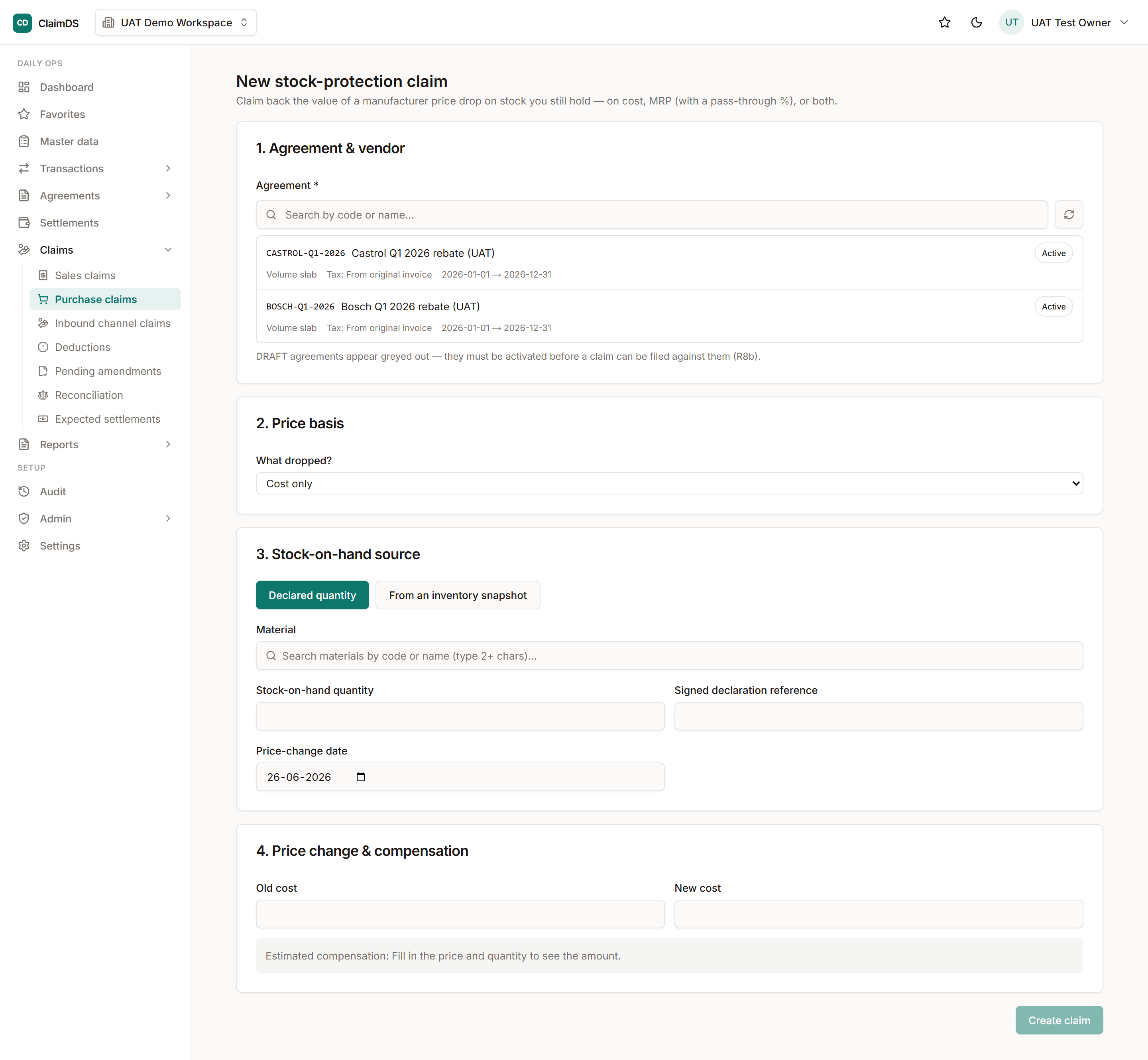
Also check adjacency. Price-drop events settle through stock compensation with no physical return, and manufacturer-driven refreshes run as supplier buybacks — if each of these needs a separate tool, the reconciliation between them moves straight back into spreadsheets.
How does buyback settlement meet GST?
Pointer-level only, because the tax layer has its own playbook: returns of expired and damaged goods follow the two routes in CBIC Circular 72/46/2018-GST — return as a fresh supply, or return against a credit note — with different documentation and ITC consequences, covered in full in credit notes for expired and damaged goods returns. Whether the settling credit note adjusts GST or only value is the tax-vs-commercial decision in financial vs. tax credit notes under GST, and the clock that decision runs against is in GST credit-note time limits. Buyback software's job is narrower but essential: record which route and which credit-note type each settlement used, and keep the linkage auditable.
How do FMCG and pharma buyback differ?
FMCG buyback centres on expiry and damage in fast-moving categories (buyback in FMCG); pharma adds saleable-vs-breakage return rules and regulated handling of expired drugs (buyback in pharma). These also connect to the deduction side via FMCG chargebacks and pharma chargebacks.
GST note: This article is general information, not tax or legal advice. Credit notes on returns and other GST positions — including CBIC Circular No. 251/08/2025-GST and the Finance Act 2026 amendments to Section 34 of the CGST Act, assented 30 March 2026 but not yet notified into force as of publication — must be re-verified at publish time with a qualified professional.
Frequently asked questions
What is buyback software?
Buyback software automates channel buyback claims — where a manufacturer buys back expired, damaged or unsold stock from distributors and dealers. It manages eligibility, valuation, returns and GST credit-note settlement. It is not about a company repurchasing its own shares.
Is channel buyback the same as a share buyback?
No. A share buyback is a company repurchasing its own securities — a corporate-finance action. Channel buyback is a manufacturer taking back unsold, expired or damaged stock from distribution partners. This guide covers channel inventory buyback only.
How is a buyback claim settled?
After eligibility and valuation are confirmed, the buyback is settled to the channel partner, typically by GST credit note on the returned value, with returns logistics handled separately. Software validates eligibility and computes the settlement.
What features should buyback software have?
At minimum: eligibility-window enforcement, batch and expiry data capture on every claim line, configurable valuation rules, a physical-verification workflow that records what was actually received or destroyed, destruction-certificate storage linked to the claim, and settlement that ties the credit note back to the verified claim. An audit trail across all of it is what makes the program defensible.
How does buyback software handle destruction certificates?
For damage and expiry stock that is destroyed rather than resold — often in the field, without a physical return — the destruction certificate, photographs and witness sign-off are attached to the claim itself. The software blocks settlement until the verification evidence is in place, so a credit note is never issued against stock nobody confirmed. That linkage is also what auditors ask for first.
How does buyback settlement interact with GST credit notes?
The credit note that settles a buyback has a GST dimension: returns of expired or damaged goods follow the two routes in CBIC Circular 72/46/2018-GST, and the credit note itself is either a tax credit note (adjusting GST, within the Section 34 window) or a commercial one (value only). Buyback software should record which type was issued and keep the claim–credit-note linkage auditable; the tax positions themselves belong with a qualified professional.
Can automation validate batch and expiry details on return claims?
Yes — batch validation is a high-value automation in returns. The system matches each claimed batch against billing history to confirm the claimant bought it, checks claimed expiry against the batch master, tests the claim date against the policy window, and screens duplicates. Clean lines flow to authorisation; exceptions route to review. RebateLedger applies these validations at submission, so ineligible batches are rejected before freight is spent moving them.
How does a DMS help capture damage and expiry at the retail shelf?
A DMS pushes claim capture to where losses surface — the shelf. Salesmen record damaged or expired units outlet-wise during beat visits, with batch, quantity, reason, photo and the retailer's acknowledgement; pickups post against outlet accounts and reconcile with godown receipts, so market pickups cannot evaporate en route. That time-stamped record becomes the distributor's evidence base. RebateLedger is designed to work alongside the DMS, taking in pickup data for validation and settlement.
See RebateLedger on your own claims data
A 30-minute walkthrough tailored to how your channel actually settles claims.