
Buyback in Pharma: Expiry Returns & Compensation
Pharma expiry returns and compensation in the CFA/stockist model — saleable vs breakage returns, return windows, valuation and settlement.
In short
Pharma buyback is the return of expired or near-expiry medicine from stockists and retailers up the chain, with the manufacturer compensating the value, usually by credit note. It operates within the CFA/stockist model under defined return windows, valuation rules and regulated handling for expired drugs.
Buyback in pharma is the return of expired or near-expiry medicine from stockists and retailers up the chain, with the manufacturer compensating the value — usually by credit note. It runs within the CFA/stockist model and follows defined return windows and valuation rules, with regulated handling for expired drugs.
How does the stockist return chain work?
Pharma returns flow back up through retailers and stockists to the C&F and manufacturer. Because medicine has hard expiry dates and strict handling rules, expiry returns are a structural part of pharma economics, not an exception. This is the pharma view of the buyback hub, paired with pharma chargebacks. It sits inside the broader picture of how claims and rebates work across the Indian pharma channel.
Verify at publish: confirm current expired-drug handling/destruction requirements and return-window norms before stating specifics; this is not regulatory advice.
The chain is the outward route run in reverse — the primary/secondary/tertiary tiers, backwards. A retailer returns short-dated or expired strips to the stockist; the stockist aggregates returns from many retailers, sorts them by category and batch, and raises a claim; the CFA receives and verifies the physical stock on the manufacturer's behalf; the manufacturer validates, credits the stockist, and the credit filters back down. Three consequences follow. First, each hop re-documents the same stock, so category and batch data degrade unless captured systematically. Second, the cycle is long — a strip that expired at a retail counter can take months to become a settled credit — so ageing visibility matters. Third, the claim and the physical stock travel separately: the paper reaches the manufacturer before the goods reach the CFA, and reconciling the two is where verification lives.
What are the return categories?
| Type | Condition | Handling |
|---|---|---|
| Saleable return | Good condition | Often resaleable; valued accordingly |
| Breakage / expiry | Damaged or expired | Not resaleable; regulated destruction |
The two are valued and processed differently — conflating them is a common source of error.
In operational practice the second row splits again, giving three lanes:
- Saleable. Good condition, adequate remaining shelf life per the company's dating norms, intact packaging. It can re-enter inventory, so it is verified for condition and dating, then restocked — the credit is essentially a reversal of the sale.
- Breakage. Physically damaged stock. It usually never travels far — destruction at or near the point of discovery against a certificate is common, because freighting broken bottles serves no one. The claim rides on the certificate and photographs, not on a goods receipt.
- Expiry. Past-date stock. It must come out of the chain entirely, be accounted batch-wise against original supplies, and be destroyed under the applicable regulatory requirements with records kept.
The reason to keep three lanes rather than two: breakage is an evidence problem (did it really break, how much), while expiry is a traceability problem (is it our batch, inside the window, not claimed before). A process tuned for one fails quietly on the other.
How do return windows and valuation work?
Windows and valuation define the cost. Return windows specify how close to or past expiry stock can be returned; valuation rules set the compensation. Clear rules keep the program managed and the claim verifiable. The mechanics mirror the buyback process; the stockist-claim view is distributor claims management (pharma uses "stockist").
Windows in pharma are anchored to the printed expiry date — so many months before expiry for a near-expiry return, so many months after for an expiry claim — and tested batch-wise, because a claim line is a batch, not a SKU. Valuation then follows category: saleable at or near invoice value, breakage and expiry per the policy basis (invoice price or an agreed percentage). The general valuation trade-offs are the same as in any claim process; pharma just applies them per batch and per category.
What does regulated destruction require?
Expired medicines carry regulatory handling and destruction obligations that ordinary FMCG stock does not. Any process or software must keep an auditable record of what was returned, valued, settled and destroyed. Treat the specific regulatory requirements as something to verify with a qualified professional, not to assert from a template.
What the claim system can and should guarantee, without asserting any regulatory specifics: an unbroken record from claim line to verified stock to destruction record, so that for any credited batch you can produce what was claimed, what was verified, what was destroyed, when, and under whose sign-off. Destruction also has a GST consequence for the manufacturer — ITC reversal on destroyed goods — which is part of the route decision covered in the tax article linked below.
What does a worked example look like?
Illustrative numbers, one stockist claim against a defined policy:
| Claim line | Category | Claimed | After verification | Credited |
|---|---|---|---|---|
| In-date stock, intact, within dating norms | Saleable | ₹1,20,000 | Verified, restocked | ₹1,20,000 |
| Broken bottles, destroyed at stockist point | Breakage | ₹60,000 | Certificate + photos accepted | ₹60,000 |
| Expired batches, returned via CFA | Expiry | ₹1,50,000 | ₹30,000 outside the return window | ₹1,20,000 |
Claimed: ₹3,30,000. Credited: ₹3,00,000. The ₹30,000 cut is a batch-dated window test, not a judgement call — and because each line carries its category, the saleable portion re-entered inventory while only the expiry portion generated a destruction record.
How are pharma buyback claims settled?
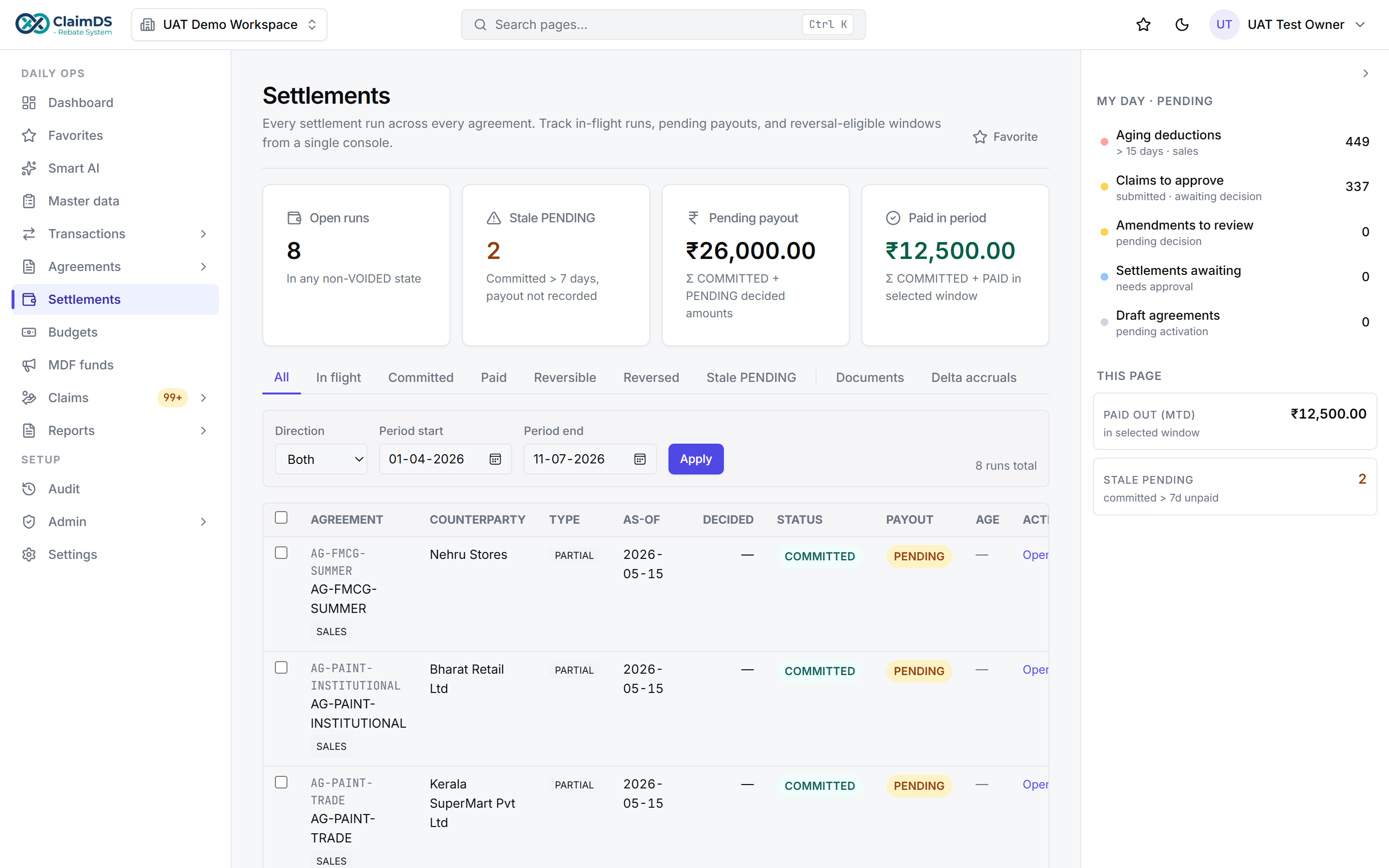
Settlement is a credit note to the stockist for the approved value, issued against the verified claim and — for expiry lines — linked to the destruction record. At portfolio scale this runs as periodic settlement cycles per agreement rather than one-off credits, with the same linkage discipline any claims management software applies: claim → verification → credit note, each referencing the others. This is what those runs look like when payouts and credit notes are tracked per agreement rather than reconciled from ledgers afterwards.
The GST layer sits behind every one of those credit notes, and pharma is where it was defined: CBIC Circular 72/46/2018-GST was written for time-expired drugs and medicines, and its two return routes — fresh supply or credit note — plus the ITC reversal on destruction are walked through in credit notes for expired and damaged goods returns. Whether a given credit note adjusts tax or only value is the decision framed in financial vs. tax credit notes under GST, on the clock described in GST credit-note time limits. This article deliberately stops at the pointer: the operations team's job is to record which route and credit-note type each settlement used, and to keep that record attached to the claim.
Expiry buyback is one line in a pharma brand's total channel spend, sitting alongside schemes, margins and promotional support. Seeing what the whole programme costs — and settling each part against its own terms — is what trade promotion management software is for.
GST note: This article is general information, not tax, legal or regulatory advice. Credit notes on returns and other GST positions — including CBIC Circular No. 251/08/2025-GST and the Finance Act 2026 amendments to Section 34 of the CGST Act, assented 30 March 2026 but not yet notified into force as of publication — must be re-verified at publish time with a qualified professional.
Frequently asked questions
What is buyback in pharma?
Pharma buyback is the return of expired or near-expiry medicine from stockists and retailers up the chain, with the manufacturer compensating the value, usually by credit note. It operates within the CFA/stockist model and follows defined return windows and valuation rules.
What is the difference between saleable and breakage/expiry returns?
Saleable returns are stock returned in good condition, often resaleable. Breakage and expiry returns are damaged or expired stock that cannot be resold and must be handled and destroyed per regulation. They are valued and processed differently.
How are pharma expiry returns settled?
After eligibility and valuation are confirmed and the return logged, the value is settled to the stockist, usually by GST credit note. Expired-drug handling must follow applicable regulatory requirements, which should be verified with a qualified professional.
What roles do the CFA and stockist play in pharma returns?
Returns travel the supply chain in reverse: the retailer returns to the stockist, the stockist aggregates and claims against the manufacturer, and the CFA (carrying and forwarding agent) typically receives, verifies and holds returned stock on the manufacturer's behalf. Each hop re-documents the stock, so a claim can take months to travel the chain — which is why batch-level records at every hop are what keep the eventual credit defensible.
Why does Circular 72/46/2018 matter for pharma expiry returns?
CBIC Circular 72/46/2018-GST was written specifically for time-expired drugs and medicines. It defines the two GST routes for the return leg — fresh supply or credit note — and the ITC reversal that follows when the manufacturer destroys returned stock. Every pharma expiry settlement implicitly picks one of its routes, so the claim file should record which; the detail belongs with your tax advisor.
How is the value of a pharma return claim calculated?
By category. Saleable returns are typically credited at or near invoice value since the stock re-enters inventory; breakage and expiry are credited per the policy basis — invoice price or an agreed percentage — for quantities inside the return window, verified batch-wise against original supplies. Lines outside the window or untraceable to a covered supply are cut before settlement, which is why the category and batch on each claim line matter more than the arithmetic.
See RebateLedger on your own claims data
A 30-minute walkthrough tailored to how your channel actually settles claims.