
The Buyback Process: Expired & Damaged Stock Returns
The channel buyback process step by step — eligibility, request, documentation, validation, returns logistics and GST credit-note settlement.
In short
The channel buyback process runs: check eligibility, raise the request, document the stock, validate and value it, coordinate the physical return, and settle by GST credit note. This is taking expired or damaged stock back from a distributor — not a company repurchasing its own shares.
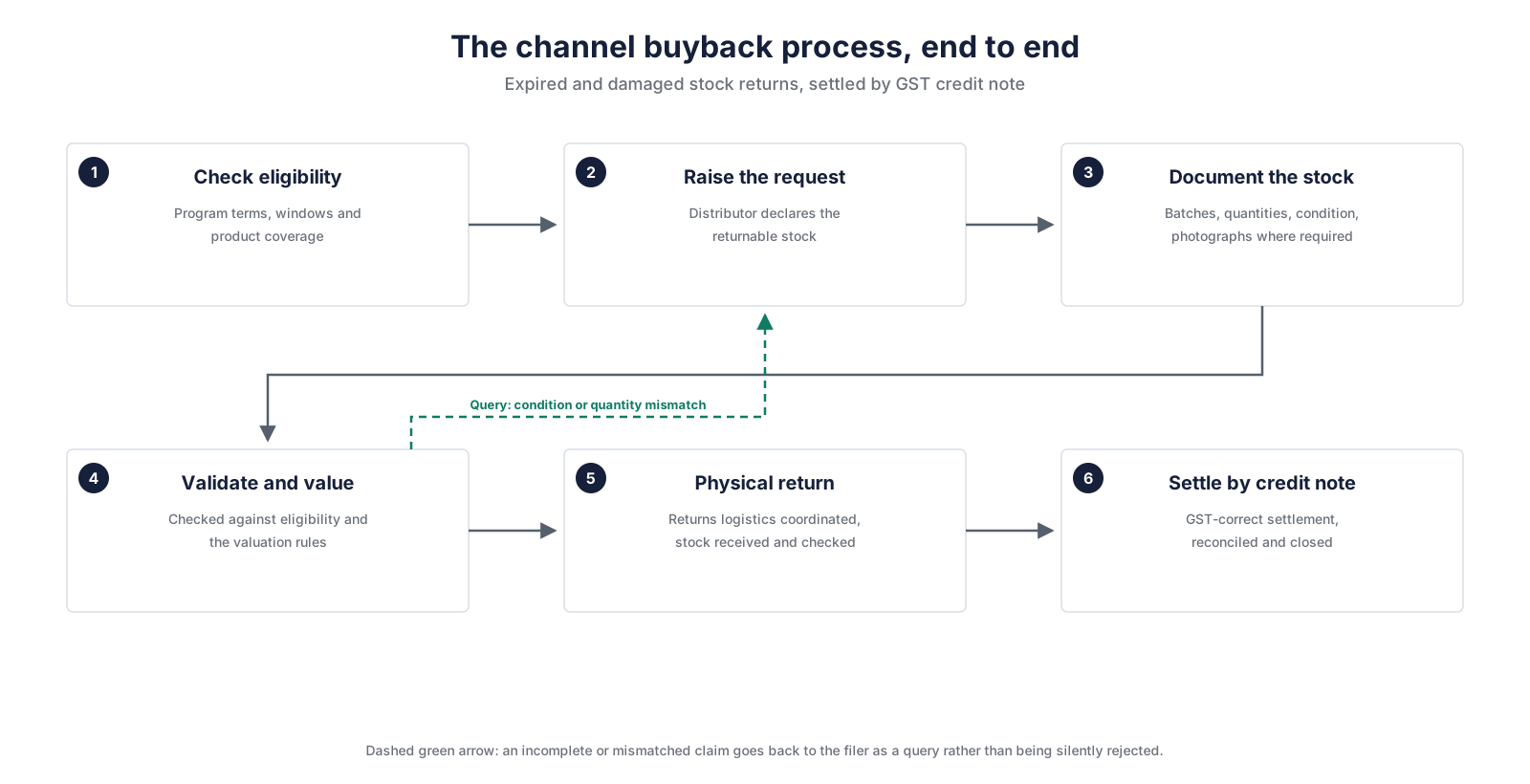
The buyback process is the sequence for taking expired or damaged stock back from a distributor or dealer: check eligibility, raise the request, document, validate and value the stock, coordinate the physical return, and settle by GST credit note. Clear eligibility and valuation rules are what keep it a managed cost rather than an open-ended one.
Channel inventory buyback, not share buyback. This is a manufacturer taking back unsold/expired/damaged stock — not a company repurchasing its own securities.
What are the five steps of the buyback process?
- Check eligibility. Confirm the stock is within the buyback window and condition rules — the gate that controls cost.
- Raise the buyback request. The partner submits batch and quantity detail for the stock to be returned.
- Document. Attach evidence — batch/expiry records, damage notes, photos, original purchase reference.
- Validate and value. Validate the stock against records and apply the agreed valuation rules.
- Return and settle. Coordinate the physical return and settle the value by GST credit note, with the two kept linked.
The hub view is buyback software; the supplier-side view is supplier buybacks.
What happens at each stage, end to end?
The five steps compress a longer chain: trigger → eligibility → physical return and verification → valuation → claim → settlement. Each link has its own failure mode.
The trigger. A buyback starts with an event: the distributor's monthly near-expiry report, damage discovered when a consignment is opened, an agreed quarterly review of non-moving stock, or a manufacturer-driven refresh. The trigger decides which program — and therefore which window, evidence standard and valuation basis — governs everything downstream. Claims filed under the wrong program are the first source of later disputes.
Eligibility. Before anything moves, the stock is tested against the program rules: is it inside the window, in a covered condition category, and traceable to purchases from this manufacturer by this partner in the covered period? This is the same gate logic that governs every channel claim — see the claim process explained — but buyback adds the traceability test, because stock can and does migrate between territories.
Physical return and verification. Either the goods travel back to a depot or CFA, where receipt is verified line by line, or — common for breakage and low-value damage — they are destroyed in the field against a certificate with photographs and a witness. Verification is where claims shrink honestly: claimed 100 cases, received 92, four of them a batch never supplied to this distributor. Those discrepancies must be recorded against the claim, not absorbed.
Valuation. The agreed basis is applied to the verified quantities — more on the bases below.
The claim. The claim record is the spine that ties trigger, evidence, verification result and valuation together, and routes for approval by value and exception like any other claim in distributor claims management — typically through tiered approval workflows.
Settlement. A credit note is issued for the approved value and linked back to the claim, closing the loop.
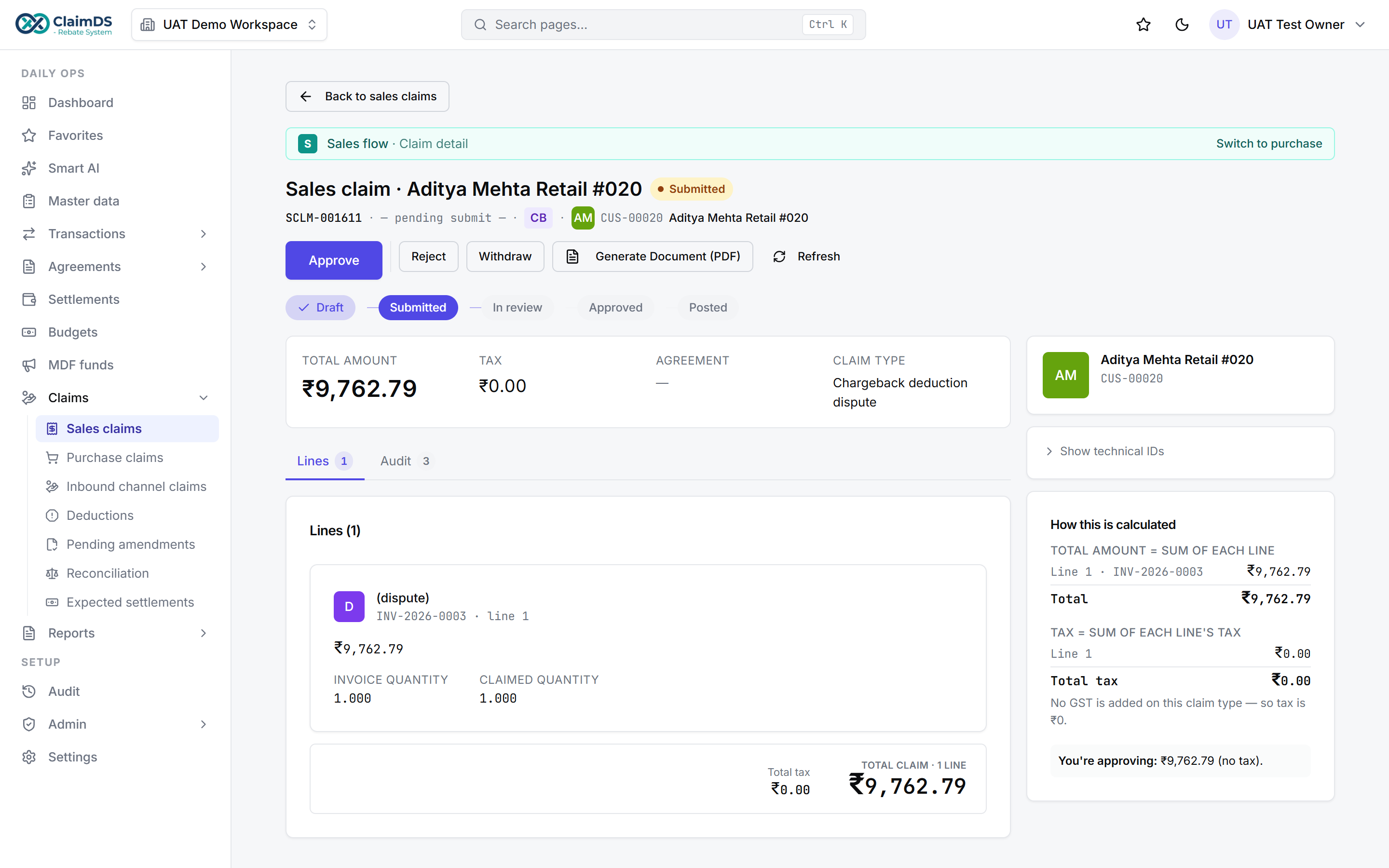
This is what that lifecycle looks like when it runs inside a system rather than an inbox — the claim carries its evidence, is validated against the agreement, and moves to settlement with the status visible at each step.
Which settlement route does the credit note take?
Pointer level only, because the tax layer deserves its own article: under CBIC Circular 72/46/2018-GST, expired or damaged goods come back either as a fresh supply on the returning party's own document, or against a credit note from the original supplier — two routes with different paperwork, e-way bill treatment and ITC consequences, walked through in credit notes for expired and damaged goods returns. Whether the settling credit note adjusts GST or only value is the framework in financial vs. tax credit notes under GST, and the deadline it runs against is in GST credit-note time limits. The process owner's job is to make sure the claim file records which route and which credit-note type were used — the positions themselves belong with a tax professional.
On what basis is returned stock valued?
| Valuation basis | How it works | Watch out for |
|---|---|---|
| Original invoice price | Stock credited at the price on the original purchase invoice | Which invoice? Price revisions since purchase, and scheme discounts already passed on |
| Landed cost | Invoice price plus agreed freight/handling the partner bore | Needs pre-agreed cost norms — per-claim freight proofs are unverifiable at scale |
| Agreed percentage | A fixed % of invoice price, often stepped by stock age or window position | Cliff effects at the step boundaries invite claim-timing games |
An illustrative example: a distributor returns 200 cases bought at ₹1,200 per case. At invoice price the claim is ₹2,40,000; at landed cost with an agreed ₹60-per-case freight norm it is ₹2,52,000; under a 70% agreed-percentage policy it is ₹1,68,000. All three are defensible policies — what is not defensible is a program that never named one, leaving an ₹84,000 spread to be negotiated on every claim. The policy names one basis per program; the system computes it.
Why does documentation decide the outcome?
Documentation decides disputes. Batch/expiry data and damage evidence captured at request time make the claim defensible; captured late or not at all, the claim becomes a negotiation. Industry rules differ — FMCG buyback centres on expiry and damage windows, while pharma buyback adds regulated handling of expired drugs.
The practical standard: every claim line carries batch number, expiry date, quantity, condition category and original invoice reference at submission. Evidence added after a claim is questioned is worth a fraction of evidence attached before anyone asked.
What causes buyback disputes, and how do you prevent them?
The recurring five:
- Quantity and condition mismatches — claimed versus verified. Prevented by a verification step whose result is recorded against the claim, with a stated tolerance policy.
- Window arguments — "the stock entered near-expiry before the cut-off." Prevented by defining the window against a system date (batch expiry, claim submission), never a narrated one.
- Valuation-basis arguments — invoice price versus what the partner actually paid net of schemes. Prevented by naming the basis in the program terms.
- Double claims — the same stock under expiry buyback and damage buyback, or claimed once per quarter until accepted. Prevented by batch-level claim history.
- Missing purchase references — stock that cannot be traced to a covered purchase. Prevented by validating claim lines against supply records at submission.
None of these is exotic; all of them are cheap to prevent at intake and expensive to argue at settlement.
Why must the return and the settlement stay linked?
The financial settlement and the physical return must stay tied together — stock returned but not settled, or settled but not received, is leakage. A system that links them, with an audit trail, turns buyback into a controlled program. This is the returns counterpart to stock compensation, where value loss is compensated without a physical return.
Related reading: how returns, reversals and cancellations are handled across channel claims, and how to build a buyback and expiry return simulator in Excel if you want to model the age-banded valuation yourself.
Buyback by category
What gets bought back, and on what terms, varies sharply by product:
- Buyback in FMCG — expired stock and damaged-goods programmes.
- Buyback in pharma — expiry returns and how compensation is calculated.
- Expiry and breakage returns in pharma — the operational side of the same programme.
- Expiry and season-end returns in agri-inputs — seasonal products with a hard shelf life.
- Credit notes for expired and damaged goods — the document that settles any of them.
GST note: This article is general information, not tax or legal advice. Credit notes on returns and other GST positions — including CBIC Circular No. 251/08/2025-GST and the Finance Act 2026 amendments to Section 34 of the CGST Act, assented 30 March 2026 but not yet notified into force as of publication — must be re-verified at publish time with a qualified professional.
Frequently asked questions
What is the buyback process?
The channel buyback process is the sequence for taking back expired or damaged stock from a distributor or dealer: check eligibility, raise the request, document, validate and value the stock, coordinate the physical return, and settle by GST credit note. It is not about repurchasing shares.
What documentation does a buyback need?
Typically batch and expiry records, damage notes or photographs, quantities, and the original purchase reference. Good documentation is what makes the buyback claim defensible and the settlement clean.
How is the buyback settled?
After validation and valuation, the buyback value is settled to the partner, usually by GST credit note, with the physical return logged and the financial claim linked to it.
What triggers a buyback?
Common triggers: a distributor's expiry or near-expiry stock report, damage discovered at receipt or in storage, an agreed periodic review of unsold or slow-moving stock, or a manufacturer-initiated refresh or recall. The trigger matters because it determines which program's window, evidence rules and valuation basis apply to the claim.
On what basis is returned stock valued?
The three common bases are original invoice price, landed cost (invoice plus agreed freight and handling), and an agreed percentage of invoice price that often steps down with stock age or window position. Each has trade-offs — the essential discipline is that the policy names exactly one basis per program and the system computes it, so valuation is never negotiated claim by claim.
What are the two GST routes for settling a buyback return?
Under CBIC Circular 72/46/2018-GST, returned expired or damaged goods either come back as a fresh supply on the returning party's own document, or against a credit note issued by the original supplier — with tax adjustment on the credit-note route only inside the Section 34 window. Which route and which credit-note type apply is a tax decision with documentation and ITC consequences; take professional advice on current positions.
Who pays destruction and disposal costs for expired goods — dealer or company?
It is a contract question, but the common pattern: the company bears destruction costs for stock taken back through the official route, the dealer bears costs where he destroys locally under authorisation, and each party bears losses it caused. Destruction is not trivial money in hazardous categories, where licensed disposal is priced per kilogram. Name the payer in the buyback agreement — silence is where this becomes a dispute.
Why do companies deduct handling charges from expiry credit notes?
To recover part of the cost of processing dead stock — reverse freight, verification labour, quarantine storage and destruction fees — and to discourage casual over-ordering that ends in expiry. The deduction should be a stated policy term, usually a fixed percentage of claim value, not a unilateral shave. Check whether it applies on gross or net value and whether company-caused returns are exempt, and query unexplained deductions promptly.
See RebateLedger on your own claims data
A 30-minute walkthrough tailored to how your channel actually settles claims.