
Price Protection Software for Channel Inventory (India)
Price protection software automates price-drop claims on channel inventory — strong in electronics, IT and mobile. Claim mechanics and settlement.
In short
Price protection software automates the calculation and settlement of price-protection claims — compensation to channel partners when a manufacturer cuts prices on stock they already hold. It identifies eligible inventory-on-hand at the price-change date, computes the protection amount, and settles by GST credit note, strongest in electronics, IT and mobile distribution.
Price protection software automates the calculation and settlement of price-protection claims — the compensation a channel partner receives when a manufacturer cuts prices on stock the partner already holds. It identifies eligible inventory-on-hand at the price-change date, computes the protection amount, and settles it, usually by GST credit note. It is strongest in consumer electronics, IT and mobile distribution.
What price protection is
When a manufacturer reduces a product's price, channel partners holding that product at the old cost are suddenly carrying over-valued stock. Price protection compensates them for the difference on inventory they already hold, so a price cut does not penalise the partners who stocked up. It is one of the core channel claim types alongside rebates and chargebacks — see the umbrella in claims management software and the step-by-step in price drop protection.
Claim mechanics
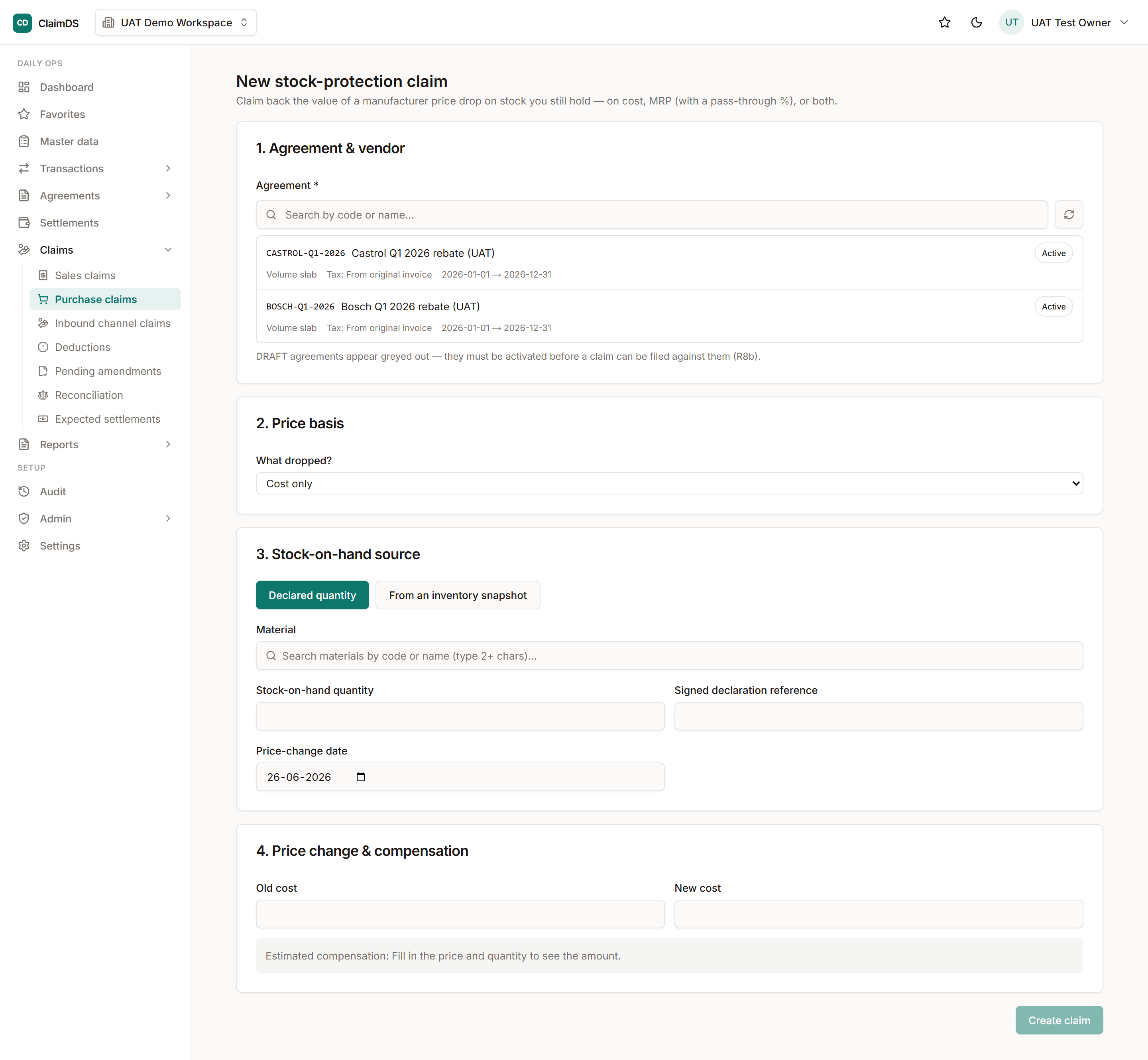
Price change declared → eligible stock identified → protection computed → validated → settled by credit note. The claim is the per-unit price drop times the eligible stock-on-hand at the price-change date. The hard part is not the multiplication — it is establishing accurate inventory-on-hand at a specific date across the channel. The contractual side is covered in price protection in sales.
How does a price-protection event run operationally?
The summary above compresses what is, in practice, a five-stage operational event. Each stage has a failure mode, and the software's job is to close them one by one.
- The price drop is declared. The manufacturer records the change in a price master — old dealer price, new dealer price, effective date and the covered SKU list. If this lives in an email instead of a system, every later step inherits the ambiguity.
- Stock is verified. Inventory-on-hand at the effective date is captured per partner, per SKU — from ERP or DMS feeds where they exist, from submitted stock statements where they do not, occasionally backed by photographic or physical verification for high-value models. In a multi-tier channel the stock may sit at both distributor and dealer level, so the snapshot has to say whose stock it is, not just how much.
- The claim is computed per dealer. Price drop times eligible units, applied per partner per SKU, with the policy's exclusions taken out — stock in transit, stock purchased before a cutoff window, SKUs outside the covered list.
- The claim is submitted and validated. Partners raise or confirm claims within the claim window, and each line is validated against the snapshot and the purchase records behind it. From here it follows the standard lifecycle any channel claim does — the Submitted → Validated → Approved → Settled path in the claim process explained.
- Settlement issues as a credit note posted to the partner's ledger, and the accrual raised for the event is released against it.
The stages look sequential, but the clock runs on all of them at once: the longer stock verification takes, the older the snapshot evidence gets, and the harder every downstream dispute becomes.
The inventory-on-hand basis
The whole game is the stock number. Get inventory-on-hand at the change date right, and the claim is trivial; get it wrong, and you either over-pay or under-compensate and invite disputes. This is why price protection is a software problem, not a spreadsheet one: it needs a defensible inventory position per partner per SKU at a precise date, ideally from imported stock data rather than self-declaration alone.
A worked example
A manufacturer cuts the price of a model by ₹1,200. A dealer holds 90 units at the change date. Protection = 90 × ₹1,200 = ₹1,08,000, validated against the dealer's stock records and settled by credit note. Across dozens of dealers and SKUs in an electronics channel, only software keeps this accurate and fast.
What does a full price-protection event look like?
Scale the single-dealer example up to an event. A manufacturer drops a model's dealer price by ₹800 effective 1 August; three partners hold stock at the change date (illustrative numbers only):
| Partner | Snapshot stock | Eligible after exclusions | Protection at ₹800/unit |
|---|---|---|---|
| Distributor A | 420 units | 400 (20 in transit) | ₹3,20,000 |
| Dealer B | 150 units | 150 | ₹1,20,000 |
| Dealer C | 95 units | 60 (35 outside the 90-day purchase window) | ₹48,000 |
| Event total | 665 units | 610 units | ₹4,88,000 |
Three things make this table defensible rather than negotiable. Each snapshot quantity traces to a stock statement or DMS feed, so the basis is evidence, not assertion. Each exclusion is applied by rule and recorded per line — Dealer C is paid on 60 units with a documented reason for the other 35, not a silent short-pay. And the event total, ₹4,88,000, is a number finance can accrue on declaration day rather than discover at quarter-end. Now multiply by the number of SKUs one price revision touches and the number of revisions a year in an electronics portfolio, and the case for automation makes itself. Where the compensation is for the stock itself — returns, liquidation support or damaged goods — the adjacent mechanism is stock compensation, which runs on the same verified-stock backbone.
What software automates
Price protection software ingests stock data, snapshots inventory-on-hand at the change date, computes the protection per partner, validates against records, and settles via the right GST credit note — the credit-note mechanics are in price protection and rate-difference credit notes under GST. Compare options in best price protection software. For the dealer-facing version see dealer claims management.
What features should price protection software have?
| Feature | Why it matters |
|---|---|
| Price masters with effective dates | The old price, new price and effective date are data the computation reads — not an email attachment |
| Stock snapshots per partner per SKU | The claim basis is captured once, frozen at the change date, and defensible later |
| Eligibility rules | Purchase-window cutoffs, in-transit stock and SKU exclusions applied consistently, not negotiated dealer by dealer |
| Enforced claim windows | Entitlements expire on schedule instead of accumulating as unbooked liability |
| Evidence capture | Stock statements and verification records attach to the claim line they support |
| Per-line approval with reason codes | Partial approvals carry documented reasons instead of silent short-pays |
| GST credit-note settlement | The approved amount settles by the right credit-note type and reconciles to the partner ledger |
| ERP/DMS integration | Stock and purchase data are imported, not re-keyed — the wiring is covered in ERP integration for claims and rebate software |
A buyer can compress this checklist into one test: ask the vendor to run a mock price-drop event end to end on your own SKU list, and to show where every number in the result came from.
How should you evaluate price protection software?
Feature lists tell you what a product claims; evaluation criteria tell you what to test. The wider testing method — scripted demos on your own data — is in the distributor claims software buyer's guide; these are the price-protection-specific criteria to add to it.
| Criterion | What to test |
|---|---|
| Snapshot integrity | Can it capture and freeze inventory-on-hand at a specific date, per partner per SKU, from imported data? |
| Computation transparency | Does every claim line show the price drop, the eligible units and each exclusion applied? |
| Dispute handling | Can a partial approval carry a documented short-pay reason the partner can see? |
| Settlement correctness | Does it issue the appropriate credit-note type and reconcile it against the accrual? |
| Scale behaviour | Does a 40-dealer, 25-SKU event run without manual patching between steps? |
How does GST treat price-protection settlements?
At pointer level: a price-protection settlement is a post-sale price adjustment, and in Indian channels it settles by credit note — which immediately raises the tax-versus-financial credit-note question. A tax (GST) credit note adjusts the tax value and triggers ITC reversal on the recipient's side; a financial credit note does not. Which one applies depends on how the arrangement is documented against the conditions in the law, and on CBIC Circular 251's framework for post-sale discounts. The full treatment for this specific claim type — including rate-difference claims, which share the same mechanics — is in price protection and rate-difference credit notes under GST. Treat all of it as a position to confirm, not a default to assume.
GST note: This article is general information, not tax or legal advice. Where settlement involves GST credit notes, positions — including CBIC Circular No. 251/08/2025-GST and the Finance Act 2026 amendments to Section 34 of the CGST Act, assented 30 March 2026 but not yet notified into force as of publication — must be re-verified at publish time with a qualified professional.
Frequently asked questions
What is price protection software?
Price protection software automates the calculation and settlement of price-protection claims, which compensate channel partners when a manufacturer reduces prices on stock the partner already holds. It identifies eligible inventory-on-hand at the price-change date and computes the protection amount.
How is a price-protection claim calculated?
The protection amount is the price drop per unit multiplied by the eligible stock-on-hand at the price-change date. Software automates the hardest part — establishing accurate inventory-on-hand — and computes and settles the claim, usually by credit note.
Which industries use price protection most?
Price protection is most common in consumer electronics, IT hardware and mobile distribution, where prices fall frequently and channel partners hold significant inventory that would otherwise lose value on a price cut.
What is a stock snapshot in price protection?
A stock snapshot is the recorded inventory-on-hand per partner per SKU at the price-change date. It is the basis of the whole claim — the protection amount is the price drop multiplied by the snapshot quantity — so software captures it from stock statements or DMS data rather than relying on self-declaration alone.
How long should a price-protection claim window be?
Long enough for partners to compile and verify stock positions, short enough that entitlements do not accumulate as unbooked liability — commonly a few weeks from the price-change announcement. What matters most is that the window is enforced by the system, so late claims are flagged rather than silently paid.
Is price protection settled in cash or by credit note?
In Indian channels, almost always by credit note against future purchases rather than cash. Whether that is a GST credit note or a financial credit note is a tax position that depends on the scheme's documentation, so it should be confirmed with a qualified professional.
How does price protection software integrate with ERP and DMS systems like Tally?
Through data feeds both ways. Inbound, the software pulls sell-in invoices from the ERP — Tally, Busy, Zoho Books or larger systems — plus secondary sales and closing-stock snapshots from the DMS, and syncs price and partner masters. Outbound, approved settlements post back as credit notes or adjustments, keeping books and claims platform in lockstep. The evaluation test: can it produce a partner's validated claimable quantity without anyone emailing a spreadsheet?
What does a good approval workflow for price protection claims look like?
Match scrutiny to risk and keep the queue moving: clean claims auto-approve below a value threshold; minor exceptions route to the area sales manager with the exception highlighted; high-value or anomaly-flagged claims escalate to sales-ops and finance jointly; every override of a validation failure records a justification. Each stage carries an SLA with auto-escalation, the approver cannot edit event rules or masters, and override frequency itself feeds leakage analytics.
See RebateLedger on your own claims data
A 30-minute walkthrough tailored to how your channel actually settles claims.