
Distributor Claims Software: Buyer's Guide for Indian Businesses
A vendor-neutral buyer's guide to distributor claims software for India — top features, benefits, FMCG fit and an evaluation scorecard.
In short
Choosing claims or rebate software in India comes down to five questions: can it hold your scheme terms as you actually write them; can it validate claims against those terms automatically; does it handle GST credit notes and Indian tax treatment; can it work with the ERP you already run; and can you afford it at your size. Everything else is secondary.
The best distributor claims software for you is the one that fits your channel — claim‑type breadth, multi‑tier RTM fidelity, GST credit‑note settlement, integration and budget. This is the commercial buyer's guide (the selection companion to the distributor claims management process article); score tools on the criteria below, pilot on your own data, and buy on fit.
Top features to look for
| Feature | Why it matters |
|---|---|
| Claim capture across types | Scheme, damage, expiry, price-difference in one place |
| Validation against scheme rules | Separates valid from invalid objectively |
| Approval workflows | Authority + segregation of duties |
| Settlement + GST credit notes | Compliant close by rule |
| Distributor portal / visibility | Partners see status; disputes drop |
| Audit trail | Defensible at assessment |
| Analytics | Leakage, TAT, recovery |
| ERP/DMS integration | Clean data in, clean books out |
The full cross-claim list is in the core features checklist.
Benefits of implementing
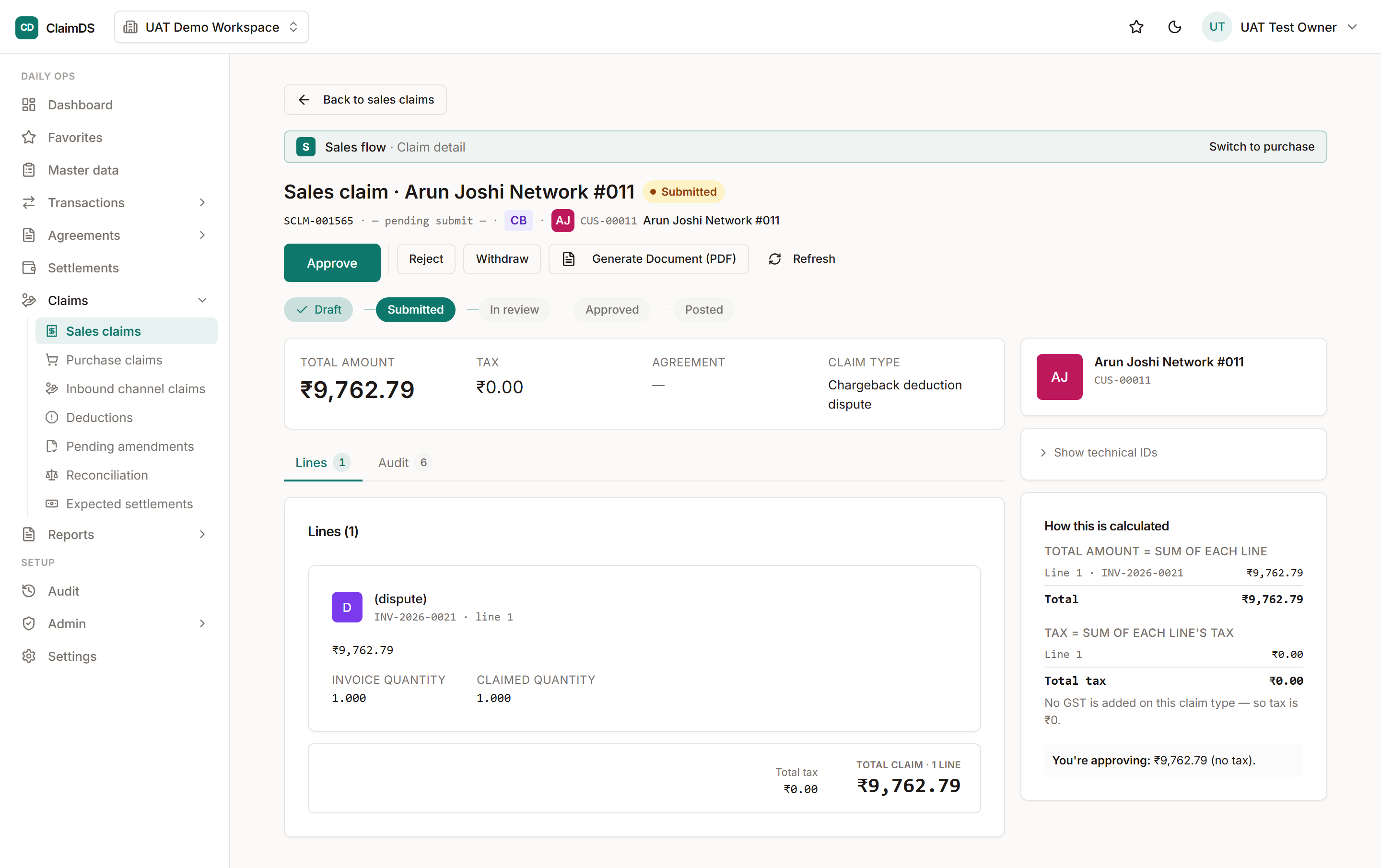
Speed, leakage control, fewer disputes, partner trust. Automated validation and settlement close claims faster, catch overpayments and duplicates, and give partners provable statements — turning a dispute-prone process into a controlled one. Any quantified benefit should be your own measured result, not a borrowed statistic. The finance framing is in the CFO revenue-leakage playbook.
How to choose for the FMCG sector
FMCG adds high scheme velocity, primary + secondary schemes, and damage/expiry interplay — so weight secondary-scheme handling and buyback/deduction interplay heavily. The FMCG feature detail is in rebate software features for FMCG; the pillar is claims management software.
How do you gather requirements before evaluating?
Before any demo, run a claim census on your own operation — most evaluation failures trace back to requirements nobody wrote down. It is also worth reading the real challenges of implementing rebate software in India first, because several of them are conditions you can assess before you shortlist anyone. Capture:
- Claim types and volumes — how many scheme, damage, expiry and price-difference claims you process per month, and the ₹ value of each stream. A business settling ₹4 crore of trade spend a year across 2,000 claims has a very different requirement from one settling ₹40 lakh across 150.
- Scheme structures in force — pull your last two quarters of circulars and list every structure: slabs, per-unit quantity schemes, targets, growth, festive top-ups. The tool must model your messiest one, not the average.
- Tiers and data sources — which tiers claim (super-stockist, distributor, dealer), and where the qualifying data lives: ERP billing, DMS secondary sales, physical evidence.
- Settlement modes — the split between tax credit notes, financial credit notes and payouts, because that determines the GST depth you need.
- Today's pain, quantified — settlement TAT, dispute rate, known leakage. This becomes the baseline you measure the tool against; the failure catalogue in challenges of manual rebate processing is a useful prompt list.
How do you score features across vendors?
Turn the census into a weighted scoresheet and force every vendor through the same grid:
| Criterion | Weight | Score each vendor 1–5 on |
|---|---|---|
| Scheme modelling depth | 25% | Your three messiest circulars configured live |
| Claim validation | 20% | Rules catching a planted bad claim |
| GST settlement | 20% | Correct credit-note type chosen by rule |
| Integration | 15% | Native connectors for your ERP/DMS |
| Partner visibility | 10% | Portal showing accruals and claim status |
| Usability + reporting | 10% | Your team navigating unaided |
Multiply weight by score, total, and keep the working — the numbers matter less than forcing like-for-like comparison. Anything scored below 3 on a 20%+ criterion is a red flag regardless of the total.
Which demo scenarios should you run?
Ask each vendor to run these three on your data, live, and watch for hesitation:
- Slab recalculation with returns. Load a month of purchase data for one distributor sitting just above a slab boundary — say ₹15,40,000 against a ₹15,00,000 slab break — then post a ₹1,00,000 return and watch whether the accrual drops a slab automatically. Manual recalculation here is exactly the error the tool exists to remove; the arithmetic is in how to calculate FMCG distributor claims.
- Secondary claim validation. Submit a secondary claim of ₹1,20,000 against DMS data that only supports ₹1,05,000 for the scheme window, with a few retailer returns inside it. The system should validate to the data, flag the gap, and show its working — the data dependency is unpacked in secondary scheme settlement.
- Deduction matching. A distributor short-pays an invoice by ₹85,000 citing pending claims. Can the system match the deduction to specific claims, split matched from unmatched, and leave the residue as a dispute? The discipline is covered in deduction management best practices.
A vendor who asks to "come back next week" on any of these is telling you something about the engine.
What should you ask on reference calls?
Insist on two references in your industry and ask about the unhappy path:
- How long did implementation actually take versus the sales estimate, and what caused the gap?
- Which of your scheme structures could not be configured natively and needed workarounds?
- How did the ERP/DMS integration behave after go-live — data gaps, sync failures, reconciliation effort?
- What is support response like at quarter-end, when everything is urgent at once?
- Did leakage or settlement TAT measurably improve, by your own numbers?
- What would you negotiate differently in the contract?
How do you assess implementation readiness?
The vendor's implementation plan matters less than your side of it. Check four things before signing: your master data (partner, product and scheme masters clean enough to load), your integration surface (ERP and DMS access confirmed with the people who own them — the patterns in the ERP integration guide apply), your open-claim migration plan (what happens to in-flight claims and historical accruals at cutover), and a parallel-run pilot where the system's numbers are reconciled against your current process for at least one full scheme cycle before you switch. The sequencing playbook is in rebate automation implementation best practices.
What will it really cost?
Score total cost of ownership, not licence price: licence + implementation + integration effort + internal time, weighed against the leakage and effort it removes — the sizing logic and price bands are in the rebate software pricing guide, and the recovery side of the equation in revenue leakage in rebate programs. A tool whose annual cost is a small fraction of your measurable leakage pays for itself on control alone; one that costs more than the spend it manages does not.
Where to buy in India
Buy through vendor demos and cross-read independent reviews on G2, Capterra India and SoftwareSuggest. Insist on a demo against your own schemes and a pilot quarter. Weigh cost with the rebate software pricing guide, and check the ERP integration guide before signing — integration is where deployments succeed or stall.
Evaluation scorecard
| Criterion | Weight | "Good" looks like |
|---|---|---|
| Claim-type breadth | High | Scheme + damage + expiry + price-diff in one ledger |
| Multi-tier RTM | High | Super-stockist → dealer native + secondary schemes |
| GST settlement | High | Correct credit-note type by rule |
| Integration | Medium | Works with your ERP/DMS |
| Cost vs leakage | Medium | Licence well below recoverable leakage |
Where RebateLedger fits
RebateLedger handles the full distributor claim taxonomy in one India-first product, with multi-tier RTM fidelity and GST credit-note depth, at a mid-market price (a RebateLedger-supplied ~₹3–5 lakh/yr figure, positioning not a benchmark). Its realistic peers are Indian DMS/SFA platforms, not Western suites. See best rebate management software, distributor rebate software and why RebateLedger.
Once you have shortlisted, the next question is how to run the project: from proof of concept to go-live covers what a PoC must test on your own data, the go-live checklist, and what to measure in the first ninety days.
GST note: Claims settle via GST credit notes — see financial vs. tax credit notes. General information, not tax advice.
Frequently asked questions
What is the best distributor claims software in India?
There's no single best — the right choice depends on your claim-type breadth, multi-tier RTM fidelity, GST credit-note settlement, integration and budget. Score tools on those criteria, pilot on your own data, and choose on fit. For Indian mid-market, India-first claim-settlement software such as RebateLedger is built for these requirements.
What features should distributor claims software have?
Claim capture across types, validation against scheme rules, approval workflows, GST-correct settlement, a distributor portal for visibility, an audit trail, analytics, and ERP/DMS integration. For FMCG, add secondary-scheme handling and damage/expiry interplay.
Where do you buy distributor claims software in India?
Through vendor websites and demos, and by cross-reading independent reviews on G2, Capterra India and SoftwareSuggest. Insist on a demo run against your own schemes and a pilot before committing — buy on fit, not on demo polish.
What demo scenarios should you run before buying distributor claims software?
Run three on your own data: a slab recalculation where a posted return drops a distributor into a lower slab, a secondary claim validated against DMS data with a deliberate window mismatch, and a deduction-matching case where a short payment is matched to its underlying claims. Each exposes engine depth that a scripted demo hides.
What should you ask a vendor's reference customers?
Ask about the messy parts, not the happy path: how long implementation actually took versus what was quoted, which scheme structures could not be configured and needed workarounds, how the DMS/ERP integration behaved after go-live, what support responsiveness looked like at quarter-end, and what they would negotiate differently.
What does implementing distributor claims software involve?
Four workstreams dominate: master data (partners, products, tiers, scheme definitions), integration with the ERP and DMS, migration of open claims and historical accruals, and a parallel-run pilot where the system's numbers are reconciled against the current process before cutover. Readiness on your side matters as much as the vendor's.
Can distributors track their claim status online like a courier shipment?
Yes — status transparency is a standard feature of modern claims platforms and one of the biggest drivers of distributor satisfaction. Each claim moves through visible stages — submitted, under validation, query raised, approved, credit note issued, settled — with timestamps at every transition. The distributor sees the full pipeline and value at each stage, replacing ritual phone calls to area managers, and the company's team answers far fewer status queries.
Can rebate software also handle damage and expiry claims, not just rebates?
Yes — mature channel-claims platforms treat damage, expiry, shortage and transit-loss claims as first-class claim types alongside scheme rebates, because distributors experience them as one settlement relationship. These claims differ operationally: they need physical evidence such as photographs and delivery challans, policy-based validation with percentage caps and claim windows rather than scheme calculations, and their own settlement classifications. One platform for both means one ledger and one reconciliation.
See RebateLedger on your own claims data
A 30-minute walkthrough tailored to how your channel actually settles claims.