
Features to Look for in Rebate Software for FMCG Companies
FMCG-specific rebate software features — high scheme velocity, primary plus secondary schemes, damage/expiry interplay and GST credit-note volume.
In short
Rebate software for FMCG has to handle what makes FMCG hard: high scheme velocity, primary and secondary schemes across many tiers, damage and expiry interplay with buybacks, modern-trade versus general-trade terms, high SKU counts and high GST credit-note volume. Score tools against those pains, feature by feature.
Rebate software for FMCG has to handle what makes FMCG hard: high scheme velocity, primary and secondary schemes across many tiers, damage/expiry interplay with buybacks, modern- vs general-trade terms, high SKU counts and high GST credit-note volume. This is the FMCG feature list — each pain mapped to the feature that solves it.
Why FMCG is a different problem
FMCG runs high volume on thin margins with dense, fast-changing schemes. A single distributor can face hundreds of schemes, claims and deductions a month, and most promotion value lives in secondary scheme settlement — a tier away from the manufacturer. This is the FMCG cut of the rebate management software pillar; the choosing process is in how to choose rebate software for retail.
Related reading: how claims and rebates work across the Indian FMCG channel.
FMCG pains → the feature that solves each
| FMCG pain | Feature to look for |
|---|---|
| Monthly/fortnightly scheme velocity | Fast scheme setup as reusable rules |
| Primary + secondary schemes | Native multi-tier RTM + sell-through capture |
| Damage & expiry returns | Buyback interplay in the same ledger (buyback in FMCG) |
| Modern vs general trade | Different terms modelled per channel |
| High SKU counts | Bulk master-data + SKU-level accrual |
| High credit-note volume | GST-correct settlement at scale |
| Distributor deductions | Deduction validation + recovery (FMCG chargebacks) |
How fast does FMCG scheme velocity really run?
Faster than any other sector's. A typical FMCG month carries the base slab scheme, a QPS on the focus brand, a display program in top outlets — and then the festive season stacks top-ups on all of it. Stacking is the stress test: every layer computes on the same purchase base, the layers are designed by different people, and the circulars rarely say whether a Diwali top-up compounds with, replaces or caps against the running slab. The full taxonomy of what gets stacked is in types of trade schemes in India.
Illustrative example. October, one distributor: base slab pays 1.5% on ₹20,00,000 net purchases (₹30,000); a Diwali top-up adds 1% on the same base (₹20,000); a brand booster pays ₹12/case on 900 cases of the focus brand (₹10,800). Stacked scheme cost: ₹60,800 — more than double the base — and finance only sees it building if the software computes all three layers per distributor as the month runs, rather than at claim time. The feature to demand is layer-aware accrual: each scheme as its own rule, explicit interaction logic, and one combined liability view per distributor. Longer-running points programs stack on top of all this too — see channel loyalty programs — and the per-distributor arithmetic is worked through in how to calculate FMCG distributor claims.
Why does secondary data make or break FMCG rebates?
Most FMCG promotion value settles on secondary sales — the distributor's billing to retailers — which the manufacturer never sees directly. The chain from factory to shelf is mapped in primary vs secondary vs tertiary sales; the software consequence is blunt: your rebate engine is only as good as its secondary-data intake. Look for four specific capabilities:
- Structured capture — DMS integration where it exists, disciplined templated uploads where it doesn't; the plumbing options are in ERP and DMS integration for claims and rebates.
- Window fidelity — sell-through counted for the exact scheme dates, net of retailer returns, not "the month roughly".
- Plausibility checks — secondary claims validated against primary purchases and stock norms; a distributor cannot sell 8,000 cases having bought 5,000 and held 1,000.
- Gap handling — explicit rules for partners who submit no data (hold the claim, estimate with a haircut, or exclude), so missing data is a policy outcome rather than an argument.
How should expiry and damage interact with rebates?
FMCG stock dies on the shelf — expiry, damage, seasonal leftovers — and comes back as buyback and return claims that hit the same distributor ledger as scheme money. The interplay is where accounts quietly go wrong. Returns must net off the scheme base (a distributor whose ₹20,00,000 of purchases includes ₹1,50,000 of returns has ₹18,50,000 of scheme-eligible base — often one slab lower); return credits must not double-count against scheme credits; and each return needs the right credit-note treatment, which differs from scheme settlement — the GST mechanics are in credit notes for expired and damaged goods returns. The feature to look for is a single partner ledger where schemes, buybacks and deductions post together, so the net position per distributor is one number, not three spreadsheets that disagree.
How granular must SKU and batch tracking be?
Account-level accruals are systematically wrong in FMCG because almost nothing applies uniformly across the range. Rates differ by brand and pack size; boosters target specific SKUs; new launches carry their own support; and expiry claims are meaningless without batch identity. The workable floor is per-SKU accrual with batch capture on returns: every scheme rule addresses the product hierarchy (company → category → brand → SKU), the engine computes at invoice-line level, and return claims carry batch and expiry data so a damage claim can be tied to what was actually supplied. Demo test: ask the vendor to run one distributor's month where the focus brand pays ₹12/case, the rest of the range pays 1%, and ₹80,000 of expired stock comes back — and show the net credit note.
What about field-team claim capture?
FMCG evidence originates in the market — display photos, damaged-stock photos, retailer acknowledgements — and the traditional path (WhatsApp to the ASM, forwarded to email, retyped into Excel) is where it loses its date, its outlet identity and often itself. Mobile capture closes that gap: the salesperson or distributor uploads dated, geo-tagged evidence against the specific scheme and outlet at the moment it exists, and the claim arrives born-digital with its proof attached. The downstream effect is felt at validation — claims with structured evidence route straight through the approval workflow instead of bouncing for missing proof.
The FMCG must-have table
| Capability | The test that proves it |
|---|---|
| Layer-aware accrual | Stack a festive top-up on a live slab scheme and show combined liability per distributor |
| Secondary-data intake | Import one distributor's DMS extract and validate it against primary purchases |
| Returns netting | Show a return dropping a distributor one slab, automatically |
| Single partner ledger | One screen with schemes, buybacks and deductions netted per partner |
| Per-SKU / batch granularity | Run a mixed-rate month with a batch-tagged expiry claim |
| Mobile evidence capture | Upload a dated display photo from a phone into a claim |
| GST credit-note scale | Generate a settlement run's credit notes with correct tax treatment per type |
The two FMCG must-haves
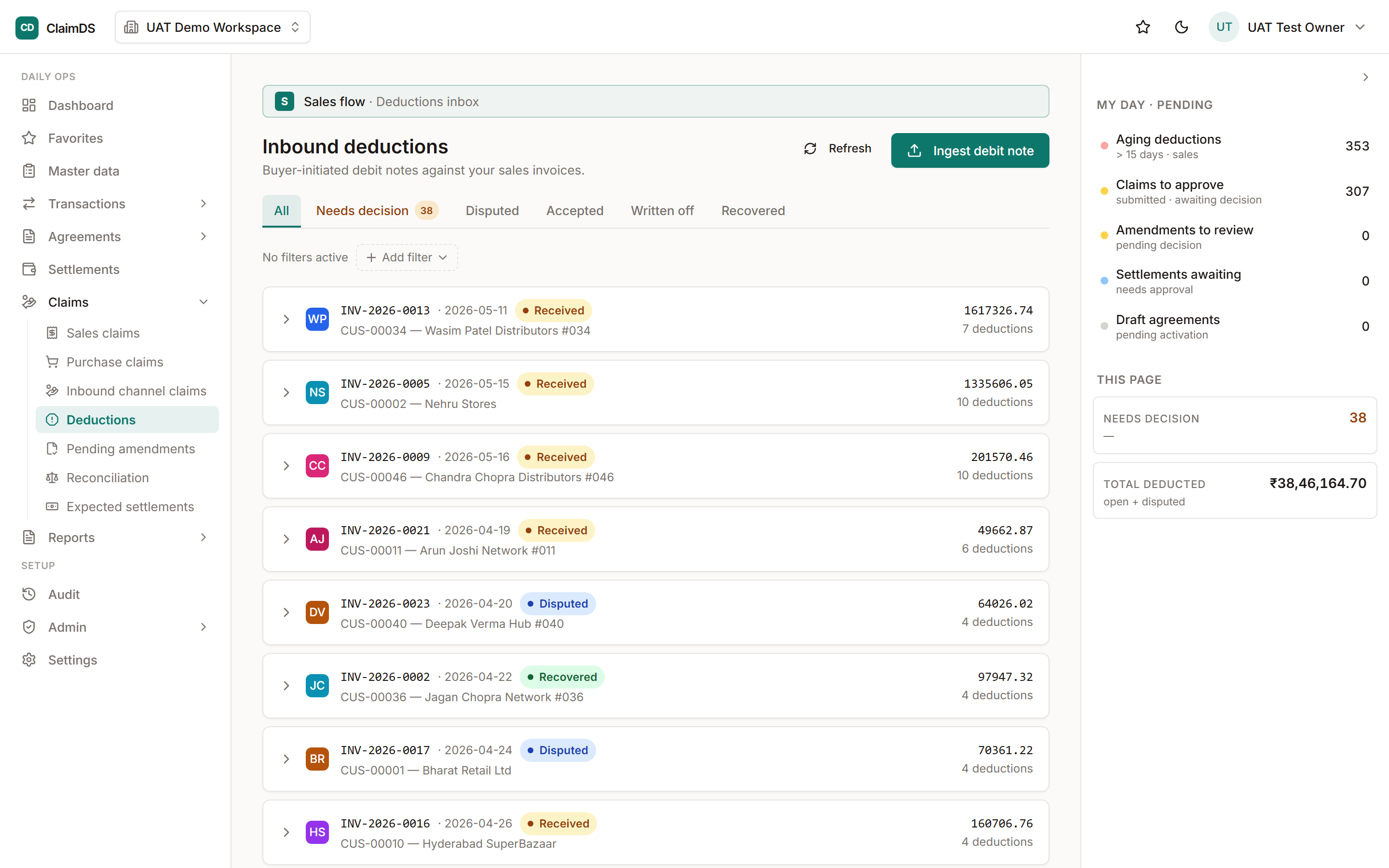
Secondary-scheme capture and deduction control are where FMCG money is made or lost. Secondary schemes need structured sell-through data validated against primary purchases; deductions need validation against agreements so the flood becomes a managed queue rather than silent write-offs. Both are volume problems only software solves at FMCG scale.
Where RebateLedger fits
RebateLedger models primary and secondary FMCG schemes natively, keeps buyback and deductions in the same claim ledger, and settles by GST-correct credit note — India-first, at a mid-market price (a RebateLedger-supplied ~₹3–5 lakh/yr figure, positioning not a benchmark). Its realistic peers are Indian DMS/SFA platforms rather than Western suites. Continue with the core features checklist and why RebateLedger.
GST note: FMCG settles a high volume of credit notes; the type used carries ITC consequences. This article is general information, not tax or legal advice; GST positions — including CBIC Circular No. 251/08/2025-GST and the Finance Act 2026 amendments to Section 34 of the CGST Act (assented 30 March 2026, not yet notified into force as of publication) — must be re-verified at publish time with a qualified professional.
Frequently asked questions
What rebate software features do FMCG companies need?
FMCG needs high scheme velocity (monthly/fortnightly schemes), primary and secondary scheme handling across super-stockist to retailer, damage and expiry interplay with buybacks, modern-trade vs general-trade terms, high-SKU support, and high-volume GST credit-note settlement — each mapped to a specific FMCG pain.
Why is FMCG rebate management harder than other sectors?
FMCG runs high volume on thin margins with dense, fast-changing schemes across many tiers, so the sheer number of schemes, claims and deductions per month overwhelms spreadsheets. Most of the value — and leakage — sits in secondary schemes, where the data lives a tier away from the manufacturer.
How does FMCG rebate software handle secondary schemes?
By capturing distributor-reported sell-through data by SKU and retailer within the scheme window, validating it against primary purchases and the agreement, and settling to the distributor by GST credit note — the discipline that makes secondary settlement reliable rather than an estimate.
How does rebate software handle festive scheme stacking?
By modelling each layer — the base slab, the festive top-up, any brand-specific booster — as its own rule on a shared base, with explicit interaction logic for whether layers compound, replace or cap against each other. The accrual then computes all layers together per distributor, so the finance team sees the stacked cost building during the season instead of discovering it at settlement.
Why does FMCG rebate software need SKU and batch-level tracking?
Because FMCG schemes are rarely uniform across the range — rates differ by brand, pack size and SKU, festive boosters target specific lines, and expiry or damage claims are meaningless without knowing which batch came back. Accruals computed at account level instead of SKU level are systematically wrong for any scheme with a differentiated rate.
Can field teams capture FMCG claims on mobile?
They should be able to — display photos, damage evidence and scheme documents originate in the market, not at a desk. Software that lets a salesperson or distributor upload dated, geo-tagged evidence from a phone at the point it exists removes the WhatsApp-to-email-to-spreadsheet chain where FMCG evidence is most often lost.
See RebateLedger on your own claims data
A 30-minute walkthrough tailored to how your channel actually settles claims.