
Vendor Rebate Management Software & Systems (India)
Vendor rebate management software automates accrual, claims and credit-note settlement of vendor-funded rebates. Features, checklist and GST fit.
In short
Vendor rebate management software automates how a business tracks, accrues, claims and settles rebates funded by its vendors: it turns vendor agreements into structured data, accrues earned amounts in real time, validates claims against vendor statements and reconciles the final GST-compliant credit note.
Vendor rebate management software automates how a business tracks, accrues, claims and settles rebates funded by its vendors. It turns vendor rebate agreements into structured data, accrues earned amounts in real time, validates claims against vendor statements and reconciles the final GST-compliant credit note — replacing the spreadsheets where vendor money quietly goes missing.
What it is
Vendor rebates are amounts a business earns back from the vendors and principals it buys from — volume rebates, growth incentives, marketing-support rebates and program funds. They are real income, but because they arrive after the purchase and settle by credit note, they are easy to under-claim. It belongs to the same family as supplier rebates on the buy side and links up to the rebate management software pillar — in practice the category overlaps almost completely with supplier rebate management software, since the same accrual, claim and reconciliation engine handles both labels.
Why vendor rebates leak
Agreements live in emails and PDFs no one totals; accruals are estimated, not calculated; claims are filed late or not at all; and vendor credit notes arrive that nobody reconciles line by line. On a mid-market purchase base, even a fraction of a percent of unclaimed vendor rebate is material money left on the table.
Features buyers evaluate
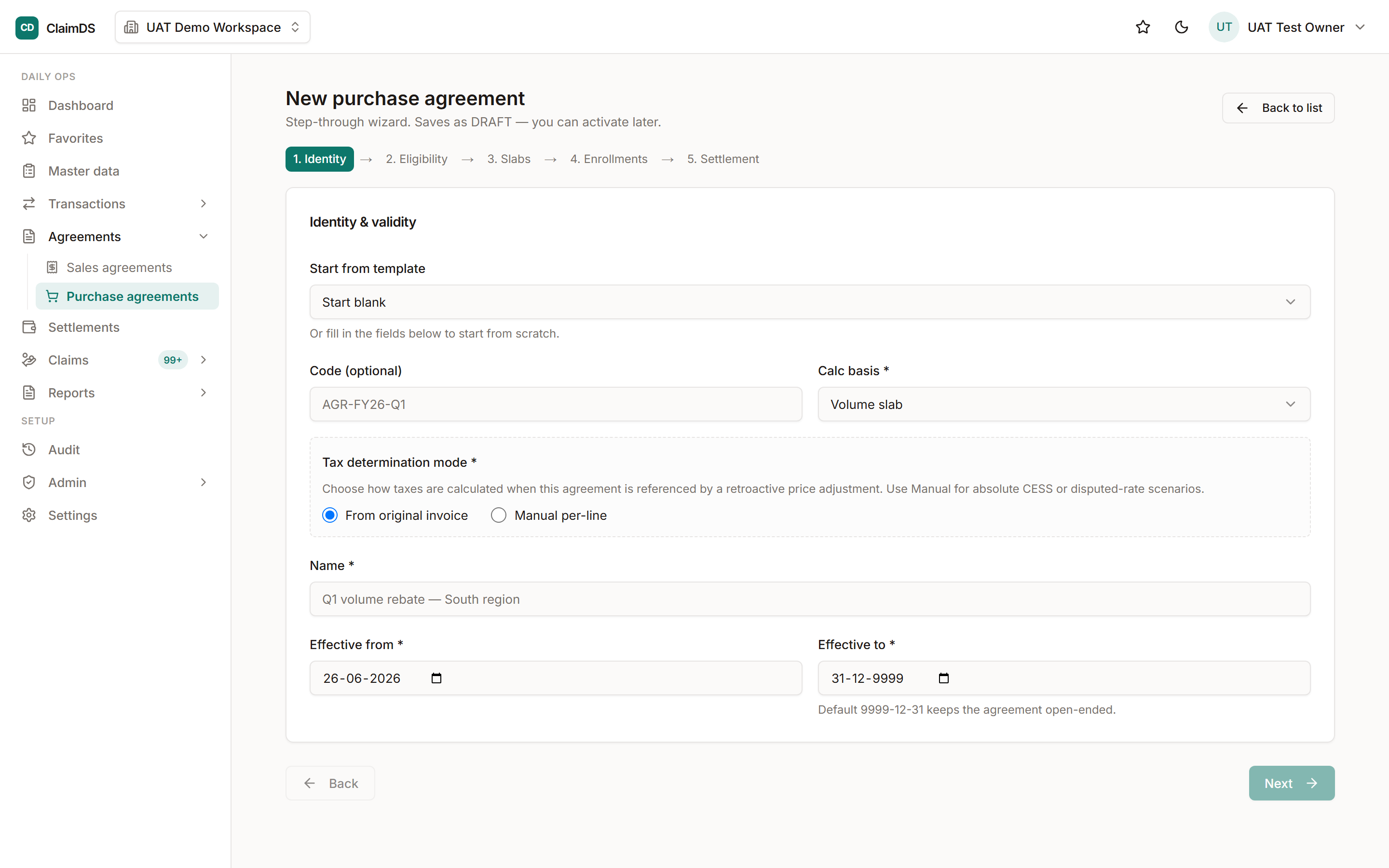
Shortlist: agreement modelling · real-time accrual · claim validation · vendor-statement reconciliation · ERP/accounting integration · GST-correct credit notes · audit trail. The features that separate strong tools from weak ones are accrual accuracy, reconciliation that matches the vendor's credit note to your expected amount, and breadth — so vendor, distributor and dealer rebates share one ledger. Breadth matters most when principals run complex supplier rebate programs — multi-product slabs, growth kickers, mixed program funds — or layer on supplier rewards such as marketing support and display allowances; a tool that only models flat percentages pushes exactly those back into spreadsheets. For the recognition mechanics, see rebate accounting and rebate tracking software.
GST credit-note handling
Like all Indian rebate settlement, vendor rebates resolve through a credit note — and the choice between a tax and a financial credit note carries different ITC consequences. Software should issue the correct instrument by rule, not by habit. See financial vs. tax credit notes and CBIC Circular 251.
GST note: This article is general information, not tax or legal advice. GST positions — including CBIC Circular No. 251/08/2025-GST and the Finance Act 2026 amendments to Section 34 of the CGST Act, assented 30 March 2026 but not yet notified into force as of publication — must be re-verified at publish time with a qualified professional.
Buyer's checklist
| Check | Why it matters |
|---|---|
| Models your vendor agreement types | Slab, growth and program rebates differ in math |
| Live accrual vs purchases | Finance sees the real receivable any moment |
| Reconciles to vendor credit notes | Catches under-settlement automatically |
| GST-correct credit-note logic | Avoids ITC-reversal disputes |
| Integrates with ERP/accounting | No double entry; clean books |
| Immutable audit trail | Defensible at assessment and in disputes |
RebateLedger covers vendor rebates within a single India-first claim-settlement product — compared fairly in the best rebate management software guide and Vistex alternatives.
Frequently asked questions
What is vendor rebate management software?
Vendor rebate management software automates how a business tracks, accrues, claims and settles rebates funded by its vendors. It captures vendor rebate agreements, accrues earned amounts against purchases or sales, validates claims and reconciles the final credit-note settlement, replacing manual spreadsheets.
What features should vendor rebate software have?
Key features include vendor agreement modelling, accurate accrual, claim validation, reconciliation against vendor statements, integration with ERP or accounting systems, GST-correct credit-note handling, and an audit trail for every rebate.
How are vendor rebates settled under GST in India?
Vendor rebates are usually settled by credit note. Whether a tax credit note (with ITC reversal) or a financial credit note (no ITC reversal) applies depends on whether the discount meets the Section 15(3)(b) conditions, as clarified by CBIC Circular 251/08/2025-GST.
What does a supplier rebate system do?
A supplier rebate system does four jobs: it stores every rebate agreement with its rates, tiers and periods; it measures purchase data from your ERP against each agreement; it computes what each supplier owes you and flags approaching thresholds and claim deadlines; and it reconciles credit notes received against entitlements earned. It also reports rebate receivables by supplier and ageing for margin analysis.
Can you manage supplier rebates in Excel?
Yes, up to a point. A small buyer with a handful of agreements can run a workable Excel register. The approach breaks down as complexity grows — concurrent schemes, tiered and growth structures, returns netting, and several people needing one live view. Missed claim cut-offs, stale purchase extracts and absent audit trails are the warning signs that you have outgrown the spreadsheet.
How do I get started with vendor rebate management?
Start with your top ten vendors, which usually drive most purchases: document their rebate terms, assign clear ownership, and establish a purchase-data pipeline that is vendor-wise, net of returns and ex-GST. Compute current and prior-period entitlements — late claims within the cut-off are often recoverable — set alerts for every deadline, and reconcile each credit note against your own computed entitlement.
What KPIs should you track for supplier rebate management?
Six KPIs cover the discipline: claim rate (entitlements claimed versus computed), recovery rate (settled versus claimed), days-to-settle by supplier, unsettled ageing in 30, 60 and 90-day buckets, forecast accuracy (accruals versus final settlements), and rebate yield (rebates earned as a share of qualifying purchases). Reviewed monthly, a falling claim rate or a lengthening settlement cycle flags process decay early.
How does supplier rebate management work in retail?
Retail chains earn rebates from the brands and distributors they buy from — volume rebates, range and display support, launch incentives and festive programmes. The complexity is scale: thousands of SKUs, multiple supply routes and returns that adjust the rebate base. Best practice is SKU-level purchase capture mapped to each agreement, monthly entitlement calculation, and keeping pure rebates separate from paid promotional services, which are treated differently for GST.
See RebateLedger on your own claims data
A 30-minute walkthrough tailored to how your channel actually settles claims.