
Distributor Rebate Software & Programs (India)
Distributor rebate software for Indian multi-tier RTM — slab and growth schemes, accrual, claim validation and GST credit-note settlement.
In short
Distributor rebate software automates the design, accrual, claiming, validation and credit-note settlement of the rebate schemes a manufacturer runs for its distributors — slab, volume and growth incentives — across multi-tier Indian route-to-market, replacing spreadsheets with one auditable record.
Distributor rebate software automates the design, accrual, claiming, validation and credit-note settlement of the rebate schemes a manufacturer runs for its distributors — slab, volume and growth incentives — across multi-tier Indian route-to-market. It replaces error-prone spreadsheets with one auditable record of what each distributor has earned and what has been settled.
Distributor rebate program types
Indian manufacturers run several distributor incentive structures at once, and the messiest ones leak the most. Common types include slab and volume rebates, growth/target rebates, and combination or mix-basket schemes. These flow down the channel and often pair with secondary schemes below the primary. The umbrella view is in rebate management software; the claim side is in distributor claims management. If the vocabulary itself is the confusion — supplier versus dealer versus trade-scheme incentive — this guide draws the line.
A worked slab-scheme example
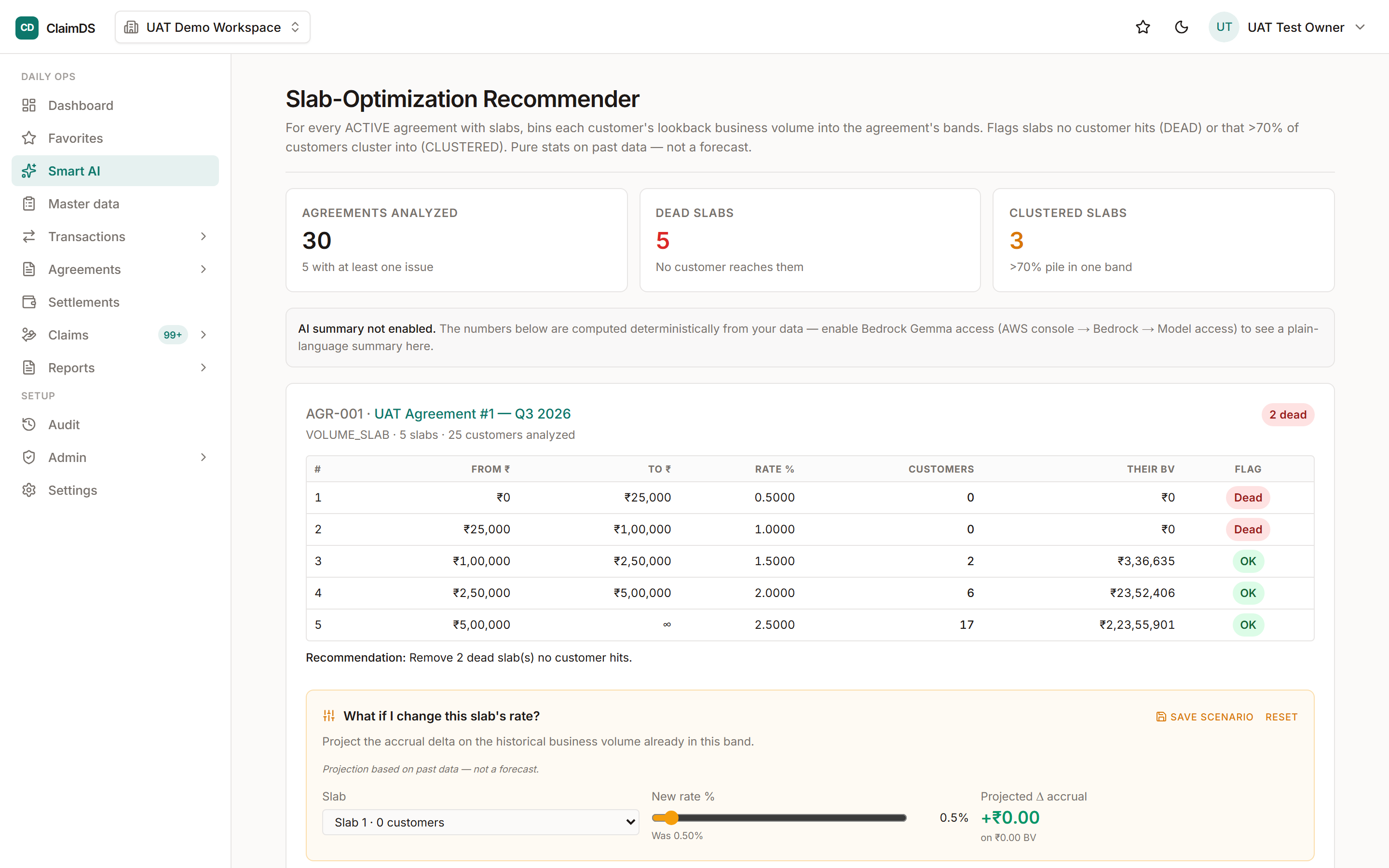
A distributor does ₹80,00,000 in a quarter against a scheme: 1% up to ₹50 lakh, 1.5% on the next ₹25 lakh, 2% above ₹75 lakh.
| Slab | Turnover in band | Rate | Rebate |
|---|---|---|---|
| Up to ₹50,00,000 | ₹50,00,000 | 1.0% | ₹50,000 |
| ₹50–75,00,000 | ₹25,00,000 | 1.5% | ₹37,500 |
| Above ₹75,00,000 | ₹5,00,000 | 2.0% | ₹10,000 |
| Total | ₹80,00,000 | — | ₹97,500 |
Done by hand, a single mis-keyed slab boundary changes this number every cycle. Software applies each band correctly and accrues the running total as sales post.
What the software does
It captures the scheme as structured data, accrues against actual distributor sales in real time, validates each claim against the agreement, and settles via a GST-correct credit note with a full audit trail. Finance gains a live view of total scheme liability; distributors get faster, provable settlements.
What do distributors need from rebate software?
The distributor is the persona most tools forget. A mid-size distributor might carry six brands with three or four live schemes each — call it twenty concurrent schemes with different slabs, windows and proof requirements (illustrative, and not unusual). What that distributor needs is specific:
- Multi-brand statements. One running statement per brand showing every scheme, the attainment so far, the accrued amount and what has settled — instead of reverse-engineering all of it from credit notes at quarter-end.
- Scheme visibility upfront. Slabs, eligibility, windows and documentation requirements published at launch, while there is still time to chase the next slab — not discovered at settlement.
- Simple claim submission. Raising a claim with documents attached in minutes, in the format the brand will actually accept — the discipline in how to submit a rebate claim request.
- Status traceability. Where each claim sits, and a reason for anything rejected — the antidote to the quiet losses catalogued in why distributor rebate claims slip through the cracks.
A concrete statement line (illustrative): Brand X, Q2 volume scheme — attainment ₹42,00,000 against a ₹50,00,000 slab boundary, ₹42,000 accrued at 1%, ₹8,00,000 short of the 1.5% slab with five weeks left. A distributor who can read that line acts on it; one who cannot finds out in August what it should have done in June. For a distributor these are working-capital questions, not reporting niceties — every unclaimed or stuck rebate is margin already earned but not yet received.
What do manufacturers need on their side?
The manufacturer's needs are the mirror image, one level up:
- Per-distributor ledgers. For every distributor — accrued, claimed, approved, settled, disputed — one ledger that finance, the sales team and the distributor's own statement all agree with.
- Approval workflows. Thresholds, delegation and escalation, so a ₹15,000 claim moves fast while a ₹15,00,000 claim gets the scrutiny it warrants — the patterns are in claim and rebate approval workflows.
- A live liability view. Total scheme exposure across all distributors, updating as sales post, so provisions are numbers rather than estimates.
- Data-in without re-keying. Distributor sales and stock arriving through ERP and DMS integration rather than spreadsheets over email.
- An audit trail. Every accrual, approval and credit note traceable years later — for statutory auditors and for GST assessment alike.
Finance cares about one more thing: that the accrual released at settlement equals the credit note issued, scheme by scheme. That reconciliation is what keeps provisions honest.
Which features serve which persona?
| Capability | What the distributor needs | What the manufacturer needs |
|---|---|---|
| Statements | One statement per brand, all schemes, always current | One ledger per distributor, reconciled to the GL |
| Scheme visibility | Slabs, windows and eligibility published at launch | Controlled publication, with versioning when terms change |
| Claims | Fast submission with documents attached | Validation against the agreement and sales data |
| Approvals | Status visibility and rejection reasons | Thresholds, delegation and SLA tracking |
| Settlement | Credit notes that reconcile to specific claims | GST-correct note type and clean liability release |
| History | Past statements for cash-flow planning | An immutable trail for disputes and assessment |
A tool built for only one side pushes the other side's work back into email and Excel — the distributor gets a portal but the manufacturer approves by spreadsheet, or the manufacturer gets a ledger but distributors still claim over WhatsApp. The systems that actually reduce disputes are the ones where both personas read the same number.
Multi-tier RTM and secondary schemes
Indian distribution rarely stops at the distributor. Schemes operate across super-stockist, distributor, sub-stockist and dealer tiers, and secondary schemes reward sell-through to retailers. Good software models those tiers natively rather than flattening them — the reason generic or Western tools struggle, discussed in Vistex alternatives and why RebateLedger.
GST settlement
Distributor rebates settle by credit note, and the tax versus financial credit-note choice matters for ITC. See financial vs. tax credit notes and CBIC Circular 251.
GST note: This article is general information, not tax or legal advice. GST positions — including CBIC Circular No. 251/08/2025-GST and the Finance Act 2026 amendments to Section 34 of the CGST Act, assented 30 March 2026 but not yet notified into force as of publication — must be re-verified at publish time with a qualified professional.
What to look for
- Native slab/growth/mix-basket modelling and accurate accrual.
- Multi-tier RTM and secondary-scheme support.
- GST-correct credit-note settlement and reconciliation.
- Breadth: distributor, dealer and vendor rebates in one product.
- An immutable audit trail for disputes and assessment.
Score options with the best rebate management software framework before you commit. The end-to-end tracking discipline behind these schemes is laid out in channel partner incentive tracking.
How do you shortlist and buy?
Start from the buyer-side playbooks rather than vendor demos. The distributor claims software buyer's guide gives the scripted-demo method — run your own schemes and claims through each candidate and score what you see, not what the deck says. The India-specific shortlist criteria for distributor and dealer networks add the multi-tier and GST tests that global comparisons skip. If you are a smaller business, right-size the exercise with the SMB rebate software guide and sanity-check budgets against rebate software pricing in India. And check ERP fit early: if your books run on Tally Prime, see rebate management with Tally Prime; if on Busy, see rebate tracking with Busy ERP. In most evaluations the deciding factor turns out to be how sales data gets in, not the length of the feature list.
Frequently asked questions
What is distributor rebate software?
Distributor rebate software automates the design, accrual, claiming, validation and credit-note settlement of rebate schemes a manufacturer runs for its distributors — slab, volume and growth incentives — across multi-tier Indian route-to-market, replacing spreadsheets with one auditable record.
How does a slab-based distributor rebate work?
A slab rebate pays a rising percentage as a distributor crosses defined turnover slabs — for example 1% up to a first slab, 1.5% above it, 2% above the next. Software applies the correct rate to each band and accrues the running total automatically.
How are distributor rebates settled in India?
Usually by GST credit note. The choice between a tax credit note (with ITC reversal) and a financial credit note (no reversal) depends on whether the scheme meets the Section 15(3)(b) conditions, per CBIC Circular 251/08/2025-GST.
What do distributors themselves need from rebate software?
Multi-brand statements showing attainment and accruals per scheme, scheme terms visible at launch rather than at settlement, simple claim submission with documents attached, and status traceability for every claim. For a distributor these are working-capital questions — an unclaimed rebate is margin earned but not received.
Does distributor rebate software work with Tally or Busy?
It should. Most mid-market Indian channel businesses keep their books on Tally Prime or Busy, so the software must import sales, purchase and credit-note data from them rather than forcing re-keying. Treat the integration demo — your data, your chart of accounts — as a shortlist gate, not an afterthought.
How do approval workflows speed up rebate settlement?
By routing claims to the right approver automatically, with thresholds and delegation — small claims clear fast, large ones get scrutiny, and nothing waits in an inbox. Rejections carry reason codes, so distributors fix and resubmit instead of guessing, which shortens the cycle on both sides.
Why does distributor ROI matter when designing incentive programs?
Distributor ROI — annual earnings from margin plus rebates, divided by working capital in stock and market credit — decides whether the channel stays invested in your brand. If it drifts below alternatives, coverage and service quietly decay regardless of scheme generosity. Design from the maths: rebates repair thin-margin categories, consistency bonuses reward year-round capital, payment discipline shrinks the base itself.
How do FMCG companies link distributor incentives to secondary sales?
By computing incentives from DMS data — the distributor's billing to retailers — rather than primary purchases: value sold to retail, outlet coverage, lines per call, new outlets. This prevents distributors loading at quarter end to hit primary slabs while stock sits in godowns. Prerequisites: reliable DMS adoption, current price masters, and audits against physical stock to deter fake entries. Payouts still settle by credit note.
See RebateLedger on your own claims data
A 30-minute walkthrough tailored to how your channel actually settles claims.