
How to Submit a Rebate / Claim Request (Step-by-Step)
How to submit a rebate or claim request step by step — documents required, referencing invoices and schemes, claim statuses and rejection reasons.
In short
To submit a rebate or claim request: confirm the scheme covers your claim and is in-window, gather the required documents, reference the specific invoices and scheme number, submit with the correct amount and complete evidence, then track it through validation, approval and settlement. Most rejections come from missing documents or out-of-window timing.
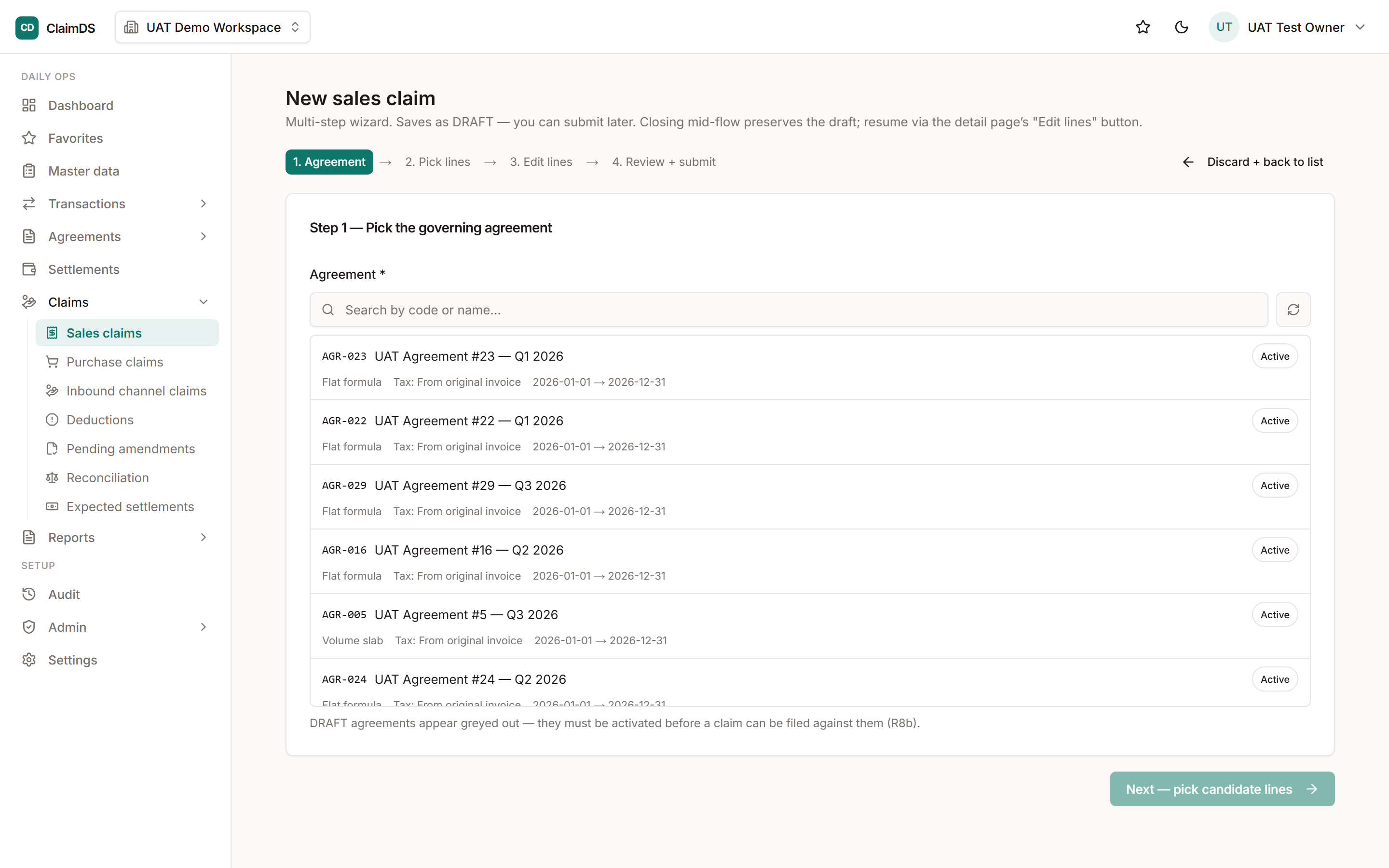
To submit a rebate or claim request: confirm the scheme covers your claim and is in-window, gather the required documents, reference the specific invoices and scheme number, submit with the correct amount and complete evidence, then track it through validation, approval and settlement. Most rejections come from missing documents or out-of-window timing — both avoidable.
The five steps
- Confirm eligibility. Check the scheme or agreement actually covers your claim and you are within the claim window.
- Gather documents. Pull the invoices, scheme reference and any stock or damage evidence before you start.
- Reference invoices and scheme. Link the claim to specific invoices and the scheme/agreement number — vague references are the top cause of delay.
- Submit. Enter the correct amount with complete documentation attached.
- Track status. Follow the claim through validation, approval and settlement, responding quickly to any query.
This is the action-level companion to the claim process explained, under the claims management hub.
The pre-submission checklist: what to verify before you type anything
Nine out of ten rejection reasons are checkable before submission, which makes the pre-submission pass the highest-leverage five minutes in the whole process:
- The scheme covers you. Your outlet/region/tier is in scope, the products claimed are in the scheme's product list, and the period matches. Schemes come in many shapes — slab, target, visibility, QPS — and each defines eligibility differently; the types of trade schemes in India guide maps the landscape.
- The window is open. Note the scheme's claim-by date at scheme launch, not at quarter end. An expired window is the one rejection with no cure.
- The amount follows from the data. Recompute the claim from the rate and the eligible base before submitting — slab boundaries and excluded SKUs are where amounts go wrong. The full arithmetic walkthrough is in how to calculate FMCG distributor claims.
- Every document in the pack exists and is legible. A referenced-but-missing attachment is functionally identical to no attachment.
- No duplicate. Confirm the same invoices haven't already been claimed under the same scheme — duplicate claims are flagged fast and remembered long.
Documents you need
| Document | Why |
|---|---|
| Relevant invoices | Anchor the claim to real transactions |
| Scheme / agreement reference | Proves eligibility and the rate |
| Stock / damage records | For price-protection, buyback or damage claims |
| Calculation basis | Shows how the amount was derived |
What evidence does each claim type need?
The table above is the common core; each claim type adds its own layer. Submitting the wrong pack shape for the claim type is one of the quietest causes of rejection:
- Scheme / rebate claims — invoice list, scheme number, and the calculation showing rate × eligible base. If the scheme is a secondary scheme settled on sell-out, the sell-through data itself is the evidence — the mechanics are in secondary scheme settlement.
- Price-protection claims — a dated stock statement proving inventory on hand on the price-change date, plus the price-change communication. The credit-note treatment that follows is covered in price protection and rate-difference credit notes under GST.
- Damage / expiry claims — batch details, damage or expiry notes, and photographic evidence where the agreement requires it.
- Display / merchandising claims — the agreed plan and proof of execution (photos, audit reports) for the claimed period.
- Chargeback-style claims — the reference to the specific billback or chargeback arrangement; the recovery path when these are disputed runs through the chargeback dispute process.
Statuses your claim passes
Submitted → validated → approved → settled. Knowing the status at any moment — and what is needed to advance it — is half the battle, which is why a system beats email threads for claim submission. See the rebate-specific context in rebate management software and volume rebates.
What happens behind each status transition — who validates, which approver the value routes to, what SLA applies — is approval-workflow design, and it is worth understanding as a submitter too: a claim that arrives complete and clearly referenced sails through routing that a vague claim fights at every step. The brand-side view is in designing claim and rebate approval workflows.
Common rejection reasons (and the fix)
Most rejections are self-inflicted. Missing documents, out-of-window timing, a wrong amount, or a claim the scheme never covered — all caught by an eligibility check and complete evidence at submission. The operational view of reducing rejections is in distributor claims management.
Mapping each rejection to its prevention:
| Rejection reason | How to avoid it |
|---|---|
| Missing or illegible documents | Assemble the full evidence pack before opening the claim form; check every attachment opens |
| Out-of-window submission | Diary the claim-by date at scheme launch; submit early in the window, not on the last day |
| Amount doesn't match the calculation | Recompute from rate × eligible base; show the working in the claim |
| Scheme doesn't cover the claim | Run the eligibility check — scope, products, period — before drafting |
| Duplicate claim | Search for the invoice numbers before submitting |
| Vague references | Name the exact scheme number and list invoice numbers, never "Q1 scheme" |
Resubmission etiquette: how to come back from a rejection
A rejection with a coded reason is an invitation to fix and resubmit — handled well, it costs days; handled badly, it costs the relationship. Four rules:
- Fix what the reason says, completely. If the rejection cites a missing stock statement, resubmit with the stock statement — not with a promise of one.
- Reference the original claim. The reviewer should see the history in one place, not treat the resubmission as a stranger.
- Resubmit once. Batch every fix into a single resubmission. Drip-feeding corrections resets the review clock each time.
- Watch the resubmission window. Rejections usually carry their own deadline; an expired resubmission window closes the claim as surely as an expired claim window.
If the rejection itself seems wrong — the reviewer misread the scheme, or applied the wrong rate — that is a dispute, not a resubmission: contest it through the dispute path with your evidence, rather than resubmitting the identical claim and hoping for a different reviewer.
The claim-quality checklist
Run this ten-point pass before hitting submit — a claim that scores ten sails; each miss is a probable query loop:
| # | Check | Pass looks like |
|---|---|---|
| 1 | Scheme reference | Exact scheme/agreement number named |
| 2 | Eligibility | Scope, product list and period all confirmed |
| 3 | Window | Claim-by date verified open |
| 4 | Invoices | Specific invoice numbers listed, all in scope |
| 5 | Amount | Recomputed independently; matches to the rupee |
| 6 | Calculation basis | Working shown, slab/rate identified |
| 7 | Claim-type evidence | The right pack for the type (stock, damage, display proof) |
| 8 | Attachments | Every document present and legible |
| 9 | Duplicates | Invoice numbers not previously claimed |
| 10 | Contact | A named owner who will answer queries fast |
Speed and accuracy compound
Every clean submission trains the reviewing side to trust your claims, and trusted claimants get faster cycles — while every sloppy claim buys extra scrutiny for the next ten. The disciplines that make submission fast and accurate at volume — templates per claim type, evidence captured at the moment of the event rather than reconstructed at quarter end — are expanded in submitting rebate requests fast and accurately.
For the brand-side mirror of this article — giving your distributors and dealers a portal where eligibility, windows and evidence requirements are enforced at intake instead of policed after — see channel partner incentive tracking, or book a demo to watch a claim go from submission to settlement on live data.
GST note: This article is general information, not tax or legal advice. Where settlement involves GST credit notes, positions — including CBIC Circular No. 251/08/2025-GST and the Finance Act 2026 amendments to Section 34 of the CGST Act, assented 30 March 2026 but not yet notified into force as of publication — must be re-verified at publish time with a qualified professional.
Frequently asked questions
How do you submit a rebate or claim request?
Confirm eligibility against the scheme, gather the required documents, reference the specific invoices and scheme number, submit with the correct amount and complete documentation, then track the claim through validation, approval and settlement.
What documents are required for a claim?
Typically the relevant invoices, the scheme or agreement reference, and supporting evidence such as stock records or damage notes. Complete documentation at submission is the single biggest factor in avoiding rejection.
Why do claims get rejected?
Common reasons are missing or mismatched documentation, out-of-window submission, incorrect amount or calculation, and claims not covered by the scheme. Most rejections are avoidable with eligibility checks and complete evidence up front.
What is a claim window and why does it matter?
A claim window is the period a scheme allows for claims to be submitted after the scheme or period ends. Miss it and even a perfectly documented claim can be rejected outright — which is why the window date belongs on your pre-submission checklist, not in someone's memory.
Can a rejected claim be resubmitted?
Usually yes, if the rejection reason is fixable — a missing document, a correctable amount — and the resubmission window is still open. Fix exactly what the coded rejection reason says, reference the original claim so the reviewer sees the history, and resubmit once, complete. Repeated partial resubmissions erode credibility and slow every future claim.
Does the evidence pack differ by claim type?
Yes. Scheme and rebate claims rest on invoices plus the scheme reference and calculation; price-protection claims need dated stock statements proving inventory on hand at the price change; damage and expiry claims need the physical record (photos, debit/damage notes, batch details); display claims need proof of execution. Submitting a scheme-style pack for a stock-dependent claim is a common and avoidable rejection.
What are the most common mistakes distributors make when submitting claims?
The recurring mistakes: submitting after the window closes; lump-sum claims without invoice-wise annexures; arithmetic that does not tie to the annexure; claiming ineligible SKUs or periods; missing evidence such as display photos; duplicating invoices already claimed; and quoting the wrong scheme reference. The fixes are mechanical — a scheme calendar with deadlines, claims built from billing exports, a self-check against the checklist, and a claimed-invoice register. Clean submissions settle much faster.
How should invoices be linked to a claim, and why does linkage matter?
Each claim line should reference the specific invoice number, date, SKU, quantity and value, so the company can machine-match it against billing records. Linkage enables auto-validation and blocks double-claiming; for GST, a post-supply discount can ride a tax credit note only where it links to the relevant invoices, so an unlinked lump-sum claim must settle as a financial credit note instead. Submit invoice-wise annexures, not single-line totals.
See RebateLedger on your own claims data
A 30-minute walkthrough tailored to how your channel actually settles claims.