
SMB Rebate Software for India
Indian SMB rebate software — affordable, fast-deploy rebate management for mid-market manufacturers and distributors, without enterprise overkill.
In short
SMB rebate software is rebate management built for small and mid-market Indian businesses — affordable, fast to deploy and light on IT — handling slab and growth schemes and GST credit-note settlement without the cost and complexity of an enterprise revenue suite.
SMB rebate software is rebate management built for small and mid-market Indian businesses — affordable, fast to deploy and light on IT — handling slab and growth schemes and GST credit-note settlement without the cost and complexity of an enterprise revenue suite. For most Indian manufacturers and distributors, that fit matters more than the breadth of a global platform.
What Indian SMBs need
A mid-market Indian manufacturer or distributor running channel schemes has a focused need: settle rebates and claims accurately, under GST, without a big IT project or an enterprise budget. The priorities are affordability, fast deployment, and low operational burden. This is the SMB view of the rebate management software pillar. Most Indian SMBs keep their books on Tally Prime or Busy — see how RebateLedger works alongside each in rebate management with Tally Prime and rebate tracking with Busy ERP.
| SMB priority | Why |
|---|---|
| Affordability | Licence well below recoverable leakage |
| Fast deployment | Value in weeks, not a multi-month project |
| Light IT | No dedicated team to run it |
| India fit | Multi-tier RTM + GST credit notes |
What does the lean-team, Tally/Busy reality look like?
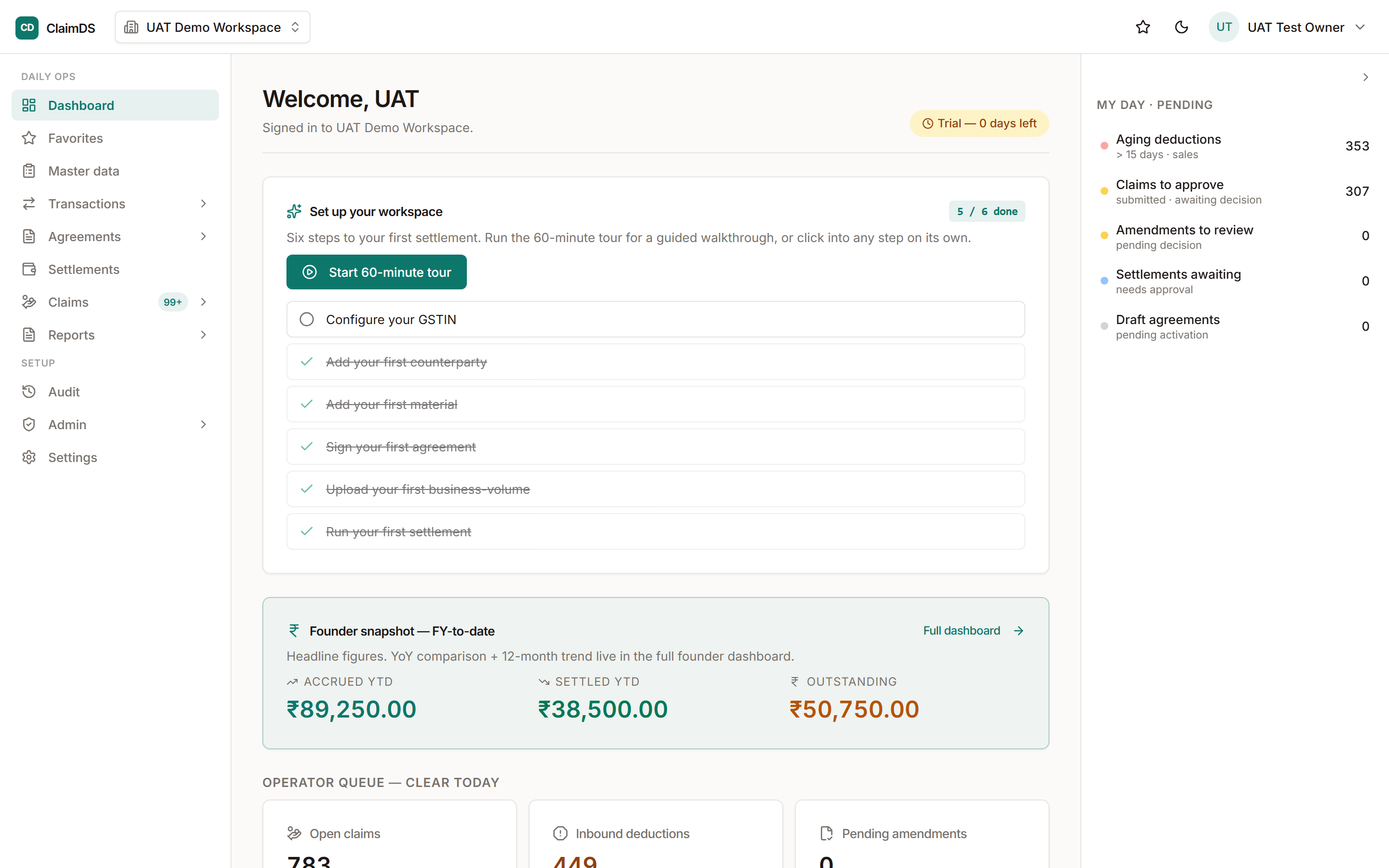
Picture the actual desk. A ₹120-crore manufacturer runs 300 distributors on three or four live scheme types. The "claims team" is one commercial executive and half of an accountant. The system of record is Tally Prime (or Busy), the scheme workings live in Excel, and the claims arrive on WhatsApp and email as photos of purchase registers. Month-end means a week of VLOOKUP against dispatch data, arguments over which slab a distributor landed in, and credit notes raised in Tally against a number nobody can fully reconstruct in March.
That reality dictates the requirement. The rebate tool doesn't replace Tally — it sits beside it: schemes, accruals, claims and validation live in the rebate engine; the settled amount flows back for the credit note to be raised where the books are. Any tool that assumes an SAP-class ERP underneath, or a dedicated administrator to run it, has failed the fit test before the demo starts. The everyday cost of staying in spreadsheets — missed slabs, duplicate claims, month-end blindness — is catalogued in challenges of manual rebate processing, and the payoff arithmetic in benefits of automating rebate calculations.
An illustrative stake. At ₹120 crore of channel turnover, even 1% leaking through missed accruals and unvalidated deductions is ₹1.2 crore a year — against which a mid-market licence is a rounding error. That ratio, not the sticker price, is the SMB affordability test; the cost-model mechanics are in rebate software pricing in India.
What should an SMB NOT pay for?
Right-sizing means saying no to features priced for someone else's problem. The common overbuys:
- Multi-country tax and currency engines — you operate under GST in rupees; a global tax matrix is pure licence weight.
- ERP-suite lock-in — modules that only make sense inside a large ERP estate, when your books are in Tally/Busy.
- AI forecasting layers — optimisation on top of settlement you haven't automated yet is a roof without walls.
- Unbundled per-module pricing — paying separately for rebates, chargebacks, price protection and buyback quadruples cost for claim types one Indian channel business faces together.
- Heavy customisation services — if the vendor's plan opens with a discovery workshop and a day rate, the product wasn't built for this segment.
The flip side — what you must not drop — is GST credit-note fidelity, multi-tier RTM, and an audit trail. Those are load-bearing at every size; the full checklist is in core features of a rebate management system.
How do you right-size the tool?
| Your shape (illustrative) | What you actually need | What to skip |
|---|---|---|
| ~₹50–150 Cr, ≤300 partners, 2–4 scheme types | Scheme engine, claim capture + validation, GST credit-note settlement, Tally/Busy round trip | Modules beyond live claim types; forecasting; SSO/IT-admin add-ons |
| ~₹150–500 Cr, multi-tier RTM, secondary schemes | All of the above + DMS/secondary-data intake, deduction management, approval workflows | Multi-country engines; deep ERP-native suites |
| ₹500 Cr+, multiple divisions | Full breadth + integration depth + analytics; enterprise evaluation applies | This is where enterprise suites stop being overkill |
Cloud and mobile aren't luxuries in this table — they're what make the economics work. Cloud delivery is why there's no server, no DBA and no upgrade project (the "light IT" row above), and mobile access matters because scheme questions get asked from the market, not from a desk: an area manager settling a slab dispute at a distributor's counter needs the claim status on a phone. The same affordability logic applied to the wider promotion stack is in affordable trade promotion management for Indian SMBs.
Why enterprise suites are overkill
Match the tool to the problem. Enterprise suites are priced and scoped for large, multi-country revenue management with long ERP-led implementations — more cost, complexity and time than an Indian SMB needs. The honest comparison is in Vistex alternatives for Indian mid-market and the scored view in best rebate management software.
DMS/SFA peers and where they fit
Indian DMS/SFA platforms serve SMBs well for distribution management and field-force automation, and some include scheme modules. Their focus is distribution rather than the settlement of claims and GST-correct credit notes, so they often complement a dedicated claim engine rather than replace it.
Where RebateLedger fits
RebateLedger is built for exactly this segment: India-only, mid-market, breadth of claim types in one product, GST credit-note depth, at a mid-market price point (a RebateLedger-supplied figure of roughly ₹3–5 lakh per customer per year — positioning, not a market benchmark). The full case is in why RebateLedger.
Choosing for SMB
Run a small, structured evaluation: map your real scheme types, score on affordability, deployment effort, multi-tier fidelity and GST correctness, and pilot on one real quarter. The detail is in distributor rebate software and volume rebates.
Three habits keep the evaluation honest at SMB scale. Demo on your own scheme, not the vendor's — bring last quarter's messiest slab circular and one real distributor's purchase register, and watch the tool compute it live. Price the first year, not the licence — implementation, migration and training often exceed the subscription; the worksheet is in the pricing and TCO guide. Pilot in parallel — run one quarter in the tool alongside the spreadsheet and reconcile the two before cutting over; the differences you find are usually spreadsheet errors, which is itself the business case. If dealer and distributor incentives beyond rebates are part of the picture, the adjacent category is covered in incentive management software, and the India-specific shortlist criteria in best rebate management software for Indian distributors and dealers.
GST note: This article is general information, not tax or legal advice. Where settlement involves GST credit notes, positions — including CBIC Circular No. 251/08/2025-GST and the Finance Act 2026 amendments to Section 34 of the CGST Act, assented 30 March 2026 but not yet notified into force as of publication — must be re-verified at publish time with a qualified professional.
Frequently asked questions
What is SMB rebate software?
SMB rebate software is rebate management built for small and mid-market businesses — affordable, fast to deploy and light on IT, handling slab and growth schemes and GST credit-note settlement without the cost and complexity of an enterprise revenue suite.
Why are enterprise rebate suites overkill for Indian SMBs?
Enterprise suites are priced and scoped for large, multi-country revenue management with long ERP-led implementations. For an Indian SMB running channel schemes, that is more cost, complexity and deployment time than the problem requires.
What should an Indian SMB look for in rebate software?
Affordability, fast deployment without heavy IT, multi-tier RTM and GST credit-note support, breadth of claim types in one product, and a clear audit trail. India fit matters more than the breadth of a global platform.
Can rebate software work with Tally or Busy?
Yes — and for most Indian SMBs it has to, because Tally Prime or Busy is the system of record for invoices and credit notes. The practical pattern is that the rebate tool computes accruals and validates claims, then hands settlement amounts back for credit notes to be raised in the accounting system, with masters and invoice data flowing in the other direction. Ask any vendor to demonstrate that round trip, not just claim it.
What should an SMB avoid paying for in rebate software?
Multi-country tax engines, deep ERP-suite lock-in, AI forecasting layers sold before basic settlement works, per-module pricing that unbundles chargebacks and price protection into separate fees, and heavy customisation services. Every one of these is defensible at enterprise scale and dead weight at SMB scale.
How fast can an Indian SMB deploy rebate software?
Weeks, not quarters, is the right expectation — load partner and product masters, configure the live scheme types, connect or upload data from the accounting system, and run one real quarter in parallel with the spreadsheet before cutting over. If a vendor's plan for an SMB deployment runs past a quarter, the product is probably scoped for a bigger buyer.
Does a ₹50 crore turnover company really need rebate management software?
It depends on channel intensity, and the honest answer is often yes-but-start-small. Selling through thirty to a hundred distributors with target schemes, damage claims and price support puts meaningful trade spend in play — and manual processes leak a share of it while consuming a finance resource. An entry-tier subscription frequently costs less than the leakage alone. Start with the highest-volume claim types, prove the reconciliation, then widen coverage.
When does an SMB outgrow Excel for scheme and claim tracking?
Earlier than most expect — usually around thirty to fifty active partners or one to two hundred claims a month. The warning signs: month-end settlement takes more than a week of one person's time; distributors dispute calculations because their spreadsheet differs from yours; a duplicate claim surfaces after payment; scheme circulars in WhatsApp and email do not match the tracker; and nobody can state the total outstanding claim liability today.
See RebateLedger on your own claims data
A 30-minute walkthrough tailored to how your channel actually settles claims.