
Why distributor rebate claims slip through the cracks
The eight places trade-promotion claims quietly leak margin — and a practical way to plug each one without adding headcount.
In short
Distributor rebate claims slip through the cracks because the claim lifecycle has unmanaged gaps — unlogged intake, missing agreements, unverifiable tier math, unmatched claim files, expired windows, orphan schemes and undecided write-offs — each quietly converting earned margin into leakage. The failure is structural, not personal: the process never forces a decision.
Distributor rebate claims slip through the cracks because the claim lifecycle has unmanaged gaps — unlogged intake, missing agreements, unverifiable tier math, unmatched claim files, expired windows, orphan schemes, undecided write-offs — and each gap quietly converts earned margin into leakage. The failure is structural, not personal: nobody decides to lose the money; the process just never forces a decision to collect it.
Ask any distributor finance team where the money goes, and you will hear the same answer: "We know we are owed it — we just cannot always prove it in time." Trade-promotion rebates and claims rarely vanish in one dramatic event. They leak, slowly, from eight predictable places.
1. The agreement nobody can find
A claim is only as good as the agreement behind it. When terms live in email threads, PDFs, and one person's memory, the first question on every disputed claim — "which scheme does this fall under?" — takes hours to answer. By the time you find it, the deduction has already been taken.
The fix: a single scheme repository where every agreement is modelled — parties, products, rates, period, claim window — before the scheme goes live. If a scheme cannot be pointed to, its claims cannot be defended; the operational discipline is the heart of distributor claims management.
2. The math that changes every tier
Volume, stepped, tiered, and special-pricing schemes each compute differently. A single wrong slab on a single line is invisible in a spreadsheet of thousands of rows — until it compounds across a quarter and shows up as margin you cannot explain.
The fix: compute rebates from modelled scheme terms, not per-line lookups. When the slab logic lives in the system rather than in formulas someone copied down a column, a wrong rate is a configuration bug you fix once — not a thousand silent per-line errors. This is the core case for moving off spreadsheets made in challenges of manual rebate processing.
3. The claim file that never gets tied out
Partners send claim files; someone re-keys them, looks up the right rate per line, and ties out hundreds of rows by hand to find the handful that disagree. It is slow and error-prone, so in practice it does not happen every cycle. The lines that were never checked are pure leakage.
The fix: auto-match the file against your own computed position and put human eyes only on the variances. The same matching discipline that protects you on incoming claims protects you on outgoing deductions — the playbook is in deduction management best practices.
4. The decision with no paper trail
Even a correct decision leaks money if it cannot be defended later. When a partner reopens a claim six months on and nobody recorded why it was accepted, adjusted, or disputed, you either pay again or spend days reconstructing the reasoning.
The fix: every decision — accept, adjust, dispute, reject — recorded in the system with who, when, and the reason coded. Approval that happens in inboxes fails this by construction, which is why decision routing belongs inside a designed workflow: see claim and rebate approval workflows.
5. The claim that never gets logged
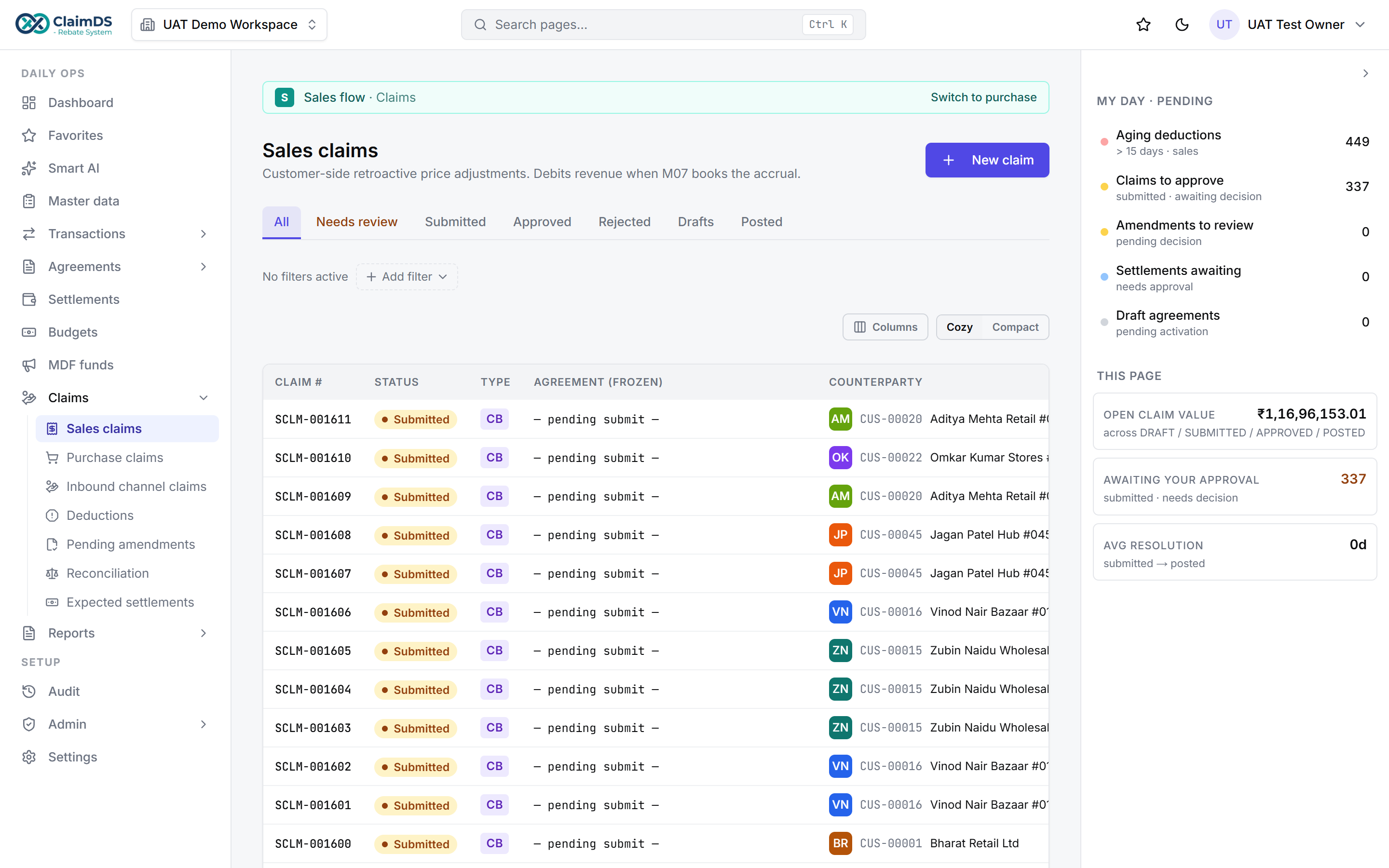
The four leaks above at least involve claims that exist somewhere. The bigger loss is often upstream: the claim that arrives as a WhatsApp photo of a damaged carton, a phone call about a scheme shortfall, or an email to a salesperson who was travelling — and never enters any queue. Nothing tracks it, so nothing ages it, so nothing escalates it. WhatsApp evidence has a second failure mode too: even when the claim is eventually raised, the photo is on someone's personal phone, unlinked to any claim record, and unfindable when validation asks for it.
The fix: one intake path, no exceptions. Every claim — however it first arrives — is logged in the system at first contact with its evidence attached, and the queue becomes the single source of truth for what is owed and how long it has been waiting. This is exactly the visibility a claims queue exists to provide.
6. The window that expired quietly
Most schemes allow a fixed period after the scheme ends for claims to land. Miss it, and the most perfectly evidenced claim in the world is worth nothing — an out-of-window claim is the one rejection with no cure. Windows expire quietly because the dates live in scheme circulars and memory rather than anywhere that alerts. The same clock discipline matters downstream too: GST credit notes carry their own statutory time limits, covered in GST credit note time limits and reporting.
The fix: capture the claim window as structured data when the scheme is modelled, and alert before it closes — with enough lead time to assemble the evidence pack described in the claim process explained.
7. The orphan scheme nobody closed out
Schemes are launched with energy and closed with none. A scheme runs, accrues obligations, the quarter moves on — and no one ever performs the close-out: final eligible base computed, claims invited, settlement reconciled against accrual, residue explicitly released. Orphan schemes pile up at year end as accrual balances nobody can explain, holding claims that remain collectible in theory and unclaimed in practice.
The fix: make close-out a mandatory scheme state, not a good intention. Every scheme ends in a reconciliation — accrued vs claimed vs settled — and any gap is a decision someone signs, which is how revenue leakage in rebate programs gets measured instead of absorbed.
8. The claim that dies of old age
Claims need owners. When a claim belongs to "the team" it belongs to nobody: it ages past 30, 60, 90 days, the person who knew its history changes roles, and eventually someone tidies the spreadsheet and removes it. That is the silent write-off — margin surrendered without any authority ever deciding to surrender it. Because no decision was made, no pattern is ever visible: the same partner, the same claim type, the same failure can repeat every quarter without anyone noticing the trend.
The fix: every claim carries a named owner and an ageing clock from intake, stale claims escalate automatically, and write-offs require an explicit, recorded approval like any other financial decision. A write-off that must be signed gets challenged; a write-off that happens by deletion never does.
Which leaks are hurting you most?
| Leak | Tell-tale symptom | Operational fix |
|---|---|---|
| Unfindable agreements | "Which scheme is this under?" takes hours | Model every scheme centrally before launch |
| Tier math errors | Margin variance nobody can explain | Compute from modelled terms, not spreadsheets |
| Unmatched claim files | Tie-outs skipped in busy cycles | Auto-match; review variances only |
| No paper trail | Reopened claims get paid twice | Coded, recorded decisions in-system |
| Unlogged intake | Claims surface months late, evidence on personal phones | Single intake path; log at first contact |
| Expired windows | Rejections citing "out of window" | Track window dates; alert before close |
| Orphan schemes | Year-end accrual balances nobody can explain | Mandatory scheme close-out with reconciliation |
| Silent write-offs | Old claims vanish from trackers | Named owners, ageing escalation, signed write-offs |
Plugging the leaks
None of these need more headcount — they need the agreement, the math, the match, and the decision to live in one place:
- Model each agreement once, so the terms are never in doubt.
- Let the rebate math accrue automatically as transactions land.
- Auto-match the partner's claim file and surface only the variances.
- Keep a tamper-evident record of every decision and why it was made.
- Log every claim at intake, with an owner and an ageing clock, whatever channel it arrived by.
- Track every claim window as data, with alerts before — not after — it closes.
- Close out every scheme with an accrued-vs-claimed-vs-settled reconciliation.
- Sign every write-off, so giving up money is a decision, never a default.
That is the loop RebateLedger's claims and deduction reconciliation is built around. If you want to see it on realistic data, the live demo takes about ten seconds to spin up.
The same system view pays forward to your partners: when distributors can see their own claims, statuses and scheme positions, the "we just cannot prove it in time" problem dissolves on both sides — that transparency layer is channel partner incentive tracking. To walk the eight leaks against your own claim book, book a demo.
Frequently asked questions
Why do distributor rebate claims slip through the cracks?
Because claims rarely die in one visible event — they leak from predictable operational gaps: agreements nobody can find, tier math nobody can verify, claim files never tied out, decisions with no paper trail, claims that never enter a system, expired claim windows, orphan schemes never closed out, and ageing claims silently written off. Each gap has a specific operational fix.
What is an orphan scheme?
A scheme that ran, generated obligations, and was then never formally closed out — no final settlement, no reconciliation of what was accrued versus claimed versus paid. Orphan schemes accumulate at year end, and the claims under them stay collectible in theory but unclaimed in practice.
How do expired claim windows cause leakage?
Most schemes allow a fixed period after the scheme ends for claims to be submitted. When window dates live in memory or scattered emails rather than a system, claims are assembled after the deadline has passed — and an out-of-window claim is the one rejection with no cure. The fix is mechanical: track every window date centrally and alert before it closes, not after.
What is a silent write-off?
A claim abandoned without a decision — it aged, the person chasing it moved on, and eventually someone cleared it from a spreadsheet without any authority formally choosing to forgo the money. Silent write-offs are pure leakage because they never surface for challenge: no one approved giving the margin up, so no one ever asks whether it was recoverable.
How do you stop claims leaking without adding headcount?
Put the agreement, the math, the match and the decision in one system: model each scheme once, accrue automatically as transactions land, log every claim at intake with an owner and an ageing clock, auto-match partner claim files so only variances need human eyes, and require a recorded decision — approve, adjust, dispute or write off — before any claim leaves the queue.
How should distributors track scheme circulars so claims are not missed?
Capture every circular at the point of arrival into one central register, whatever the channel — email, WhatsApp, portal or a verbal commitment confirmed in writing. Log a standard record per scheme: supplier, scheme code, period, eligible products, slabs, evidence required, deadline and expected value. Review weekly, sorted by deadline. One register, one owner, one weekly review eliminates most missed-claim leakage before any software enters the picture.
How can manufacturers reduce claim leakage in their channel?
Five controls do most of the work: invoice-level duplicate detection across periods; systematic matching of claims against billing and scheme data instead of sampling; maker-checker approval with monetary limits; line-level settlement advices reconciled to distributor ledgers quarterly; and reason-coded rejection analytics that expose repeat offenders and ambiguous schemes. Post-settlement audits of a random sample catch what prevention misses — and close the opposite leak too: valid claims that never arrive.
What escalation matrix should exist for stuck rebate claims?
Define in advance who acts when a claim exceeds stage-level time limits: verification beyond ten working days escalates to the claims manager; approval beyond a further week to the finance controller; partner disputes beyond thirty days to a joint commercial review; and any claim at risk of breaching a scheme deadline or the GST credit-note declaration window escalates immediately. Name roles, not departments, and publish the matrix to partners.
Why are my distributor scheme claims getting rejected?
In rough frequency order, from industry practice: claims outside the scheme window; wrong or missing documents; sales-data mismatch between the distributor's DMS and company records; slab miscalculation; duplicate claims; ambiguous scheme terms; missing GST documentation; target-shortfall disputes; and claims against verbally-promised schemes that were never circulated. Note these are distributor scheme claims — nothing to do with the medical-billing 'claim rejection' content that dominates search results for the phrase.
See RebateLedger on your own claims data
A 30-minute walkthrough tailored to how your channel actually settles claims.