
ERP Integration for Claims, Rebate & TPM Software: What Indian Businesses Should Check
Why ERP integration decides claims/rebate/TPM software in India — the data flows that matter, the sales-incentive data you need, and a readiness checklist.
In short
ERP integration decides whether claims, rebate and TPM software actually works, because these systems run on data that originates in the ERP: invoices and primary sales flow in, credit notes and ledger postings flow out. If that data does not move cleanly, accruals are wrong and settlement cannot reconcile.
ERP integration decides whether claims, rebate and TPM software succeeds — because these systems live on data that originates in the ERP. Invoices and primary sales flow in; credit notes and ledger postings flow out. This guide covers the data flows that matter, the integration patterns, the Indian ERP landscape, the extra data a sales-incentive system needs, and a readiness checklist.
For the data-exchange view of the same problem — which three data sets have to meet before a claim can settle, and how they move — see connected claims.
Why integration decides success
A rebate or distributor claims system is only as good as the data feeding it. If invoices, returns and credit notes don't move cleanly between the ERP and the claims tool, accruals drift and settlement won't reconcile — the software becomes another silo. Integration is therefore an evaluation criterion, not an afterthought, and belongs on the core features checklist.
The data flows that matter
| Flow | Direction | Why |
|---|---|---|
| Invoices / primary sales | ERP → claims system | The accrual base |
| Secondary sales | DMS/SFA → claims system | Sell-through schemes |
| Credit notes | Claims system → ERP | GST-correct settlement |
| Ledger postings | Claims system → ERP | Clean books |
Miss the secondary-sales feed and you can't run sell-through schemes; miss the credit-note flow and settlement isn't reflected in the books.
Integration patterns
- API — real-time, the cleanest option where both systems support it.
- Scheduled file / CSV — a robust, common pattern in Indian mid-market.
- Middleware — where an integration layer already exists.
- Manual import — the floor: acceptable to start, but not a long-term answer.
The Indian ERP landscape
Indian mid-market businesses commonly run Tally and Busy, alongside SAP Business One, Zoho Books, Marg and Microsoft Dynamics in parts of the market. The practical question isn't whether a vendor lists an ERP — it's whether it can exchange the specific data flows above with the ERP you actually run. Always confirm the exact connector and data scope with the vendor before you buy rather than assuming a logo on a website means a working, maintained integration. Using Tally Prime? See how RebateLedger works alongside it in rebate management with Tally Prime; Busy users have the equivalent walkthrough in rebate tracking with Busy ERP.
Reconciliation and master-data hygiene
Integration lives or dies on master-data mapping. SKU codes and partner/distributor codes must line up between the ERP, the DMS and the claims system, or every "integrated" number is quietly wrong. Plan a master-data clean-up as part of any integration — it's a core step in implementation best practices.
Integrating sales-incentive data
The four flows above cover the channel. If you also run sales incentives — for your own field force or channel partners — the same integration discipline applies, plus one extra data problem: attribution. An incentive can only be paid once you know whose sale earned it, so the incentive system needs three things the ERP holds only partially:
- Rep attribution — a customer-to-rep mapping, a territory or beat mapping, or a rep stamp on the invoice line. The ERP records the invoice; it does not always know who to credit for it.
- Qualifier data — beat-visit compliance, days-sales-outstanding, minimum range sold. These decide whether an incentive is earned and typically live across a DMS or SFA, not the ledger.
- Payee routing — the settled payout forks by payee type, and the two branches leave the system at different points. An amount earned by an agent or partner is settled as a channel payout. An amount earned by your own employee is handed to payroll, which processes it under its own rules and the law in force — a claims or incentive system computes what was earned, not what is withheld from a salary. The tax fork itself is worked in TDS on commission and incentives: Section 192 versus 194H.
The master-data lesson above extends directly: rep, territory and beat codes have to line up across the ERP, the DMS/SFA and the incentive system, exactly as SKU and partner codes do — or every attributed payout is quietly wrong. Whether your ERP can compute any of this natively is a separate question, taken up in running claims management alongside your accounting system.
Integration-readiness checklist
If the question behind this is whether a settlement layer duplicates the DMS you already run, that boundary is drawn in how claims software works alongside a DMS.
- Which of the four data flows do you need, and from which systems?
- Does the vendor support API, or only scheduled files?
- Are SKU and partner codes consistent across systems?
- If you run incentives: can a sale be attributed to a rep (by customer, territory/beat or an invoice-line stamp)?
- If you run incentives: do rep, territory and beat codes line up across the ERP, DMS/SFA and incentive system?
- Who owns the mapping and keeps it current?
- What's the fallback if the API breaks (manual import)?
Where RebateLedger fits
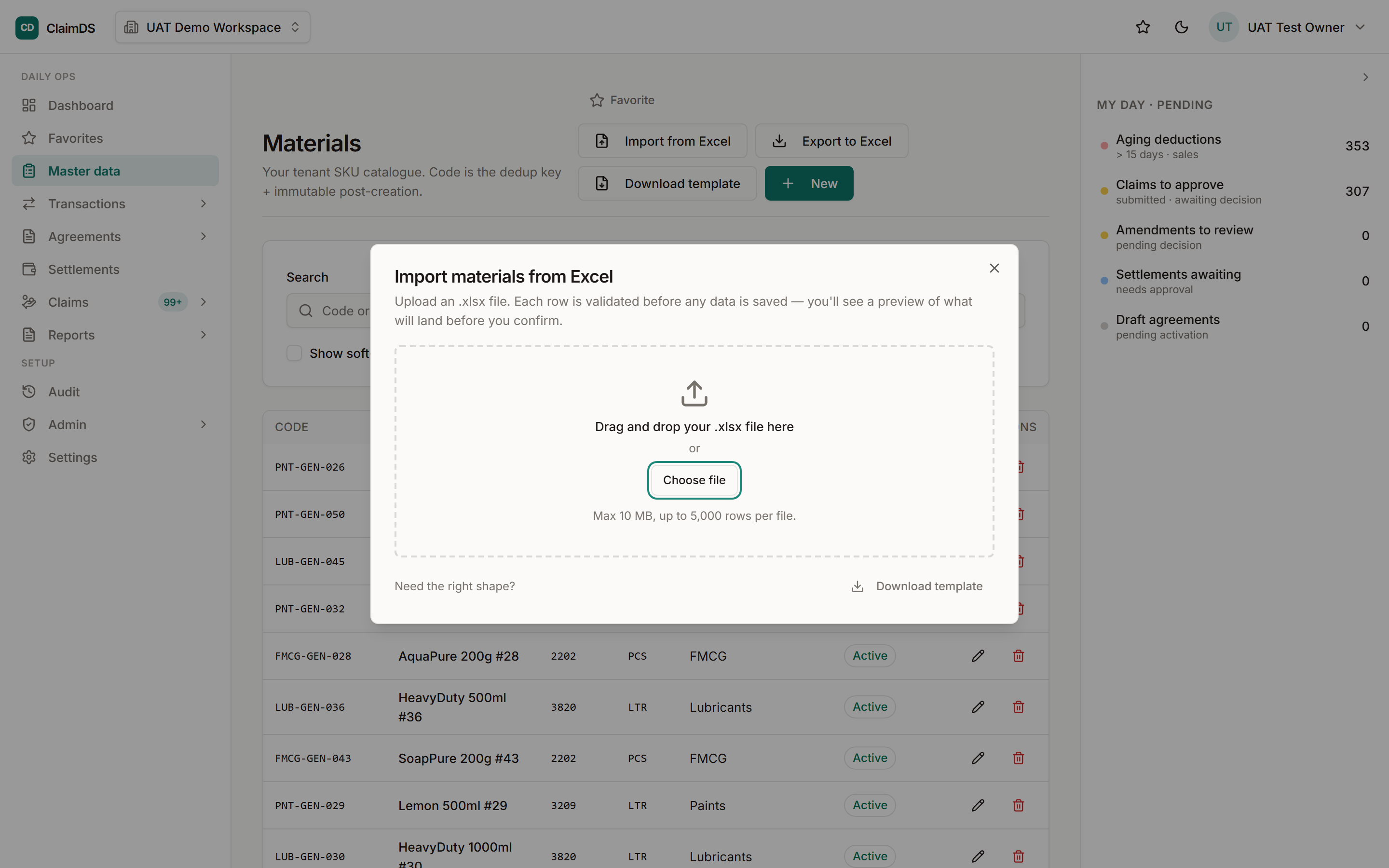
RebateLedger works alongside Tally, Busy and any other ERP through a file-based Excel/CSV workflow — validated Excel templates for import, settlement data exported back out for posting — rather than native API connectors. The Tally Prime and Busy walkthroughs linked above show exactly how that workflow runs in practice. It's India-first, mid-market (~₹3–5 lakh/yr, RebateLedger-supplied positioning). Weigh integration alongside the distributor claims buyer's guide, best rebate management software, rebate software pricing and why RebateLedger.
GST note: Credit-note flows to the ERP have GST implications — see financial vs. tax credit notes. General information, not tax advice.
Frequently asked questions
Why does ERP integration matter for rebate and claims software?
Because claims, rebate and TPM systems run on data that originates in the ERP — invoices and primary sales in, credit notes and ledger postings out. If that data doesn't flow cleanly, accruals are wrong and settlement can't reconcile, so integration decides whether the software actually works.
What ERP data flows matter for claims/rebate software?
Invoices and primary sales in; secondary sales from a DMS/SFA; credit notes out; and ledger postings back to the ERP. Getting these four flows right — with consistent SKU and partner codes — is what makes accrual and settlement trustworthy.
Which ERPs do Indian mid-market businesses run?
Commonly Tally and Busy, alongside SAP Business One, Zoho Books, Marg and Microsoft Dynamics in parts of the market. The right question isn't "does the vendor list an ERP" but "can it exchange the specific data flows you need with the ERP you actually run" — confirm the connector before you buy.
What data does a sales-incentive system need from the ERP?
A sales-incentive system needs the invoices and payments that sales are measured from, plus attribution data — which rep, territory or beat a sale belongs to — and qualifier inputs such as collection status. The ERP holds the invoices and payments; the attribution and qualifier data often sit in a DMS or SFA, so the integration has to pull from more than one system.
How is a sale attributed to a sales rep?
A sale is credited to a rep through a customer-to-rep mapping, a territory or beat mapping, or a rep stamp placed on the invoice line at billing. Without one of these, an incentive system cannot tell whose deal a sale was, which is why attribution — not calculation — is usually the hardest part of integrating incentives.
Do rebate and incentive systems need the same ERP integration?
They share the core flows — invoices and sales in, settlement out — but incentives add attribution and qualifier data (rep, territory, beat, collection status) that channel rebates do not need. The master-data discipline is the same: SKU and partner codes for rebates, plus rep and territory codes for incentives, must line up across every system.
Can rebate management software integrate with SAP?
Yes, and the pattern depends on which SAP you run. With S/4HANA or ECC, standard approaches use IDoc or API exchange: billing documents flow to the rebate platform and settlement credit memos post back through standard interfaces, keeping SD and FI consistent. With SAP Business One, common in the Indian mid-market, connector or file-based integration is typical. Evaluate the full round trip, not just the inbound feed.
My ERP has a discount module — do I still need rebate management software?
Usually yes, if you run genuine trade schemes. ERP discount modules handle on-invoice discounts; rebates are conditional, retrospective and cross-invoice, with slabs that re-rate all purchases once a threshold crosses — most ERP modules cannot compute them, track scheme accruals, run partner claim workflows, or manage the tax-versus-commercial credit-note settlement layer. Keep the ERP as system of record while dedicated software such as RebateLedger runs calculation, claims and settlement.
See RebateLedger on your own claims data
A 30-minute walkthrough tailored to how your channel actually settles claims.