
Purchase Incentives: How Channel Purchase-Linked Programs Work
Purchase incentives explained — buy-side incentives earned from suppliers vs sell-side incentives offered to partners. Structures and settlement.
In short
Purchase incentives are programs tied to purchase volume, and the term carries two meanings: incentives you earn from suppliers for your own purchases (buy-side), and incentives you offer channel partners to drive theirs (sell-side). Both accrue against purchase volume and usually settle by credit note.
Purchase incentives are programs tied to purchase volume — and the term carries two meanings: incentives you earn from suppliers for your own purchases (buy-side), and incentives you offer channel partners to drive theirs (sell-side). Both accrue against purchase volume and settle later, usually by credit note. This guide centres on the channel meaning.
Two meanings — disambiguated
| Buy-side purchase incentive | Sell-side purchase incentive | |
|---|---|---|
| Who earns it | You, from your suppliers | Your distributor/dealer, from you |
| Trigger | Your purchase volume | Their purchase volume |
| Direction of money | In (supplier → you) | Out (you → partner) |
| Related | Supplier rebates | Distributor rebate software |
Keeping the two apart matters because they account differently and sit on opposite sides of the ledger. The buy-side view connects to vendor rebate management; the sell-side is a form of channel incentive under the rebate management software pillar, sitting alongside the other trade-scheme types. The definitional ground floor — what a rebate is and how it differs from a discount — is in what is a rebate.
How channel purchase incentives work
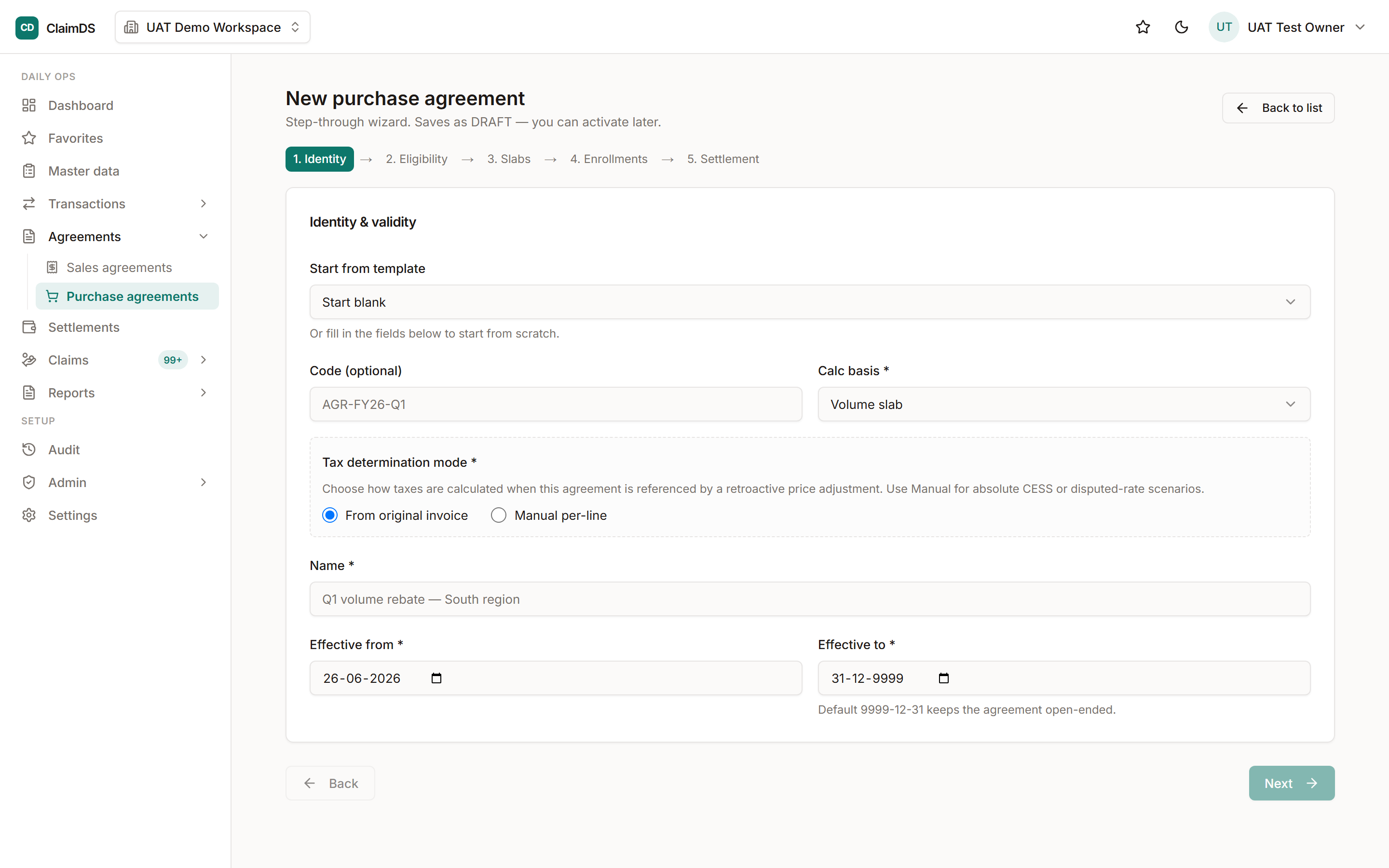
A sell-side purchase incentive rewards a partner for buying more from you — a slab or growth structure on primary purchases. It is agreed as a rule, accrued as purchases post, claimed, validated against the agreement, and settled by credit note. The slab mechanics are in volume rebates; the sell-through counterpart is customer rebates.
Illustrative only. A dealer scheme pays 2% on quarterly purchases above ₹30 lakh. The dealer closes the quarter at ₹38 lakh; the ₹8 lakh above the threshold earns 2% = ₹16,000, accrued as the purchases posted and settled by credit note after the claim is validated. Simple — until you multiply it by every dealer, every scheme and every quarter, which is where the accrual and documentation discipline below earns its keep.
What structures do purchase incentives take?
Four structures cover most programs, on either side of the ledger. All numbers illustrative.
Early-payment incentives. Money for cash-flow behaviour rather than volume: 1% for settling invoices within 10 days instead of 45. On ₹20 lakh of monthly purchases that is ₹20,000 a month — a return on working capital that finance, not procurement alone, should evaluate against the cost of funds.
Volume slabs. Stepped rates against period purchases: 1% above ₹25 lakh a quarter, 2% above ₹50 lakh. A buyer closing at ₹60 lakh earns whatever the agreement's drafting says — and drafting is exactly where it turns: "2% on everything once you cross ₹50 lakh" and "2% only on the portion above ₹50 lakh" differ by ₹50,000 on the same quarter. The slab mechanics and their traps are in volume rebates.
Mix incentives. An extra rate for buying the right basket: an additional 0.5% if premium-range purchases stay above 25% of the total. Mix structures protect margin and steer assortment, but they need line-level purchase data to compute — a summary purchase total cannot answer a basket question.
Growth-over-baseline. A rate only on purchases above history: 3% on purchases above last year's ₹2 crore. Closing at ₹2.4 crore earns 3% × ₹40 lakh = ₹1,20,000 — and nothing for standing still. Baselines need documented reset and adjustment rules, or the baseline becomes the dispute.
| Structure | Trigger | Best for | Watch-out |
|---|---|---|---|
| Early payment | Payment inside agreed days | Working-capital trade-offs | Compare the annualised rate to your cost of funds |
| Volume slab | Period purchase value or quantity | Consolidating spend with fewer partners | Slab drafting — whole-base vs marginal |
| Mix | Share of priority products in the basket | Margin protection, assortment steering | Needs line-level purchase data |
| Growth | Purchases above a baseline | Funding genuinely incremental volume | Baseline resets and adjustments |
How do purchase incentives interact with supplier rebates?
On the buy side, purchase incentives are the umbrella and supplier rebates are the best-known family inside it — the volume-linked money a buyer earns from vendors. The umbrella also covers early-payment terms and mix programs that pure "rebate" language sometimes misses. What all of them share is the operational shape: earned over a period, evidenced from purchase data, settled later. The design patterns suppliers offer are catalogued in supplier incentive programs, and the contractual anatomy in supplier rebate agreements.
The practical consequence of the umbrella view: a buyer should see all purchase-linked money from a vendor in one place. A 2% volume rebate, a 1% early-payment discount and a 0.5% mix incentive from the same supplier are, together, a 3.5% movement in effective cost — and negotiating any one of them without the others in view leaves money on the table.
How should purchase incentives be accrued?
Earned-but-unsettled incentive money is an asset (buy-side) or a liability (sell-side) from the day the qualifying purchases post — not from the day the credit note arrives. The discipline is a live accrual: compute what each open program has earned to date, every period, from actual purchase data. Buy-side, missing the accrual understates margin all year and produces a mysterious year-end windfall; sell-side, it understates trade-spend liability and surprises the P&L at settlement. The computation walkthrough is in how to calculate supplier rebate accruals, and the credit-note accounting side in rebate accounting under GST — pointer-level here; take professional advice for the specific facts.
How do you negotiate and document a purchase incentive?
Most incentive disputes are drafting gaps, not bad faith. The terms worth nailing before signature:
- Basis and data source. Whose numbers measure the purchases — the supplier's sales register or the buyer's purchase register — and how differences reconcile.
- Qualifying scope. Products, periods, and whether returns, cancellations and rate-difference credits reduce the qualifying base.
- The rate structure, with a worked example inside the agreement. One illustrative computation in the document prevents the whole-base-vs-marginal slab argument later.
- Caps and floors. What bounds the exposure for the payer and the expectation for the earner.
- Claim mechanics and deadlines. What evidence, submitted by when, validated how — the claim and rebate approval workflow discipline applies on both sides of the ledger.
- Settlement instrument and timing. Credit-note type and the settlement calendar, so finance can plan rather than chase.
A one-page schedule answering these six converts an incentive from a relationship understanding into an auditable program.
Structures, accrual and settlement
The discipline is the same as any rebate: accrue live, validate against the agreement, settle correctly. Because purchase incentives are earned over a period and settled afterwards, an accurate live accrual is what keeps finance honest and partners paid on time — the rebate tracking view.
Where RebateLedger fits
RebateLedger handles both buy-side and sell-side purchase-linked programs in one India-first product, accruing against purchase volume and settling by GST-correct credit note, at a mid-market price (a RebateLedger-supplied ~₹3–5 lakh/yr figure, positioning not a benchmark).
Purchase-linked programmes are one branch of a larger family that also includes target, growth and non-financial rewards. The full incentive range sets them side by side.
GST note: Purchase incentives may settle via credit notes with ITC consequences. This article is general information, not tax or legal advice; GST positions — including CBIC Circular No. 251/08/2025-GST and the Finance Act 2026 amendments to Section 34 of the CGST Act (assented 30 March 2026, not yet notified into force as of publication) — must be re-verified at publish time with a qualified professional.
Frequently asked questions
What are purchase incentives?
Purchase incentives are programs tied to purchase volume. They have two meanings — buy-side incentives a business earns from its suppliers for its own purchases, and sell-side incentives a business offers channel partners to drive their purchases. Both accrue against purchase volume and usually settle by credit note.
What is the difference between buy-side and sell-side purchase incentives?
Buy-side purchase incentives are money you earn from suppliers for buying more (linked to supplier rebates). Sell-side purchase incentives are money you offer distributors or dealers to buy more from you. Same volume trigger, opposite direction of money — and different accounting.
How are purchase incentives settled?
Purchase incentives are accrued against qualifying purchase volume and settled later, usually by GST credit note. The choice between a tax and financial credit note follows the GST rules for the adjustment.
What is an early-payment purchase incentive?
A discount or rebate earned for paying supplier invoices ahead of terms — for example, 1% for payment within 10 days instead of 45. It is a purchase-linked incentive in cash-flow form: the supplier buys working-capital certainty, and the buyer earns a return on early cash that should be compared against its cost of funds.
How is a purchase incentive different from an upfront trade discount?
An upfront discount is priced into the invoice at the time of sale, so nothing needs tracking afterwards. A purchase incentive is earned over a period against a condition — volume, growth, mix or payment behaviour — so it must be accrued while it builds and settled later, usually by credit note.
What should a purchase incentive agreement document?
The essentials are: the measurement basis and data source, qualifying products and periods, the rate structure with a worked example, caps, how returns and cancellations adjust the base, claim evidence and deadlines, and the settlement instrument. Most incentive disputes trace back to one of these being left verbal.
Does TDS apply to purchase-linked gifts and rewards?
Often, yes — where the reward is a benefit in kind rather than a trade rebate. Gold coins, gadgets and trips given to business recipients can attract withholding once aggregate value crosses the statutory yearly threshold. Trade discounts and credit-note rebates are excluded — the quarterly rebate carries no deduction, while the mixer-grinder for the same achievement does. Track cumulative value per recipient; confirm current rates with your adviser.
How do you design purchase incentive slabs without eroding margin?
Start from margin headroom, not competitor schemes: compute gross margin after channel margins, set the maximum trade-spend percentage the product can carry, and cap total slab cost at full achievement. Prefer incremental slabs to whole-turnover. Set thresholds from partner-level baselines, model the worst case with every partner at top slab, impose a ceiling across stacked schemes, and define the base GST-exclusive, net of returns.
See RebateLedger on your own claims data
A 30-minute walkthrough tailored to how your channel actually settles claims.