
Supplier and Purchase Rebates in Automotive
How Indian automotive treats money received from component and material suppliers — turnover and cash discounts under Ind AS 2 and GST credit notes.
In short
An automotive manufacturer also receives money from its component and material suppliers — turnover discounts (TODs), cash discounts and annual target incentives released in arrears, settled by credit note. This buy-side money is treated under Ind AS 2 quite differently from the incentives the company pays its dealer channel; confirm treatment with a professional.
An automotive OEM or aftermarket manufacturer does not only pay its dealer channel — it also receives money from the suppliers it buys from: component makers, steel and aluminium mills, tyre and electronics vendors, and the contract manufacturers who build sub-assemblies to order. Those suppliers reward volume, prompt payment and annual targets. That money received is the buy-side mirror of the incentives a company pays down its channel. But its accounting and GST treatment differ sharply from money paid — because a rebate you earn reduces what your stock cost you, not what you sold.
What do Indian buyers call money received from suppliers?
Indian automotive procurement has its own words for money received from a supplier, and none of them is supplier rebate. The dominant term is the turnover discount (TOD) — a rebate credited on your total purchase turnover from a vendor over a quarter or a year, settled in arrears once a slab is crossed. Next is the cash discount (CD), earned for paying an invoice early or within stated terms. A target purchase incentive — often just called a scheme — rewards hitting an agreed volume or value of purchases in a window. When the money is finally released, the paperwork is a claim the buyer raises and a credit note the supplier issues against it.
Name the English equivalents once, for anyone searching in English: a TOD is a purchase volume rebate or supplier rebate, a target purchase incentive is a vendor incentive, and the whole family is buy-side rebates. From here on this article uses the Indian words, because those are the words on the actual claim form, the ledger narration and the vendor agreement. If you formalise these terms with your component and material vendors, the structure of a supplier rebate agreement is the place to start, and the wider family of supplier incentive programs sets the context.
Who claims what from whom?
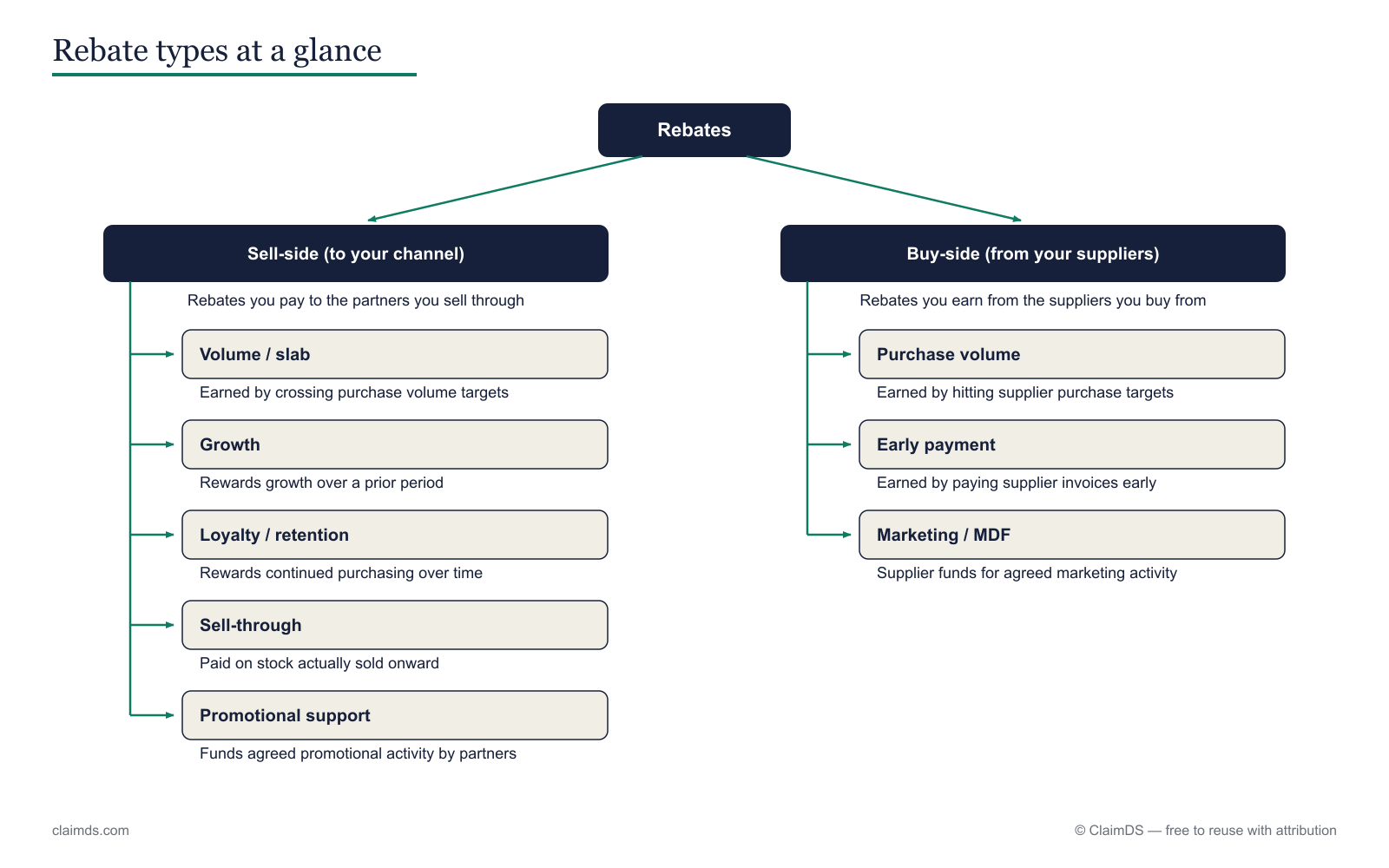
Buy-side rebates are earned from the suppliers you buy from — the mirror of the sell-side incentives you pay your channel.
Every tier in the Indian automotive channel both pays incentives downward and earns them upward, and the direction decides the treatment. A retailer or mechanic earns secondary-scheme benefit and turnover discounts from the aftermarket distributor it buys parts from. The distributor, in turn, claims schemes and price-drop protection from the parts manufacturer or its stockyard. A dealer earns volume and target incentives and warranty support from the OEM it retails vehicles for. The OEM or manufacturer — the tier everyone downstream claims from — is not only a payer: it buys castings, forgings, steel, tyres, electronics and contract-manufacturing services, and it earns TOD, CD and target purchase incentives from those suppliers. The full automotive channel map sets out the sell-side view in depth; this article is its buy-side mirror, and what a supplier rebate is at its core holds whichever tier earns it.
The single rule to hold on to: the same rupee is a cost reduction to whoever earns it and a trade-spend expense to whoever pays it — which is why where a partner sits in the channel decides which side of the ledger a claim lands on.
| Tier | Earns from upstream (buy-side) | Pays downstream (sell-side) |
|---|---|---|
| OEM / manufacturer | TOD, CD, target purchase incentive from component, steel, tyre, electronics and contract-manufacturing suppliers | Dealer incentives, price protection, warranty support to the channel |
| Aftermarket distributor | TOD, price-drop from the parts manufacturer | Secondary schemes to retailers and mechanics |
| Dealer | Volume and target incentives from the OEM | — (retails to the vehicle buyer) |
| Retailer / mechanic | Secondary benefit, TOD from the distributor | — (sells to the vehicle owner) |
What makes supplier rebates in automotive different?
Automotive procurement runs on contracts, not campaigns. Where a paint or FMCG maker negotiates arrears turnover discounts, an auto manufacturer typically buys under a long-term supply agreement (LTA) with a built-in annual cost-down — a contractual price reduction, year on year, that the supplier concedes in exchange for the platform's multi-year volume. That reshapes the buy-side rebate entirely: the benefit is a scheduled price step-down baked into the next year's purchase order, not a credit note released after a slab is crossed. It changes what you accrue (a known, dated reduction) and what you reconcile (did the agreed price actually drop on the effective date?).
Underneath the LTA sits commodity indexation. The metals that dominate a component's cost — steel, aluminium, copper — are benchmarked to published indices, so many contracts carry a raw-material price-adjustment clause settled periodically by debit or credit note as the index moves. This is where buy-side and sell-side blur: the same index swing you recover from a Tier-2 supplier you may owe to your Tier-1 customer, and the direction decides the ledger side. [Founder to add a real figure — e.g. a [X]% annual cost-down under your LTAs, or a steel-index clause that resets every [N] months. Placeholder — replace before publish.]
Finally, the split between OEM-line and aftermarket procurement matters: line volumes track the build schedule and drive platform-linked target incentives, while spares and aftermarket buying follows demand and looks more like a conventional volume TOD. Two buying patterns, two rebate shapes, one vendor master — which is exactly the reconciliation that gets lost in spreadsheets.
How are rebates received treated in the accounts?
Under Ind AS 2, the cost of purchase is generally measured net of rebates received, so a TOD or annual cost-down earned on the components, steel and tyres you buy is generally a reduction in the cost of that inventory, not other income — it flows into cost of goods sold as the stock is consumed. Three consequences follow: rebates on parts still on hand at period-end must be carried against them, or closing inventory is overstated; booking them as income flatters revenue and understates gross margin; and a cost-down accrued but not yet credited still reduces cost in the period the purchases fall — the discipline in how rebate accruals work, calculating supplier rebate accruals and rebate accrual management. Treat this as general guidance, not the MCA-notified standard applied to your own facts.
What does the buyer do with a supplier credit note under GST?
The type of credit note decides whether GST moves. A Section 34 tax credit note reduces the taxable value and the GST originally charged, so the buyer must make a proportionate ITC reversal — valid only where the discount met the Section 15(3)(b) post-supply-discount conditions. A financial or commercial credit note carries no GST adjustment at all; the same mechanics echo downstream in GST adjustments on channel settlements. How to classify the two and reverse correctly is covered in financial vs. tax credit notes under GST and the ITC-reversal guide. Two caveats specific to autos: where a rebate settles against parts scrapped or destroyed, Section 17(5)(h) blocks the credit entirely; and non-payment within 180 days triggers a separate Rule 37 reversal. Treat this section as subject to publish-time verification and CA review.
Where should you go next?
- GST and TDS on automotive dealer incentives — the sell-side companion, covering how the OEM's dealer schemes are taxed.
- GST credit notes for rebates — the documentation rule behind every rebate credit note.
- Credit notes for expired, damaged and returned goods — where the Section 17(5)(h) write-off question bites hardest.
- Vendor rebate management software — how buy-side rebates are tracked, accrued and reconciled in one place, and how it differs from a billback.
- Product basics: the rebate concept in the RebateLedger docs.
GST and accounting note: This article is general information, not tax, accounting or legal advice. The Ind AS 2 treatment and the GST credit-note positions above must be re-verified at publish time and reviewed by a qualified chartered accountant before any of it is relied on.
Seeing buy-side TOD, CD and target incentives accrue and settle against the right supplier — with the credit-note type and inventory treatment handled — is what turns a year-end reconciliation scramble into a controlled flow. To see it working on your own vendor agreements and claim volumes, book a demo.
Rebates earned from suppliers and incentives paid to dealers sit on opposite sides of the same ledger, and most businesses can only see one at a time. Trade promotion management software is where both belong.
Frequently asked questions
What is a turnover discount?
A turnover discount (TOD) is a rebate a supplier credits on your total purchase turnover over a quarter or a year, released in arrears once an agreed volume or value slab is crossed. In Indian automotive procurement it is the dominant term for what English sources call a supplier or purchase volume rebate, and it is settled by credit note against the buyer's account.
What is a cash discount in procurement?
A cash discount (CD) is a reduction a supplier gives for paying an invoice early or within stated payment terms — a reward for prompt settlement rather than for volume. Because it is earned on the primary purchase, it is simple to validate against the invoice date. An automotive buyer treats it as a reduction in the cost of the parts or material bought, not as separate income.
Is a purchase rebate income or a reduction in cost?
Under Ind AS 2 a rebate received on goods bought is generally a reduction in the cost of purchase, not other income. It is deducted in measuring what the inventory cost you and flows through to cost of goods sold as the stock is consumed. Booking it as income overstates revenue and understates gross margin, so the classification genuinely matters to the accounts.
Does a supplier credit note require ITC reversal?
Only if it is a Section 34 tax credit note that reduces the GST originally charged — then the buyer must reverse input tax credit proportionately, because the effective price has fallen. A financial or commercial credit note carries no GST adjustment, so no ITC is touched. The buyer must therefore classify every supplier credit note by type before acting on it.
What is the difference between a sales rebate and a purchase rebate?
A sales rebate is money you pay down your channel to earn a sale — a trade-spend expense. A purchase rebate is money you earn from a supplier you buy from — a reduction in the cost of your inventory. The same rupee is an expense to the payer and a cost reduction to the earner, and the two sit on opposite sides of the ledger with different GST treatment.
How does supplier rebate management work for automotive parts businesses?
Automotive parts distributors earn rebates from component manufacturers and OEM spares divisions — volume slabs, range-stocking incentives and loyalty programmes across thousands of part numbers. Effective management needs brand-wise and category-wise purchase tracking, strict separation of warranty settlements from rebate streams, netting of returns per the agreement, and disciplined quarterly claims. Given the part-number counts, aftermarket businesses hit spreadsheet limits early.
How are aftermarket parts rebate schemes structured?
Aftermarket schemes reward parts purchases with annual and quarterly volume slabs, range-stocking incentives across product lines such as filters, brakes and lubricants, and loyalty programmes for sustained sourcing. Bases are usually defined at brand or product-line level rather than SKU level, measured ex-GST and net of returns. Keep warranty settlements out of rebate calculations, and reconcile each supplier's credit notes against computed entitlements every quarter.
What are the challenges of rebate management for auto parts distributors?
A distinctive combination: tens of thousands of part numbers across brands, each supplier defining its own qualifying lines; frequent price-list revisions shifting values mid-period; returns of slow-moving parts to net from bases; and warranty settlements — a separate stream — to keep out of rebate arithmetic. Spreadsheets break early here. RebateLedger computes entitlements per agreement from purchase records, flags approaching thresholds and deadlines, and ages unsettled claims so recovery follow-up is systematic.
See RebateLedger on your own claims data
A 30-minute walkthrough tailored to how your channel actually settles claims.