
Supplier and Purchase Rebates in Indian Paints
How Indian paints treats money received from raw-material and packaging suppliers — turnover and cash discounts under Ind AS 2 and GST credit notes.
In short
A paint manufacturer also receives money from its suppliers — makers of resins, pigments, solvents and packaging rewarding volume and annual targets through turnover discounts (TODs) and cash discounts, settled by credit note. This buy-side money is treated under Ind AS 2 quite differently from the schemes paid to dealers and painters; confirm treatment with a professional.
An Indian paint manufacturer does not only pay its channel — it also receives money from the suppliers it buys from: makers of resins, pigments, solvents, additives, titanium dioxide and packaging who reward volume, prompt payment and annual targets. That money received is the buy-side mirror of the schemes a company pays down its dealer and painter channel. But its accounting and GST treatment differ sharply from money paid — because a rebate you earn reduces what your raw material and stock cost you, not what you sold.
What do Indian paint makers actually call supplier rebates?
Indian procurement has its own words for money received from a supplier, and none of them is supplier rebate. The dominant term is the turnover discount (TOD) — a rebate credited on your total purchase turnover from a vendor over a quarter or a year, settled in arrears once a slab is crossed. Next is the cash discount (CD), earned for paying an invoice early or within stated terms. A target purchase incentive — often just called a scheme — rewards hitting an agreed volume or value of purchases in a window. When the money is finally released, the paperwork is a claim the buyer raises and a credit note the supplier issues against it.
Name the English equivalents once, for anyone searching in English: a TOD is a purchase volume rebate or supplier rebate, a target purchase incentive is a vendor incentive, and the whole family is buy-side rebates. From here on this article uses the Indian words, because those are the words on the actual claim form, the ledger narration and the vendor agreement. If you formalise these terms with your resin, pigment or packaging vendors, the structure of a supplier rebate agreement is the place to start.
Who claims what from whom?
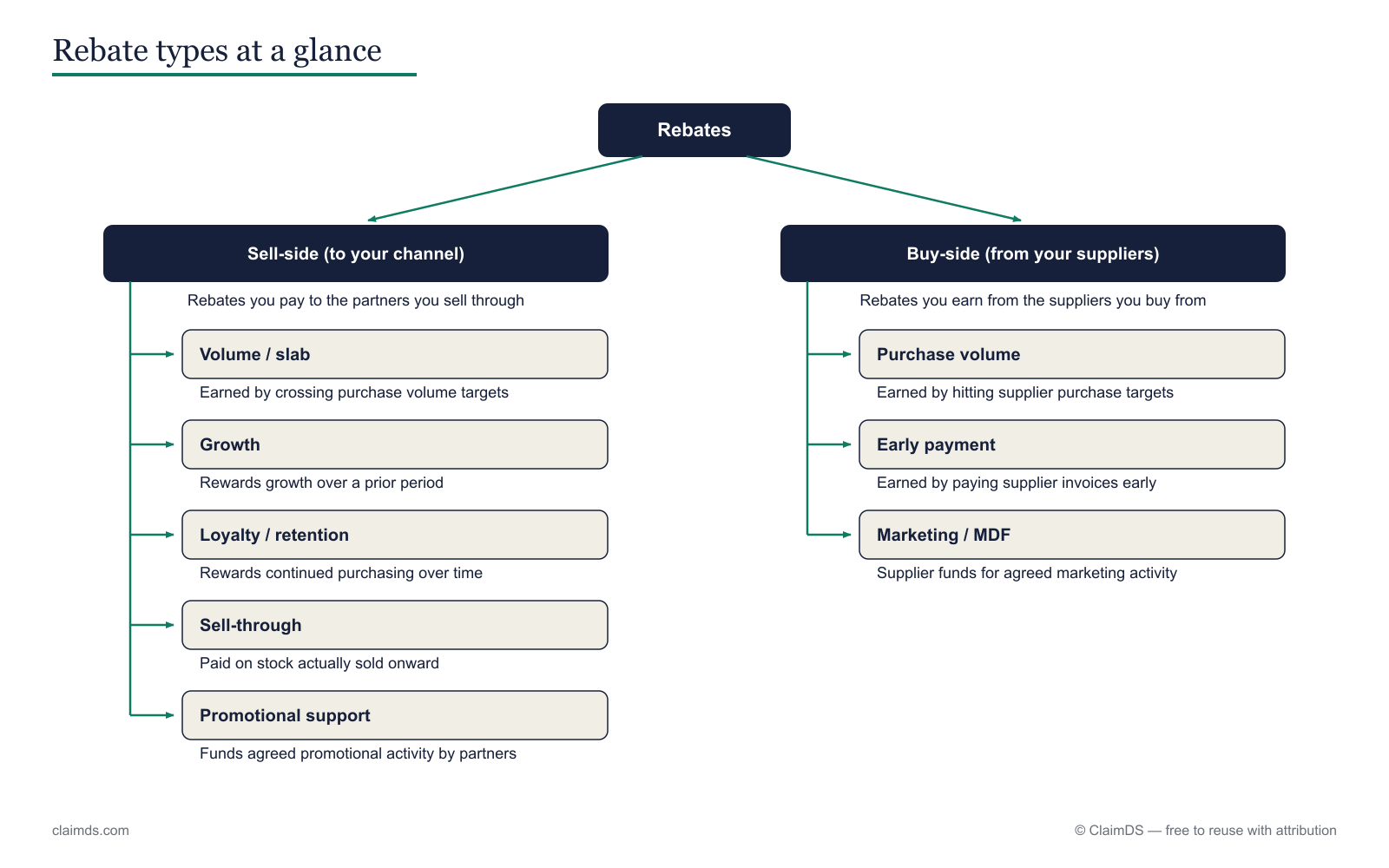
Buy-side rebates are earned from the suppliers you buy from — the mirror of the sell-side schemes you pay your channel.
Every tier in the Indian paints channel both pays rebates downward and earns them upward, and the direction decides the treatment. A painter or retailer earns loyalty rewards, display support and secondary-scheme benefit from the dealer it buys from. The dealer, in turn, claims trade schemes, rate-difference protection and turnover discount from the company or its depot. The company — the tier everyone downstream claims from — is not only a payer: it buys resins, pigments, solvents, additives, titanium dioxide and packaging, and it earns TOD, CD and target purchase incentives from those suppliers. Even a large distributor earns margin from the company while paying schemes to the dealers below it. The full paints channel tier map sets out the sell-side view in depth; this article is its buy-side mirror, and what a supplier rebate is at its core holds whichever tier earns it.
The single rule to hold on to: the same rupee is a cost reduction to whoever earns it and a trade-spend expense to whoever pays it — which is why where a partner sits in the channel decides which side of the ledger a claim lands on.
| Tier | Earns from upstream (buy-side) | Pays downstream (sell-side) |
|---|---|---|
| Paint company | TOD, CD, target purchase incentive from resin, pigment, solvent, additive, titanium dioxide and packaging suppliers | Dealer schemes, rate-difference protection, painter loyalty rewards |
| Distributor / depot | Margin, turnover discount from the company | Dealer schemes to the network below |
| Dealer | Trade schemes, TOD, rate-difference from the company | Point-of-sale support to painters and retail |
| Painter / retailer | Loyalty rewards, display and secondary benefit from the dealer | — (applies or sells to the customer) |
What makes supplier rebates in paints different?
Three features of paint procurement shape how buy-side rebates are structured — and they are worth separating from the generic accounting treatment that follows, because they decide where the money is and what triggers it.
Titanium dioxide sets the tone. TiO₂ is the single largest raw-material line in most paint formulations and one of the most price-volatile — India relies on imports for a meaningful share of supply, so the landed cost moves with global prices, the rupee, and any anti-dumping-duty position in force. Because the spend is large and lumpy, TiO₂ is where the biggest turnover discounts are negotiated, and where a supplier is most likely to add price protection on stock you are still holding when the index falls. A TOD tied to annual TiO₂ tonnage is not the same animal as one on a stable additive: the slab is material money, and the accrual you carry against unconsumed TiO₂ at period-end moves your closing-stock value. [Founder to add a real figure — e.g. TiO₂ ≈ [XX]% of raw-material cost, or a [X]% TOD over ₹[Y] of annual TiO₂ spend. Placeholder — replace before publish.]
Resins and solvents move with crude. Binders, monomers and solvents are petrochemical derivatives, so many paint makers buy them on formula-linked pricing indexed to a published benchmark. When the index moves between order and delivery, the settlement often arrives as a price-difference credit note rather than a volume TOD — mechanically a supplier credit, but triggered by an index, not a slab. Classifying those correctly (financial vs. Section 34 tax credit note) is exactly the distinction the GST section below turns on.
Demand is seasonal, so procurement is too. Paint offtake peaks ahead of the monsoon and again in the festive season, so companies stock raw material against those windows. That makes window-based purchase targets common — a target purchase incentive earned for lifting an agreed volume before a cut-off — and it makes rebate accruals lumpy across the year rather than smooth, which the accrual true-up discipline has to carry.
None of this changes the accounting principle — Ind AS 2 and the GST credit-note rules below apply to a paint maker exactly as they do to any other buyer — but it changes which line the biggest rebates sit on, what event releases them, and how uneven the accrual is through the year.
How are rebates received treated in the accounts?
Under Ind AS 2, the cost of purchase is generally measured net of rebates received, so a TOD or target incentive earned on the titanium dioxide, resins and packaging you buy is generally a reduction in the cost of that inventory, not other income — it flows into cost of goods sold as the stock is consumed. Three consequences follow: rebates on stock still on hand at period-end must be carried against it, or closing inventory is overstated; booking them as income flatters revenue and understates gross margin; and a TOD accrued but not yet credited still reduces cost in the period the purchases fall — the discipline in how rebate accruals work, calculating supplier rebate accruals and rebate accrual management. Treat this as general guidance, not the MCA-notified standard applied to your own facts.
What does the buyer do with a supplier credit note under GST?
The type of credit note decides whether GST moves. A Section 34 tax credit note reduces the taxable value and the GST originally charged, so the buyer must make a proportionate ITC reversal — valid only where the discount met the Section 15(3)(b) conditions for a post-supply discount. A financial or commercial credit note carries no GST adjustment at all. The mechanics of telling the two apart and reversing correctly are in financial vs. tax credit notes under GST, the ITC-reversal guide and the CBIC Circular 251/08/2025-GST explainer. One caveat specific to paints: where a rebate settles against expired batches or damaged stock written off or destroyed, Section 17(5)(h) blocks the credit entirely — see credit notes for expired, damaged and returned goods. Treat this section as subject to publish-time verification and CA review.
Where should you go next?
- GST and TDS on paints dealer and painter incentives — the sell-side tax companion for the schemes a paint company pays down its channel.
- Channel claims and rebates in Indian paints — the full channel view this buy-side article mirrors.
- Vendor rebate management software — how buy-side rebates are tracked, accrued and reconciled in one place, and how it differs from a billback.
- Buy-side versus sell-side: supplier rebates are money you earn; customer rebates and distributor rebate software cover money you pay.
- The same buy-side pattern in other sectors: automotive and pharma.
- Product basics: what a rebate is and the rebate concept in the RebateLedger docs.
GST and accounting note: This article is general information, not tax, accounting or legal advice. The Ind AS 2 treatment and the GST credit-note positions above must be re-verified at publish time and reviewed by a qualified chartered accountant before any of it is relied on.
Seeing buy-side TOD, CD and target incentives accrue and settle against the right supplier — with the credit-note type and inventory treatment handled — is what turns a year-end reconciliation scramble into a controlled flow. To see it working on your own vendor agreements and claim volumes, book a demo.
Supplier rebates and dealer schemes move in opposite directions through the same business, and net channel margin is the difference. Tracking that difference is the job of a platform that tracks trade spend both ways.
Frequently asked questions
What is a turnover discount?
A turnover discount, or TOD, is a rebate a supplier credits on your total purchase turnover over a quarter or a year, released in arrears once an agreed volume or value slab is crossed. In Indian paints procurement it is the common term for what English sources call a supplier or purchase volume rebate, and it is settled by a credit note against the buyer's account.
What is a cash discount in procurement?
A cash discount, or CD, is a reduction a supplier gives for paying an invoice early or within stated payment terms — a reward for prompt settlement rather than for volume. Because it is earned on the primary purchase, it is simple to validate against the invoice date. A paints buyer treats it as a reduction in the cost of the goods bought, not as separate income.
Is a purchase rebate income or a reduction in cost?
Under Ind AS 2 a rebate received on goods bought is generally a reduction in the cost of purchase, not other income. It is deducted in measuring what the inventory cost you and flows through to cost of goods sold as the stock is consumed. Booking it as income overstates revenue and understates gross margin, so the classification matters to the accounts.
Does a supplier credit note require ITC reversal?
Only if it is a Section 34 tax credit note that reduces the GST originally charged — then the buyer must reverse input tax credit proportionately, because the effective price has fallen. A financial or commercial credit note carries no GST adjustment, so no ITC is touched. The buyer must therefore classify every supplier credit note by type before acting on it.
What is the difference between a sales rebate and a purchase rebate?
A sales rebate is money you pay down your channel to win a sale — a trade-spend expense. A purchase rebate is money you earn from a supplier you buy from — a reduction in the cost of your inventory. The same rupee is an expense to the payer and a cost reduction to the earner, and the two sit on opposite sides of the ledger with different GST treatment.
How do supplier purchase rebates work in the Indian paints industry?
Paint companies run some of India's most structured dealer programmes: annual volume slabs on ex-GST purchases, quarterly on-account settlements with a year-end true-up, growth incentives and focus-product rebates on premium emulsions and waterproofing. Seasonality matters — festive-quarter purchases dominate attainment. Painter-loyalty support and tinting-machine arrangements are separate streams from purchase rebates, and paid promotional obligations are treated differently for GST, so keep the streams apart.
See RebateLedger on your own claims data
A 30-minute walkthrough tailored to how your channel actually settles claims.