
Supplier and Purchase Rebates in Indian Pharma
How Indian pharma treats money received from API, excipient and packaging suppliers — turnover and cash discounts under Ind AS 2 and GST credit notes.
In short
A pharma company also receives money from its suppliers — API makers, excipient vendors, packaging converters and contract manufacturers rewarding volume and targets through turnover discounts (TODs) and cash discounts, settled by credit note. This buy-side money is treated under Ind AS 2 quite differently from channel schemes; confirm treatment with a professional.
An Indian pharma company does not only pay its channel — it also receives money from the suppliers it buys from: makers of active pharmaceutical ingredients (APIs), excipient vendors, packaging converters, and the contract or loan-licence manufacturers who make product on its behalf. Those suppliers reward volume, prompt payment and annual targets. That money received is the buy-side mirror of the schemes a company pays down its channel — but its accounting and GST treatment differ sharply from money paid, because a rebate you earn reduces what your stock cost you, not what you sold.
What do Indian pharma buyers call supplier rebates?
Indian pharma procurement has its own words for money received from a supplier, and none of them is supplier rebate. The dominant term is the turnover discount (TOD) — a rebate credited on your total purchase turnover from a vendor over a quarter or a year, settled in arrears once a slab is crossed. Next is the cash discount (CD), earned for paying an invoice early or within stated payment terms. A target purchase incentive — often just called a scheme — rewards hitting an agreed volume or value of API, excipient or packaging purchases in a window. When the money is finally released, the paperwork is a claim the buyer raises and a credit note the supplier issues against it.
Name the English equivalents once, for anyone searching in English: a TOD is a purchase volume rebate or supplier rebate, a target purchase incentive is a vendor incentive, and the whole family is buy-side rebates. From here on this article uses the Indian words, because those are the words on the actual claim form, the ledger narration and the vendor agreement. If you formalise these terms with your API and packaging vendors, the structure of a supplier rebate agreement is the place to start, and the purchase-incentive basics hold whichever input you are buying.
Who claims what from whom in pharma?
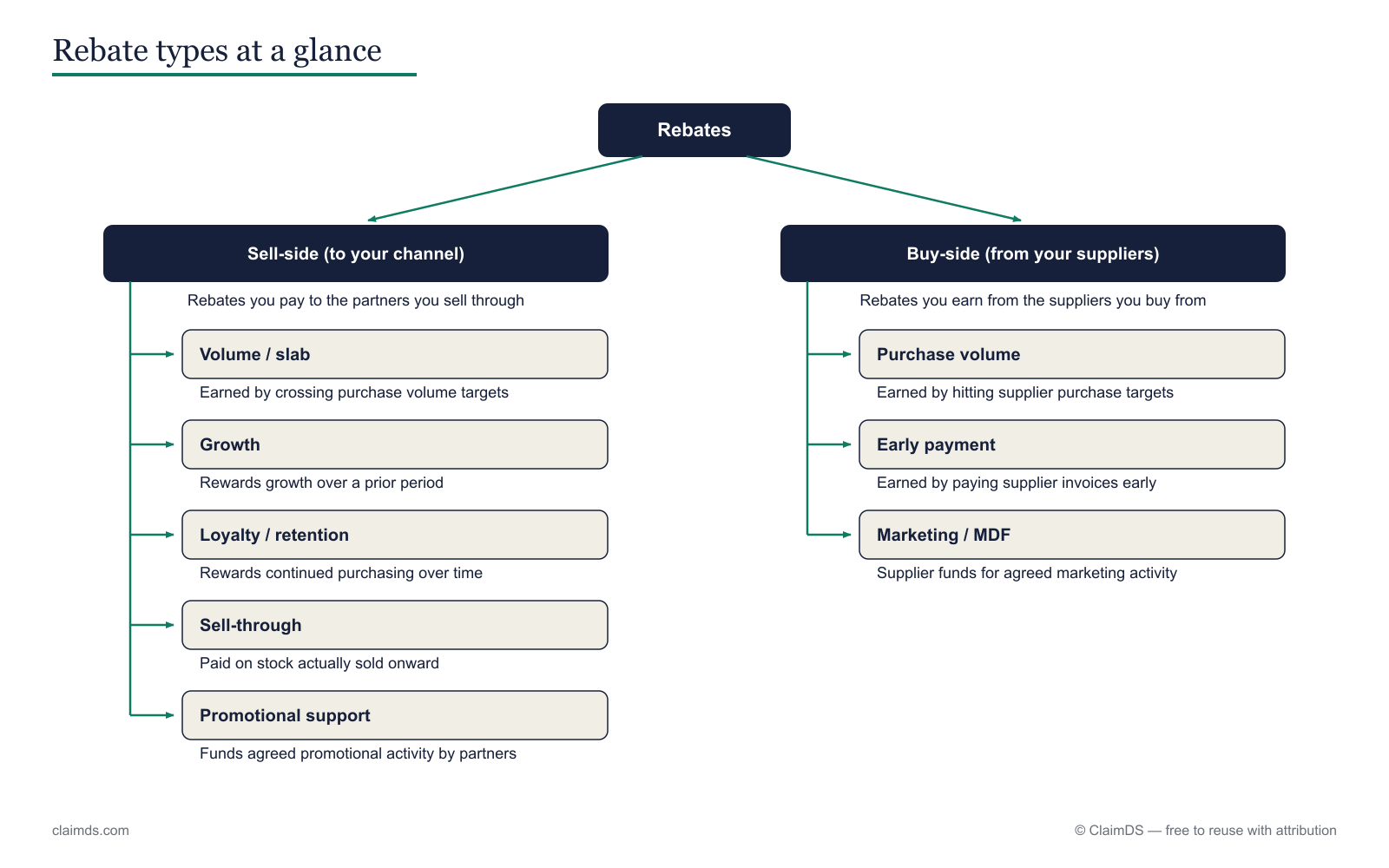
Buy-side rebates are earned from the suppliers you buy from — the mirror of the sell-side schemes you pay your channel.
Every tier in the Indian pharma channel both pays rebates downward and earns them upward, and the direction decides the treatment. A chemist earns turnover discount, scheme benefit and margin from the stockist it buys from. The stockist, in turn, claims schemes, expiry and breakage support and TOD from the company or its C&F agent (CFA). The company — the tier everyone downstream claims from — is not only a payer: it buys APIs, excipients and packaging, and it contracts out manufacturing to loan-licence and third-party (contract) manufacturers. From those suppliers it earns TOD, CD and target purchase incentives. Even a super stockist earns margin from the company while paying schemes to the stockists below it. The buy-side view here mirrors the sell-side pharma channel claims and rebates pillar, and what a supplier rebate is at its core holds whichever tier earns it.
The single rule to hold on to: the same rupee is a cost reduction to whoever earns it and a trade-spend expense to whoever pays it — which is why where a partner sits in the channel decides which side of the ledger a claim lands on, and why buy-side supplier incentive programs are managed differently from the pharma chargebacks moving down it.
| Tier | Earns from upstream (buy-side) | Pays downstream (sell-side) |
|---|---|---|
| Pharma company | TOD, CD, target purchase incentive from API, excipient, packaging and contract / loan-licence suppliers | Schemes, expiry and breakage support to the channel |
| Super stockist | Margin, QPS from the company | Secondary schemes to stockists |
| Stockist | Schemes, TOD, expiry support from company / CFA | Scheme discount to chemists |
| Chemist | Scheme benefit, TOD, margin from the stockist | — (sells to patient) |
What makes supplier rebates in pharma different?
Two features set pharma procurement apart before any accounting question arises. The first is who actually makes the product. A large share of Indian pharma volume is made not in-house but by loan-licence and third-party (P2P) contract manufacturers, so a significant part of the buy-side flow is not a raw-material turnover discount at all — it is commercial settlement with a contract manufacturer over conversion cost, yield and volume. It sits on the vendor ledger beside API and packaging rebates but behaves differently, and it has to be classified separately for both accounting and GST.
The second is price control. Scheduled formulations fall under the DPCO and NPPA ceiling-price regime, so a manufacturer cannot always pass a procurement saving through to price — which changes how a supplier rebate is negotiated and where the benefit is allowed to land. A TOD on a price-controlled molecule is not the same commercial conversation as one on an unscheduled product. [Founder to add a real figure — e.g. loan-licence ≈ [XX]% of volume, or API ≈ [YY]% of cost. Placeholder — replace before publish.]
Underneath both sits the familiar API import exposure — actives are heavily sourced overseas, a large share from China, USD-linked and volatile, so much of the settlement arrives as price-difference credits rather than clean slabs — and shelf-life: when a rebate ends up settling against expired API or finished stock that is written off, Section 17(5)(h) blocks the credit outright, the route covered below. Contract manufacturing, price control, imports and expiry together make pharma the most structurally distinct buyer of the six.
How are rebates received treated in the accounts under Ind AS 2?
Under Ind AS 2, the cost of purchase is generally measured net of rebates received, so a TOD or target incentive earned on the API, excipient and packaging you buy is generally a reduction in the cost of that inventory, not other income. Pharma feels this harder because inventory is batch-costed: rebates attributable to API and packaging still on hand at period-end must be carried against those batches, not swept to the P&L; booking them as income flatters revenue and understates gross margin; and a TOD accrued but not yet credited still reduces cost in the period the purchases fall — the discipline in how rebate accruals work, calculating supplier rebate accruals and rebate accrual management. Treat this as general guidance, not the MCA-notified standard applied to your own facts.
What does the buyer do with a supplier credit note under GST?
The type of credit note decides whether GST moves. A Section 34 tax credit note reduces the taxable value and the GST originally charged, so the buyer must make a proportionate ITC reversal — valid only where the discount met the Section 15(3)(b) post-supply-discount conditions. A financial or commercial credit note carries no GST adjustment at all. The mechanics of telling the two apart, documenting them under Rule 53(1A) and reversing correctly are in financial vs. tax credit notes under GST and the ITC-reversal guide. One caveat specific to pharma: where a rebate settles against expired API or damaged packaging written off or destroyed, Section 17(5)(h) blocks the credit entirely — handled in credit notes for expired and damaged goods. Treat this section as subject to publish-time verification and CA review.
Where should you go next?
- Pharma channel claims and rebates in India — the sell-side pillar this buy-side view mirrors, covering how schemes, TOD and claims move down the channel.
- Vendor rebate management software — how buy-side TOD, CD and target incentives are tracked, accrued and reconciled against the right supplier in one place.
- Chargebacks in pharma distribution — the downstream instrument, and how it differs from a buy-side rebate.
- Supplier rebate agreements and calculating supplier rebate accruals — how to formalise and estimate what you are owed.
- Product basics: the rebate concept in the RebateLedger docs.
GST and accounting note: This article is general information, not tax, accounting or legal advice. The Ind AS 2 treatment and the GST credit-note positions above must be re-verified at publish time and reviewed by a qualified chartered accountant before any of it is relied on.
Seeing buy-side TOD, CD and target incentives accrue and settle against the right API, excipient or packaging supplier — with the credit-note type and batch-level inventory treatment handled — turns a year-end reconciliation scramble into a controlled flow. To see it working on your own vendor agreements, book a demo.
Purchase rebates from manufacturers and schemes paid out to stockists are two entries in one trade-spend picture. Holding both is what a platform for managing trade spend is built to do.
Frequently asked questions
What is a turnover discount?
A turnover discount (TOD) is a rebate a supplier credits on your total purchase turnover over a quarter or a year, released in arrears once an agreed volume or value slab is crossed. In Indian pharma procurement it is the standard term for what English sources call a supplier or purchase volume rebate, and it is settled by a credit note against the buyer's account.
What is a cash discount in pharma procurement?
A cash discount (CD) is a reduction an API, excipient or packaging supplier gives for paying an invoice early or within stated payment terms — a reward for prompt settlement rather than for volume. It is earned on the primary purchase, so it is simple to validate against the invoice date. Buyers treat it as a reduction in the cost of the goods purchased, not as separate income.
Is a purchase rebate income or a reduction in cost?
Under Ind AS 2 a rebate received on goods bought is generally a reduction in the cost of purchase, not other income. It is deducted in measuring what the inventory cost you and flows through to cost of goods sold as the stock is consumed. Booking it as income overstates revenue and understates gross margin, so the classification matters to the accounts.
Does a supplier credit note require ITC reversal?
Only if it is a Section 34 tax credit note that reduces the GST originally charged — then the buyer must reverse input tax credit proportionately, because the effective price of the purchase has fallen. A financial or commercial credit note carries no GST adjustment, so no ITC is touched. The buyer must therefore classify every supplier credit note by type before acting on it.
What is the difference between a sales rebate and a purchase rebate?
A sales rebate is money you pay down your channel to earn a sale — a trade-spend expense. A purchase rebate is money you earn from a supplier you buy from — a reduction in the cost of your inventory. The same rupee is an expense to the payer and a cost reduction to the earner, and the two sit on opposite sides of the ledger with different GST treatment.
How do supplier purchase rebates work in Indian pharma distribution?
Pharma stockists earn purchase rebates from manufacturers on top of trade margins — volume schemes, new-product stocking incentives and prompt-payment rewards, with bonus-quantity offers common alongside cash-equivalent rebates. The sector's complexities are batch and expiry tracking, price-controlled formulations constraining margins, and expiry returns interacting with the rebate base. Net expiry and breakage claims separately from rebate claims — mixing the streams is the sector's most common reconciliation failure.
What makes supplier rebate management challenging for pharma stockists?
Four things: the volume of parallel scheme circulars across manufacturers and divisions, each with its own base and window; bonus-goods settlements, which complicate valuation and are messier than credit notes; returns interplay, because expiry credits must be netted from rebate bases; and weak documentation, since schemes often circulate as field-force messages. The fixes are a written scheme register, monthly attainment tracking and strict separation of expiry claims from rebate claims.
See RebateLedger on your own claims data
A 30-minute walkthrough tailored to how your channel actually settles claims.