
Supplier and Purchase Rebates in Indian FMCG
How Indian FMCG treats money received from suppliers — turnover discounts, cash discounts and target incentives — under Ind AS 2 and GST credit notes.
In short
An FMCG maker also receives money from its suppliers — raw-material vendors, packaging converters and co-packers rewarding volume, prompt payment and annual targets through turnover discounts (TODs) and cash discounts, settled by credit note. This buy-side money is treated under Ind AS 2 quite differently from the schemes paid down the channel; confirm treatment with a professional.
An Indian FMCG maker does not only pay its channel — it also receives money from the suppliers it buys from: raw-material vendors, packaging converters and co-packers who reward volume, prompt payment and annual targets. Every tier does the same, earning something from the tier above it. That money received is the buy-side mirror of the schemes a company pays down its channel. But its accounting and GST treatment differ sharply from money paid — because a rebate you earn reduces what your stock cost you, not what you sold.
What do Indian buyers actually call supplier rebates?
Indian trade has its own words for money received from a supplier, and none of them is supplier rebate. The dominant term is the turnover discount (TOD) — a rebate credited on your total purchase turnover from a vendor over a quarter or a year, settled in arrears once a slab is crossed. Next is the cash discount (CD), earned for paying an invoice early or within stated terms. A target purchase incentive — often just called a scheme — rewards hitting an agreed volume or value of purchases in a window. When the money is finally released, the paperwork is a claim the buyer raises and a credit note the supplier issues against it.
Name the English equivalents once, for anyone searching in English: a TOD is a purchase volume rebate or supplier rebate, a target purchase incentive is a vendor incentive, and the whole family is buy-side rebates. From here on this article uses the Indian words, because those are the words on the actual claim form, the ledger narration and the vendor agreement. If you formalise these terms with your vendors, the structure of a supplier rebate agreement is the place to start.
Who claims what from whom?
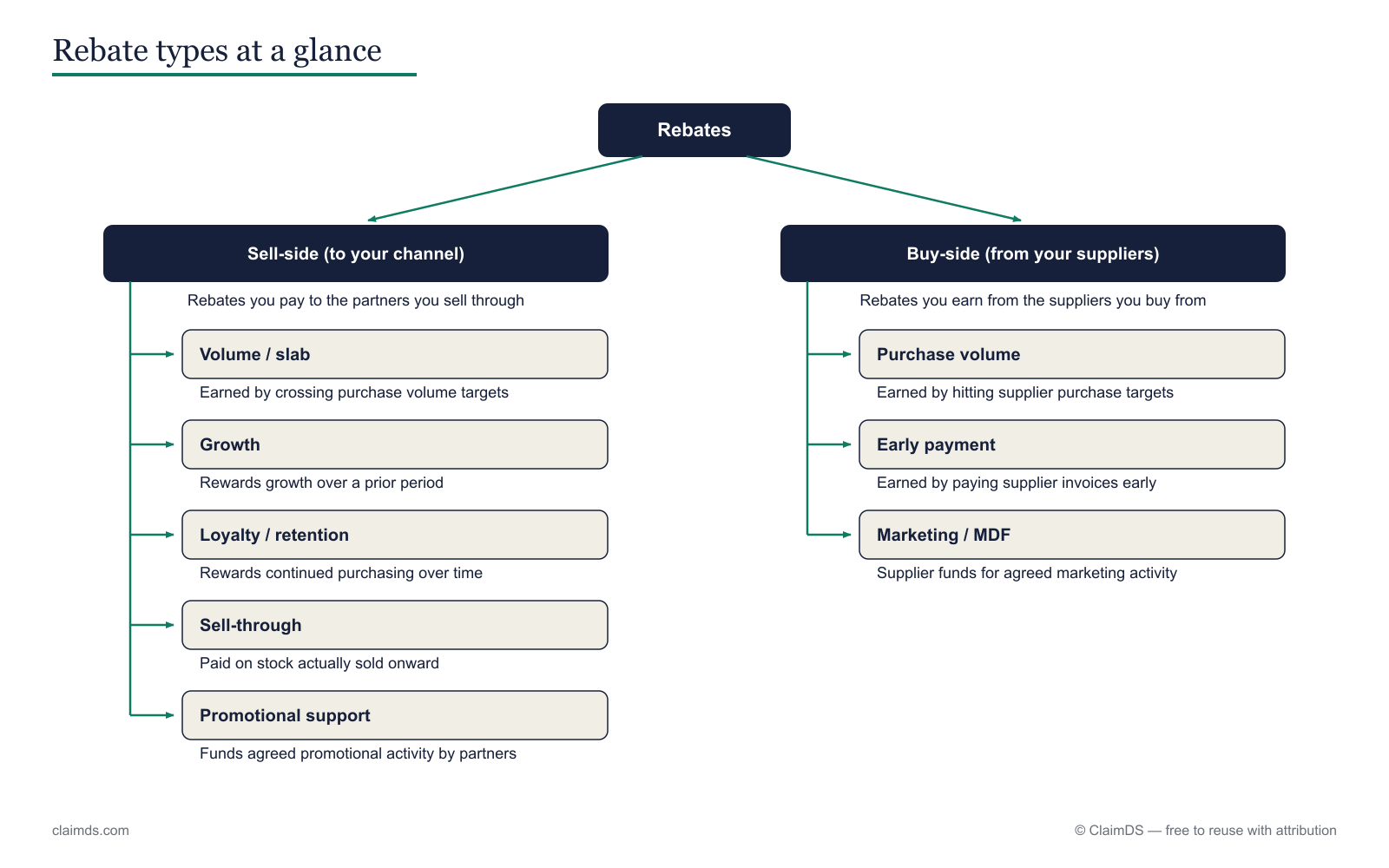
Buy-side rebates are earned from the suppliers you buy from — the mirror of the sell-side schemes you pay your channel.
Every tier in the Indian channel both pays rebates downward and earns them upward, and the direction decides the treatment. A retailer earns secondary-scheme benefit, display money and turnover discounts from the distributor it buys from. The distributor, in turn, claims trade schemes, price-drop protection and TOD from the company or its C&F agent. The company — the tier everyone else claims from — is not only a payer: it buys raw material, packaging and contract-manufacturing (co-packing) services, and it earns TOD, CD and target purchase incentives from those suppliers. Even a super stockist earns margin from the company while paying schemes to the distributors below it. The full channel tier map sets out the sell-side view in depth; this article is its buy-side mirror, and what a supplier rebate is at its core holds whichever tier earns it.
The single rule to hold on to: the same rupee is a cost reduction to whoever earns it and a trade-spend expense to whoever pays it — which is why where a partner sits in the channel decides which side of the ledger a claim lands on.
| Tier | Earns from upstream (buy-side) | Pays downstream (sell-side) |
|---|---|---|
| FMCG company | TOD, CD, target purchase incentive from material, packaging and co-packing suppliers | Trade schemes, L&D, price-drop to the channel |
| Super stockist | Margin, QPS from the company | Secondary schemes to distributors |
| Distributor | Trade schemes, TOD, price-drop from company / C&F | Secondary-scheme discount to retailers |
| Retailer / kirana | Secondary benefit, display, TOD from the distributor | — (sells to shopper) |
What makes supplier rebates in FMCG different?
FMCG buys commodities, and commodities move. The big input lines — edible and palm oils, wheat, sugar, milk solids, and the films, laminates and cartons that package them — are price-volatile and partly import-linked, so between contract and delivery the price can shift enough that the settlement arrives as a price-linked credit note rather than a volume reward. In many categories the swing on a single commodity in a quarter dwarfs the entire annual turnover discount, which is why FMCG procurement watches input indices as closely as it watches offtake.
Because the category runs on high volume and thin margins, a turnover discount on packaging or a core commodity is not a rounding item — it is a measurable share of gross margin, and a TOD accrued but not yet credited genuinely moves the reported cost of goods. That raises the stakes on the Ind AS 2 treatment below: a rebate parked as "other income" instead of a cost reduction flatters the P&L in a business where every margin point is fought for. [Founder to add a real figure — e.g. [your dominant commodity, e.g. palm oil] ≈ [XX]% of input cost, or a [X]% packaging TOD over ₹[Y] of annual spend. Placeholder — replace before publish.]
The third factor is co-manufacturing. A large share of FMCG volume is made by co-packers and contract manufacturers, so part of the buy-side flow is not raw-material rebate at all but commercial settlement with the co-packer — a different instrument that still lands on the same vendor ledger and still has to be classified for GST. Volatility, thin margins and co-packing together make FMCG the category where getting the classification right matters most.
How are rebates received treated in the accounts?
Under Ind AS 2, the cost of purchase is generally measured net of rebates received, so a TOD or price-linked credit earned on the raw material and packaging you buy is generally a reduction in the cost of that inventory, not other income — it flows into cost of goods sold as the stock is consumed. Three consequences follow: rebates on stock still on hand at period-end must be carried against it, or closing inventory is overstated; booking them as income flatters revenue and understates gross margin — which bites harder in a thin-margin business; and a TOD accrued but not yet credited still reduces cost in the period the purchases fall — the discipline in how rebate accruals work, calculating supplier rebate accruals and rebate accrual management. Treat this as general guidance, not the MCA-notified standard applied to your own facts.
What does the buyer do with a supplier credit note under GST?
The type of credit note decides whether GST moves. A Section 34 tax credit note reduces the taxable value and the GST originally charged, so the buyer must make a proportionate ITC reversal — valid only where the discount met the Section 15(3)(b) post-supply-discount conditions. A financial or commercial credit note carries no GST adjustment at all; the same mechanics echo downstream in GST adjustments on channel settlements. How to classify the two and reverse correctly is covered in financial vs. tax credit notes under GST and the ITC-reversal guide. One caveat: where a rebate settles against commodity or packaging stock written off or destroyed, Section 17(5)(h) blocks the credit entirely. Treat this section as subject to publish-time verification and CA review.
Where should you go next?
- GST treatment of FMCG claims and schemes — the sell-side companion, covering how schemes, discounts and claims are taxed.
- GST credit notes for rebates under Rule 53(1A) — the documentation rule behind every rebate credit note.
- Credit notes for expired, damaged and returned goods — where the Section 17(5)(h) write-off question bites hardest.
- FMCG trade schemes explained and calculating FMCG distributor claims — the sell-side schemes this buy-side view mirrors.
- Vendor rebate management software — how buy-side rebates are tracked, accrued and reconciled in one place, and how it differs from a billback.
- Product basics: the rebate concept in the RebateLedger docs.
GST and accounting note: This article is general information, not tax, accounting or legal advice. The Ind AS 2 treatment and the GST credit-note positions above must be re-verified at publish time and reviewed by a qualified chartered accountant before any of it is relied on.
Seeing buy-side TOD, CD and target incentives accrue and settle against the right supplier — with the credit-note type and inventory treatment handled — is what turns a year-end reconciliation scramble into a controlled flow. To see it working on your own vendor agreements and claim volumes, book a demo.
What you earn upstream funds a good deal of what you spend downstream, but the two are rarely planned together. Doing so is the practical value of software that manages trade spend in both directions.
Frequently asked questions
What is a turnover discount?
A turnover discount (TOD) is a rebate a supplier credits on your total purchase turnover over a quarter or a year, released in arrears once an agreed volume or value slab is crossed. In Indian trade it is the dominant term for what English sources call a supplier or purchase volume rebate, and it is settled by credit note against the buyer's account.
What is a cash discount in FMCG?
A cash discount (CD) is a reduction a supplier gives for paying an invoice early or within stated payment terms — a reward for prompt settlement rather than for volume. It is earned on the primary purchase, so it is simple to validate against the invoice date. FMCG buyers treat it as a reduction in the cost of the goods purchased, not as separate income.
Is a purchase rebate income or a reduction in cost?
Under Ind AS 2 a rebate received on goods bought is generally a reduction in the cost of purchase, not other income. It is deducted in measuring what the inventory cost you and flows through to cost of goods sold as the stock is consumed. Booking it as income overstates revenue and understates gross margin, so the classification matters to the accounts.
Does a supplier credit note require ITC reversal?
Only if it is a Section 34 tax credit note that reduces the GST originally charged — then the buyer must reverse input tax credit proportionately, because the effective price has fallen. A financial or commercial credit note carries no GST adjustment, so no ITC is touched. The buyer must therefore classify every supplier credit note by type before acting on it.
What is the difference between a sales rebate and a purchase rebate?
A sales rebate is money you pay down your channel to earn a sale — a trade-spend expense. A purchase rebate is money you earn from a supplier you buy from — a reduction in the cost of your inventory. The same rupee is an expense to the payer and a cost reduction to the earner, and the two sit on opposite sides of the ledger with different GST treatment.
How do hotels and restaurant chains earn supplier rebates on procurement?
By consolidating food, beverage and housekeeping purchases with fewer suppliers and negotiating annual spend-based terms — volume slabs on aggregate ex-GST purchases, category rebates and prompt-payment incentives. The operational challenge is aggregation: properties order independently while the rebate is measured on group spend, so central procurement must consolidate purchase data monthly and agree which entities' purchases count towards the target.
Can kirana and independent grocery retailers get rebates from FMCG suppliers?
Mostly indirectly. FMCG brands run rebate programmes at distributor level, so a kirana store's incentives usually come from its distributor as retail schemes — display incentives, slab-based offtake rewards or quantity offers. Direct terms come with scale: modern-trade chains negotiate their own agreements, and independent retailers can improve terms through buying groups. Whatever the level, keep scheme communications and claim proofs on record.
How are FMCG distributor rebates typically structured in India?
Typical FMCG structures stack three layers: a base purchase rebate on the month's or quarter's qualifying purchases, often slabbed; a growth layer that pays extra for beating the prior period; and a mix layer rewarding strategic categories such as new launches. Each layer has its own base definition and cut-off, so one supplier can require several parallel calculations. Model total expected back margin per brand annually.
See RebateLedger on your own claims data
A 30-minute walkthrough tailored to how your channel actually settles claims.