
Chargeback Fraud: Detection & Prevention in Channel Claims
Chargeback fraud and leakage in channel claims — duplicate, inflated and unsupported deductions — and the controls that detect and prevent them.
In short
In channel claims, chargeback fraud and leakage occur when deductions or claims are duplicated, inflated or raised without support — deliberately or through error. The defence is the same either way: validation against the agreement, duplicate and anomaly detection, mandatory evidence, segregation of duties and an audit trail. This is distinct from card chargeback fraud.
In channel claims, chargeback fraud and leakage occur when deductions or claims are duplicated, inflated, or raised without support — sometimes deliberately, often through error. The defence is the same either way: validation against the agreement and data, anomaly and duplicate detection, mandatory evidence, segregation of duties, and an audit trail.
Trade/channel claim fraud, not card fraud. This covers leakage in deductions and claims between a manufacturer and channel partners — not card or payment chargeback fraud handled by banks and networks.
How leakage and fraud occur
| Pattern | What it looks like |
|---|---|
| Duplicate claims | Same deduction raised more than once |
| Inflated claims | Quantity or rate above what is supported |
| Unsupported deductions | No agreement or evidence behind the claim |
| Out-of-window | Claims raised after the eligible period |
Whether deliberate or accidental, each drains money the same way. The hub view is chargeback management software and the claim engine is chargeback claim software.
Which patterns should you actually look for?
The four-row table above is the taxonomy; here is what each pattern looks like in the queue, plus the fifth that hides between the rows.
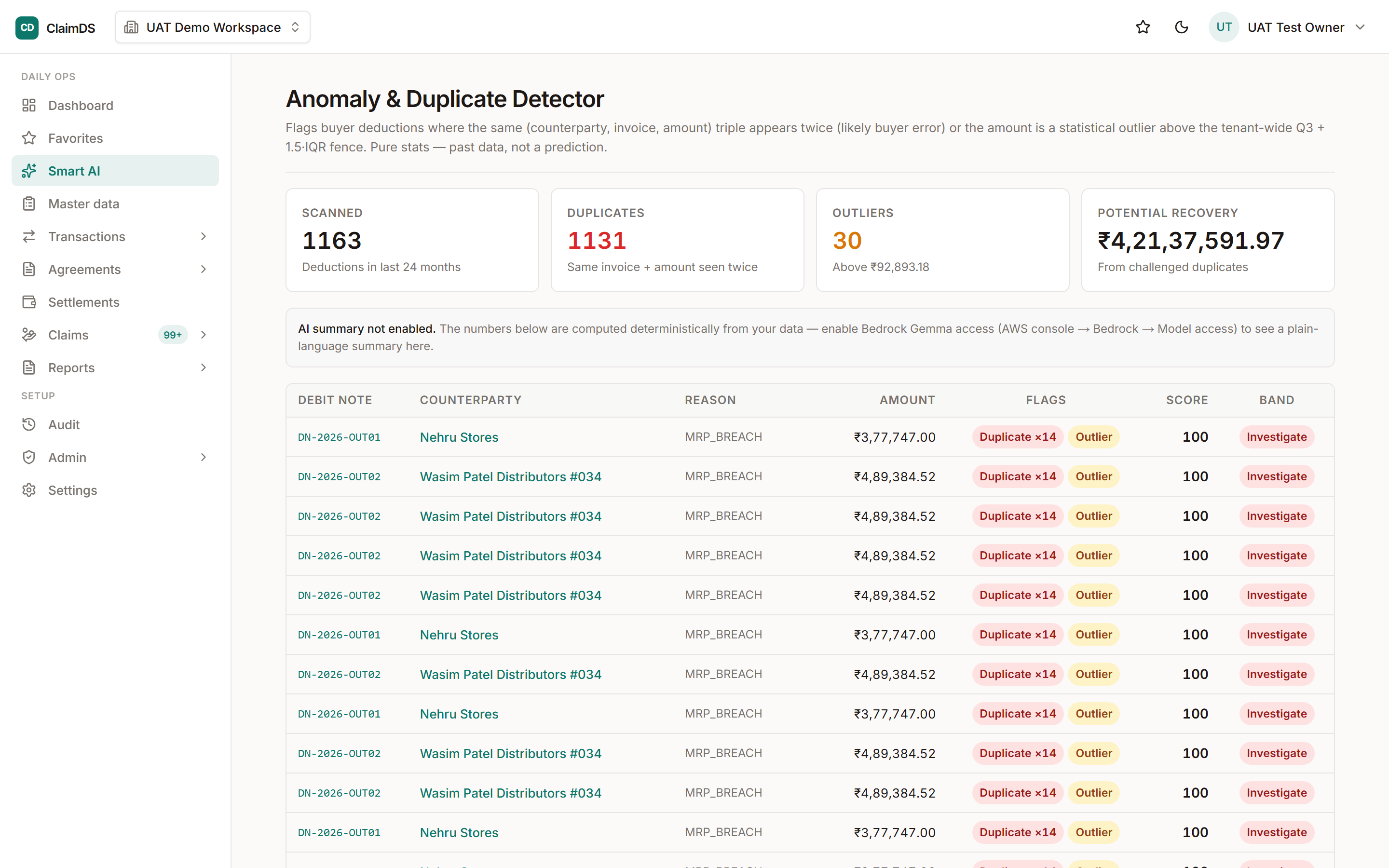
Duplicate submissions rarely arrive as identical copies. The same underlying deduction comes back reformatted — a debit note this month for a short payment already netted last month, the same damage claim routed once through the portal and once by email, the same invoice reference with the amount rounded differently. Anything keyed on document appearance misses these; only matching on the underlying claim identity catches them.
Inflated quantities claim more units than the paper trail supports — a damage claim for 300 units against a delivery of 250, scheme payouts claimed on outlets that were never enrolled. The inflation is usually modest, which is exactly why it persists: each individual claim looks plausible, and only comparison against supply and agreement data exposes it.
Phantom compliance failures assert a breach that never happened — a late-delivery penalty where the proof-of-delivery shows on-time receipt, a labelling chargeback with no supporting photograph. These thrive where the supplier cannot easily lay hands on its own delivery evidence, which is an argument for the evidence vault, not for suspicion.
Expired-window resubmissions take a claim that lapsed and re-date it into the current period, or re-raise it under a fresh document number. The chargeback process enforces windows at validation — but only if the system can recognise that a "new" claim is an old one wearing a new date.
Split claims are the fifth pattern. Suppose approvals under ₹25,000 auto-clear while larger claims get reviewed (illustrative numbers only). A ₹60,000 claim that would invite scrutiny arrives instead as three claims of ₹20,000, days apart, each individually unremarkable. No single reviewer sees anything wrong — which is the point, and why detection has to run at the pattern level rather than the claim level.
Which detection controls catch them?
Each pattern has a control that catches it mechanically, without anyone having to allege anything.
| Control | How it works | Pattern it catches |
|---|---|---|
| Dedup keys | Every claim keyed on partner + document reference + amount + reason + period; new claims checked against the key set | Duplicate submissions, expired-window resubmissions |
| Threshold analytics | Flag clusters of same-partner claims sitting just below approval limits in a short window | Split claims |
| Evidence verification | Require photos and documents per claim line; check dates, cross-reference against delivery records, flag reused images | Phantom compliance failures, inflated quantities |
| Quantity reconciliation | Compare claimed units against supplied and sold units from channel data | Inflated quantities |
| Pattern review | Periodic partner-level reports — claim frequency, reason-code mix, rejection rate — reviewed for drift | Systematic abuse across all patterns |
The common property is that all five run on data the claims process already generates. None requires an investigation to start; they turn why distributor claims slip through the cracks from a lament into a checklist.
How do you balance prevention against policing?
Design controls that are invisible when claims are clean. A distributor submitting valid claims should feel nothing: validation passes, settlement lands on time — indeed faster than before, because the queue is no longer clogged with junk. The controls should bite only when something does not reconcile, and the first response to a flag should be a question, not a charge — most flags are honest error, and treating a duplicate as a clerical fix preserves the relationship that treating it as an accusation would burn.
Escalate on pattern, not incident. One duplicate is paperwork; the same partner clustering under thresholds quarter after quarter is a conversation — grounded in the partner-level report, conducted with the evidence attached. Suppliers running this posture keep both the money and the channel, which is the balance the broader distributor claims management discipline aims at. What kills channels is the opposite posture in either direction: paying everything to avoid friction, or treating every partner as a suspect.
What does the audit trail actually do?
Three jobs. Deterrence — when every submission, edit and approval is recorded immutably with who and when, resubmitting a lapsed claim under a new date stops being worth attempting; the record survives even when memory and inboxes do not. Forensics — when a pattern does surface, the trail reconstructs exactly what was claimed, validated and settled, turning a suspicion into a documented finding within hours. Fairness — the same trail that catches abuse also exonerates: a partner wrongly flagged can be cleared by the record, which makes the controls defensible in the relationship rather than corrosive to it.
The trail also carries the compliance weight. Settlements flow into credit notes with GST consequences, and the documentation chain behind each settled claim is the same one a scheme settlement documentation playbook demands — pointer-level here, since the tax detail is its own subject. Leakage control and compliance are, conveniently, the same paperwork done once; that is also why anomaly detection belongs inside claims management software rather than bolted on beside it.
Detection signals
Detection is pattern-spotting at scale. Repeated round-number claims, the same invoice claimed twice, quantities exceeding supply, and clusters of out-of-window deductions are all flags a system can surface automatically. Manual review cannot keep up with the volume — especially in FMCG — which is why anomaly detection and duplicate matching matter.
Preventive controls
- Agreement-based validation — every claim checked against its terms.
- Duplicate detection — block the same deduction twice.
- Mandatory evidence — no support, no settlement.
- Segregation of duties — who raises ≠ who approves.
- Immutable audit trail — every action recorded.
These are the same controls a finance leader should demand in the CFO revenue-leakage playbook.
Fraud vs honest error
Most channel leakage is honest error, not fraud — but the controls that stop one stop the other. Treating the problem as a control problem rather than an accusation keeps channel relationships intact while protecting the money. The dispute side is in the chargeback dispute process.
GST note: This article is general information, not tax or legal advice. Where settlement involves GST credit notes, positions — including CBIC Circular No. 251/08/2025-GST and the Finance Act 2026 amendments to Section 34 of the CGST Act, assented 30 March 2026 but not yet notified into force as of publication — must be re-verified at publish time with a qualified professional.
Frequently asked questions
What is chargeback fraud in channel claims?
In channel claims, chargeback fraud and leakage occur when deductions or claims are duplicated, inflated, or raised without support — intentionally or through error. It is distinct from card chargeback fraud and is controlled through validation, anomaly detection, audit trails and segregation of duties.
How do you detect channel chargeback fraud?
By validating each claim against the agreement and source data, detecting duplicates and statistical anomalies, requiring evidence, and maintaining an audit trail. Patterns such as repeated round-number claims or out-of-window deductions are flags.
How do you prevent chargeback leakage?
With preventive controls — agreement-based validation rules, duplicate detection, mandatory evidence, segregation of duties between who raises and who approves, and an immutable audit trail — so invalid claims are stopped before settlement.
What are split claims in channel chargebacks?
Split claims are a single large deduction broken into several smaller ones so each stays under an approval or scrutiny threshold and sails through on auto-approval. The tell is clustering — multiple claims from the same partner, in the same period, each sitting just below the threshold. Threshold analytics catch what individual review cannot.
What is a dedup key?
A dedup key is the combination of fields — typically partner, invoice or document reference, amount, reason code and period — that uniquely identifies a claim. Every new claim is checked against existing keys, so the same underlying deduction cannot be settled twice even if it is reformatted, re-dated or resubmitted through a different channel.
Is most channel chargeback leakage deliberate fraud?
No. Most leakage is honest error — duplicated paperwork, misread agreements, stale rate cards — which is why the response should be controls applied uniformly to every claim, not accusations. The same validation that catches an innocent duplicate also catches a deliberate one, without requiring anyone to judge intent first.
How does duplicate claim fraud work and how is it detected?
Duplicate claim fraud extracts payment twice for one transaction — the same sale claimed in different months, through different files, or under slightly altered references. Detection uses composite-key matching across the full claim history — end customer, product, invoice number, date and quantity — plus fuzzy matching to catch deliberately perturbed references. Reject duplicates with explicit reason codes, monitor duplicate rates by partner, and treat repeat offenders as an audit trigger.
What are the consequences for a distributor caught committing chargeback fraud?
Consequences escalate through three stages. Commercially: recovery of the amounts by debiting the distributor's account, often with penalties, plus claim-by-claim scrutiny thereafter. Contractually: fraudulent claims are usually a material breach justifying termination, forfeiture of pending claims and encashment of security deposits. Legally: fabricated invoices and forged documents can support criminal complaints and create tax exposure. The durable cost is reputational — losing a profitable brand in an industry where reputations circulate.
See RebateLedger on your own claims data
A 30-minute walkthrough tailored to how your channel actually settles claims.