
Billbacks vs Chargebacks vs Deductions: A Glossary
Billback, chargeback, deduction and rebate defined and contrasted for Indian channels — what each means, who raises it, and how each settles.
In short
A billback is a claim a partner bills back to the supplier for an agreed cost or incentive; a chargeback is a deduction the supplier applies against the partner; a deduction is any amount netted from a payment; a rebate is an earned incentive. They differ by who initiates and which way the money moves.
A billback is a claim a partner bills back to the supplier for an agreed cost or incentive; a chargeback is a deduction the supplier applies against the partner; a deduction is any amount netted from a payment; a rebate is an earned incentive. They differ by who initiates and which way the money moves — and confusing them is a frequent source of channel disputes.
Every term in this glossary is a trade or channel claim between businesses in a supply chain — none of them is an insurance claim, and "chargeback" here is a channel price-difference or deduction rather than a card-payment reversal. "Deduction" likewise means a short-payment on a trade invoice, not a tax-deductible business expense claimed on a tax return.
Definitions
Each entry below follows the same format — what it is, who initiates it, which way the money moves, how it settles, and where to go deeper — because those four attributes are what actually distinguish the terms.
Billback. The partner bills back the supplier for an agreed amount — a promotion cost, a display fee, an incentive earned. Money flows from supplier to partner; the partner initiates.
- Who initiates: the channel partner (distributor, dealer, retailer), by raising a claim or an invoice on the supplier.
- Direction of money: supplier → partner.
- Settles how: the supplier validates the claim against the agreement, then pays or issues a credit note. An illustrative case: a distributor runs an agreed in-store activation costing ₹1,20,000 and bills the supplier for it under the trade agreement.
- Deep dive: what is a billback — the detailed guide.
Chargeback. The supplier charges back the partner — a deduction for a scheme it funded, a price difference, damage. Money is recovered by the supplier; the supplier initiates. (Trade chargebacks, not card chargebacks.)
- Who initiates: the supplier (or the party higher in the chain), against the partner's account.
- Direction of money: partner → supplier — a recovery, netted or invoiced.
- Settles how: offset against amounts payable to the partner, or recovered by debit note; contested ones enter the chargeback dispute process.
- Deep dive: the end-to-end flow is in the chargeback process; industry flavours in chargebacks in FMCG distribution and pharma distribution.
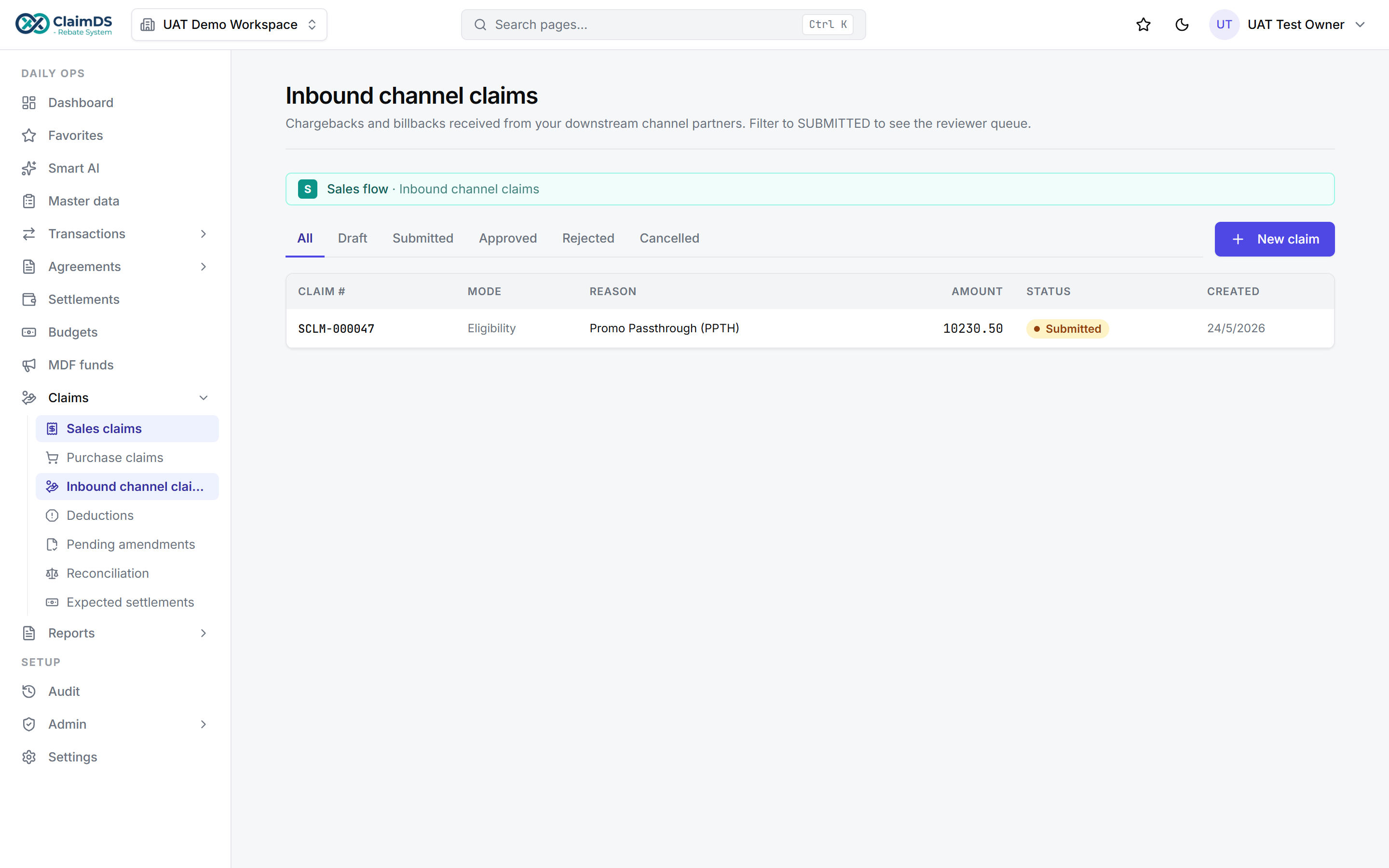
Both instruments arrive as inbound claims that must be captured, coded and validated before any money moves — the intake looks like this in practice:
Deduction. Any amount netted from a payment, for any reason. A chargeback is one kind of deduction; the receivables view is deduction reason codes and claim matching.
- Who initiates: whoever is paying — in an Indian channel, usually the distributor or retail chain paying the supplier's invoice short.
- Direction of money: it reduces a payment; no separate money movement occurs.
- Settles how: each deduction is coded, validated against the scheme or claim it cites, then accepted (credit note issued), disputed, or written off — the operating discipline is in deduction management best practices.
- Deep dive: the pillar on deduction management for AR teams.
Debit note. A document raised by the party who believes it is owed money, increasing the counterparty's payable. A distributor debits the supplier for a claim; a supplier debits a distributor to recover an invalid deduction.
- Who initiates: either side — it is the "you owe me" instrument, whichever direction the grievance runs.
- Direction of money: creates a receivable for the issuer; cash follows only when the counterparty accepts or the dispute resolves.
- Settles how: by payment, by offset against the next settlement, or by the counterparty issuing the matching credit note.
- Deep dive: debit notes as a recovery tool appear throughout the chargeback dispute process.
Credit note. The supplier-issued document that reduces what the buyer owes — the workhorse instrument by which rebates, scheme claims and accepted deductions actually settle in India.
- Who initiates: the supplier, against its own earlier invoice(s).
- Direction of money: supplier → buyer, as a reduction of receivable rather than a cash payment.
- Settles how: it is the settlement — but the type matters: a GST credit note adjusts tax and triggers buyer-side ITC reversal, a financial credit note does not. The choice is the framework in financial vs tax credit notes under GST.
- Deep dive: the same article, plus the GST cluster it anchors.
Short-payment. The raw event: a remittance smaller than the invoice it pays. It is the cash-application view of what receivables teams, once the gap is coded and tracked, call a deduction.
- Who initiates: the payer, at the moment of payment.
- Direction of money: none beyond the payment itself — it is a gap, not an instrument.
- Settles how: it doesn't, by itself. Each explained portion becomes a coded deduction and follows that path; unexplained portions age in an "unidentified" queue until researched.
- Deep dive: deduction reason codes and claim matching covers the capture-and-code step that turns short-payments into manageable items.
Rebate. An earned incentive based on volume or growth, usually settled by credit note — see rebate management software.
Side-by-side comparison
| Term | Who initiates | Money direction | Typical settlement |
|---|---|---|---|
| Billback | Partner | Supplier → partner | Credit note / payment |
| Chargeback | Supplier | Partner → supplier (recovery) | Netted / credit note |
| Deduction | Either (netted by payer) | Reduces a payment | Netted at payment |
| Rebate | Agreed scheme | Supplier → partner | Credit note |
| Debit note | Party owed money | Creates a receivable for issuer | Payment / offset / matching credit note |
| Credit note | Supplier | Supplier → buyer (receivable reduced) | Is itself the settlement instrument |
| Short-payment | Payer | Gap in a payment | Becomes coded deduction(s) |
How do the terms combine in one transaction?
The vocabulary earns its keep when several mechanics ride on a single remittance. An illustrative month with one distributor: the supplier invoices ₹25,00,000; the distributor remits ₹23,10,000 — a short-payment of ₹1,90,000. On coding, ₹1,50,000 is a deduction citing a quantity-discount rebate claim still awaiting settlement, and ₹40,000 is a netted billback for an agreed display activation. The rebate claim validates, so the supplier issues a credit note for ₹1,50,000, closing that deduction. The display claim turns out to be ₹10,000 over the agreed cap, so the supplier accepts ₹30,000 and raises a chargeback — recovered via debit note — for the excess.
Seven terms, one payment. Notice what did the work: knowing who initiated each item and which instrument closes it. Teams that lack the shared vocabulary book the entire ₹1,90,000 as "on account" and reconstruct this story months later.
Where rebates fit
A rebate is the incentive; the others are mechanics. The same earned rebate might reach the partner as a billback, a credit note, or a netted deduction — the term describes the mechanism, not the economics.
Why the confusion matters
When teams use these words loosely, claims get mis-routed, double-counted or disputed. A shared glossary — and a system that records which mechanic applies — removes the ambiguity. This page disambiguates terms used across the whole cluster, from claims management to distributor claims.
GST note: This article is general information, not tax or legal advice. Where settlement involves GST credit notes, positions — including CBIC Circular No. 251/08/2025-GST and the Finance Act 2026 amendments to Section 34 of the CGST Act, assented 30 March 2026 but not yet notified into force as of publication — must be re-verified at publish time with a qualified professional.
Frequently asked questions
What is the difference between a billback, a chargeback and a deduction?
A billback is a claim a partner bills back to the supplier for an agreed cost or incentive. A chargeback is a deduction the supplier applies against the partner. A deduction is any amount netted from a payment. They differ by who initiates and the direction of money.
How is a rebate different from these?
A rebate is an earned incentive based on volume or growth, usually settled by credit note. A billback, chargeback or deduction is a specific transactional adjustment. A rebate is the incentive; the others are mechanics by which amounts move.
Why do these terms get confused?
Because the same economic outcome can be reached by different mechanics, and Indian channel usage is inconsistent. Defining who raises each and how it settles removes the ambiguity that causes disputes.
What is the difference between a debit note and a credit note?
They are mirror instruments. A credit note is issued by the supplier to reduce what the buyer owes — the usual way rebates and claims settle. A debit note is raised by the party who believes it is owed money, to increase the counterparty's payable — a buyer debits a supplier for a claim, or a supplier debits a buyer to recover an invalid deduction.
Is a short-payment the same as a deduction?
Nearly — the terms describe the same event from two angles. Short-payment is the cash-application view: the remittance is less than the invoice. Deduction is the receivables-management view: each explained gap becomes a coded, trackable item to validate and resolve. Every deduction begins life as a short-payment; calling it a deduction implies you have captured and coded it.
Which of these instruments carries GST consequences?
Credit notes are the tax-sensitive instrument: a GST credit note adjusts taxable value and tax and obliges the buyer to reverse input tax credit, while a financial credit note settles the same rupees with no tax adjustment. Billbacks raised as invoices can attract GST on the service billed. Netted deductions and short-payments move cash but leave the tax position of the original invoice untouched until the right document is issued.
Should D2C brands worry about trade chargebacks or payment chargebacks?
Both, but they are different problems owned by different teams. Payment chargebacks — cardholders reversing online transactions — are managed through fraud screening, clear billing descriptors and gateway dispute responses. Trade chargebacks arrive once a D2C brand enters marketplaces, quick-commerce or offline distribution: settlement deductions, fill-rate penalties and rate differences, managed through claims validation and reconciliation. The tools differ too — card-dispute software and trade-claims platforms solve unrelated problems.
Why does classifying chargebacks as trade or non-trade matter?
Classification decides how a chargeback hits your financials. Trade chargebacks linked to pricing generally reduce gross revenue, affecting reported sales and gross-to-net metrics; non-trade items such as penalties and freight recoveries are operating expenses with different owners. The GST route can differ too — price-linked adjustments flow through credit notes, while penalty-type recoveries need separate evaluation. A reason-code master mapping every chargeback type to its treatment at entry is the practical control.
See RebateLedger on your own claims data
A 30-minute walkthrough tailored to how your channel actually settles claims.