
CPG Trade Promotion Guide: Schemes, Settlement & ROI (India)
A practical CPG trade promotion guide for India — scheme types, settlement across the channel, secondary scheme settlement and promotion ROI.
In short
A CPG trade promotion is a manufacturer-funded incentive to push product through the channel — discounts, slab schemes, display and visibility deals — settled with distributors and retailers. In India it settles through GST credit notes and spans both primary and secondary schemes.
A CPG trade promotion is a manufacturer-funded incentive to push product through the channel — discounts, slab schemes, display and visibility deals — settled with distributors and retailers. This guide covers the scheme types, how settlement works across primary and secondary tiers, and how to measure promotion ROI in the Indian, GST-driven context.
Scheme types
| Scheme | Mechanic |
|---|---|
| Volume / slab | Rising payout across turnover bands (volume rebates) |
| Growth / target | Reward for beating a baseline |
| Display / visibility | Paid shelf presence and merchandising |
| Combination / mix | Basket-based incentives |
This guide sits under the trade promotion management pillar.
How settlement works
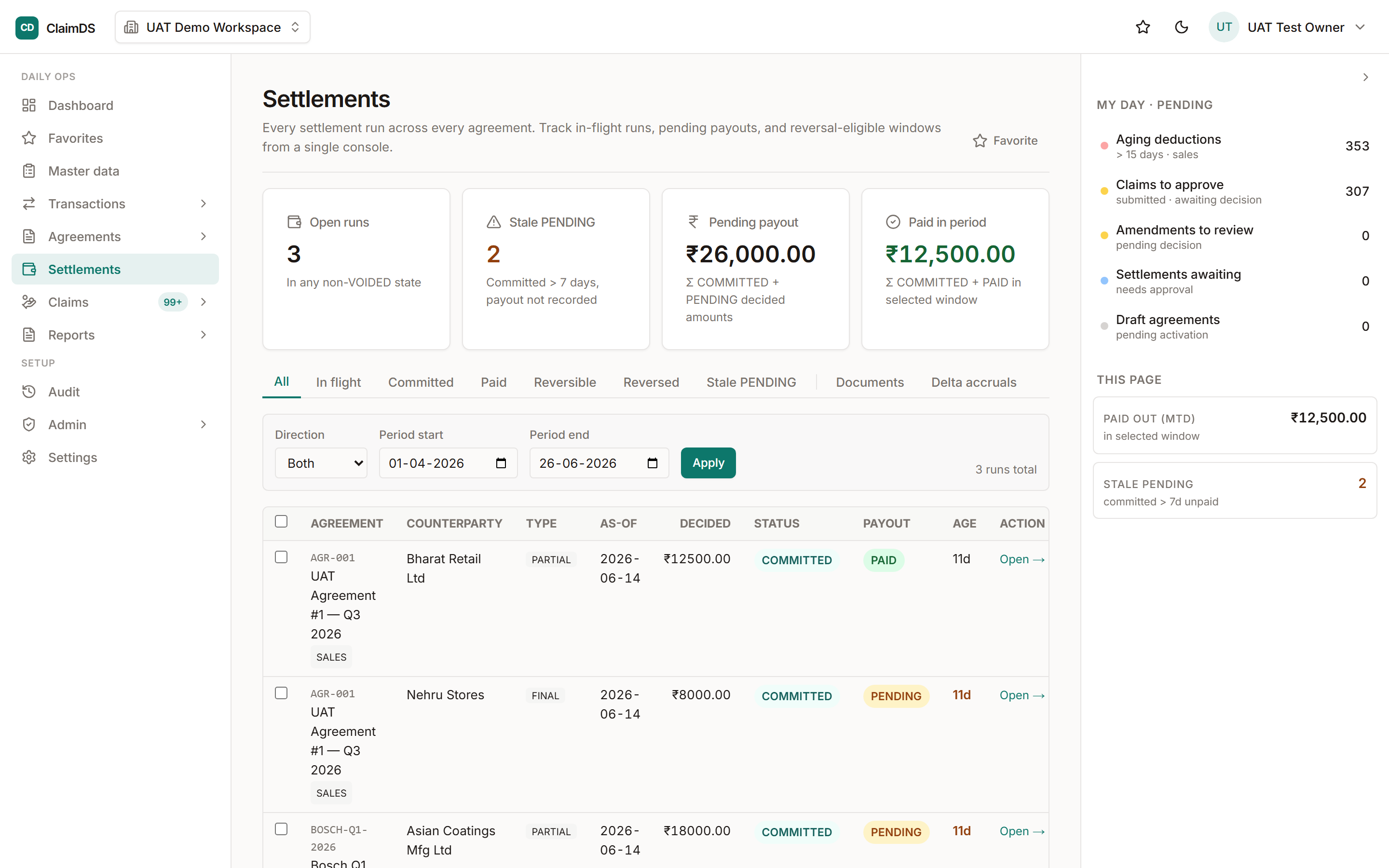
Scheme planned → accrued as sales post → claimed → validated → settled by credit note. Schemes accrue as sales happen and settle through GST credit notes. The credit-note type matters for ITC — see financial vs. tax credit notes.
Secondary scheme settlement
Most CPG promotion value lives in secondary scheme settlement — incentives on sell-through from distributor to retailer. These are harder because the data sits a tier away from the manufacturer, which is where capture and validation discipline pays off.
Measuring ROI
ROI = incremental volume or margin ÷ total promotion cost (including settled claim value). Reliable accrual and settlement data are the prerequisite, so spreadsheet-run promotions rarely have dependable ROI. With clean settlement data, finance and sales can compare schemes like-for-like and retire the ones that do not pay back — the method is in the ROI & settlement-time benchmark guide. Present any figures as your own measured results, not industry benchmarks.
What does the full promotion lifecycle look like?
Everything above — scheme types, settlement, ROI — sits inside one loop that runs continuously through the year. Where CPG promotion programs go wrong is almost never inside a single stage; it is in the handoffs between them.
| Stage | Owner | Key output | Where it fails |
|---|---|---|---|
| Annual planning | Sales leadership + finance | Promotion calendar and budget by channel and quarter | Budget set top-down with no per-scheme cost model |
| Scheme design | Trade marketing / sales ops | Mechanic, slabs, eligibility, dated circular | Circular issued after the window opens; ambiguous slab rules |
| Execution & evidence | Field sales + distributors | Sell-in, sell-through data, proof of performance | Evidence captured late or never; secondary data gaps |
| Settlement | Claims / finance ops | Validated claim, credit note, GST reporting | Slow validation, missing documentation, leakage |
| Post-promotion analysis | Finance + trade marketing | Baseline vs lift, true cost, ROI per scheme | Never happens, because the settled data is unusable |
The loop closes when the analysis stage feeds the next planning cycle — the schemes that paid back get funded again, the ones that did not get redesigned or retired.
How does annual planning set up the year?
Planning fixes two things before any scheme exists: the calendar (which quarters carry which promotion intensity, anchored to the festive season and category cycles) and the budget envelope (total trade spend, split by channel and scheme family). Illustratively, a mid-market food brand might plan ₹12 crore of annual trade spend as roughly 45% volume and growth schemes, 25% visibility and display, 20% festive-quarter top-ups, and 10% held as a response reserve for competitive moves. The discipline that matters is granularity: a budget that exists only as one annual number cannot be tracked against accrual, so overruns surface at year-end. The mechanics of how scheme budgets are allocated and tracked against spend are what close that gap. A stage-by-stage walkthrough of this planning rhythm is in the trade promotion management step-by-step guide.
How should schemes be designed?
Design is where most settlement pain is created — months before settlement happens. Three rules carry most of the weight:
- Pick the mechanic for the objective. Slab schemes buy volume, growth schemes buy share expansion, display schemes buy visibility, mix schemes protect range — the full catalogue and when to use each is in types of trade schemes in India. A mechanic mismatched to the objective produces payouts without behaviour change. A dealer incentive, a trade scheme and a supplier-side rebate are not the same instrument either — the difference between supplier, dealer and trade-scheme incentives is worth settling before you pick one.
- Write the ambiguity out. Whether the top-slab rate applies to full value or increment, how returns net off, how mid-window joiners are prorated — every ambiguity left in the circular becomes a dispute at claim time.
- Date the circular before the window opens. The scheme document is also the GST pre-agreement evidence; free-goods and BOGO mechanics need their own tax thinking at design time, not settlement time — see GST on free goods and BOGO schemes.
What does execution and evidence capture involve?
While the scheme runs, two streams must be captured as they happen: the sales data at the tier the scheme pays on, and the proof of performance for execution-linked payouts. For sell-through schemes that means distributor-reported secondary data — the tier structure and why it matters is in primary vs secondary vs tertiary sales — and for display schemes it means date-stamped photos against the agreed planogram, tied to outlet and window. The operational reality: evidence not captured in-window is reconstructed after it, at ten times the effort and a fraction of the credibility. This capture burden falls on the same distributor operations described in distributor claims management, which is why brands that make submission easy get better data.
How does settlement close the loop?
Settlement converts the scheme's promise into a credit note that survives scrutiny: claim submitted with its evidence, validated against the circular's rules, approved at the right authority, settled by correctly classified credit note linked to original invoices, and reported in the right GST return period. The claim arithmetic itself is the easy half; the paper trail is the half that fails audits — the seven-artifact documentation standard, and what auditors keep finding on trade schemes, is laid out in the scheme settlement documentation playbook. Settlement speed also feeds back into the program itself: partners who are paid in days participate harder in the next scheme than partners paid in quarters.
What happens in post-promotion analysis?
The stage most CPG teams skip is the one that makes the next year cheaper. Within weeks of the window closing, each scheme should get a verdict: baseline versus incremental lift (netting out forward-buying), true cost including settlement leakage, and a keep / redesign / retire decision. Illustratively, a festive slab scheme that generated ₹25 lakh of net incremental lift against ₹6.5 lakh of true cost gets refunded next year; a display program whose evidence shows 60% execution gets its payout gated on capture-time photos before it runs again. The full measurement method — baselines, liability forecasting and what-if simulation for the next calendar — is in how TPM software improves forecasting and promotion ROI.
India-specific notes
Indian CPG promotion is multi-tier and GST-settled, which shapes how schemes are designed and reconciled. That is why generic global TPM tools fit awkwardly and why India channel fidelity matters — see why RebateLedger.
Two structural features deserve their own planning line:
- The GT/MT split. General trade — distributors feeding lakhs of kirana outlets — runs on slab schemes, secondary schemes and distributor-settled display incentives, with evidence flowing up through the tiers. Modern trade runs on joint business plans with organised chains: negotiated margins, listing and visibility fees, promotion participation, and settlement that often arrives as the chain's own deduction claims rather than your credit-note cycle. Treating the two as one program in one spreadsheet is how both end up mis-measured; they need separate mechanics, budgets and settlement paths even when they promote the same SKU.
- The festive calendar. A large share of the year's promotion intensity compresses into the Onam–Navratri–Diwali arc, with regional peaks (Pongal, Durga Puja, Christmas in the south and east) layered on. That compression means scheme design, circular issuance, evidence capture and settlement capacity all spike together — the operations that cope are the ones that planned the festive quarter's settlement workload in the annual calendar, not just its spend.
GST note: This article is general information, not tax or legal advice. GST positions — including CBIC Circular No. 251/08/2025-GST and the Finance Act 2026 amendments to Section 34 of the CGST Act, assented 30 March 2026 but not yet notified into force as of publication — must be re-verified at publish time with a qualified professional.
Frequently asked questions
What is a CPG trade promotion?
A CPG trade promotion is a manufacturer-funded incentive to push product through the channel — discounts, slab schemes, display and visibility deals — settled with distributors and retailers. In India it is settled through GST credit notes and spans primary and secondary schemes.
How is a trade promotion settled across the channel?
Primary schemes settle from the manufacturer to the distributor; secondary schemes settle on sell-through to retailers. Both accrue as sales happen and settle by credit note, with secondary schemes requiring distributor-reported data.
How do you measure trade promotion ROI?
Trade promotion ROI compares the incremental volume or margin a scheme generated against its total cost, including the settled claim value. Reliable accrual and settlement data are prerequisites, so spreadsheet-run promotions rarely have dependable ROI.
What are the stages of the CPG trade promotion lifecycle?
Five stages in a loop: annual planning (the promotion calendar and budget), scheme design (mechanic, slabs, eligibility, the pre-agreed circular), execution and evidence capture (sell-in, sell-through and proof of performance), settlement (claim, validation, credit note, GST reporting), and post-promotion analysis (baseline versus lift, true cost, ROI) — whose findings feed the next planning cycle.
How do GT and MT trade promotions differ in India?
General trade promotions run through distributors to lakhs of kirana outlets — slab schemes, secondary schemes and display incentives settled on distributor-reported data. Modern trade runs through organised chains with negotiated terms: listing fees, margins agreed in joint business plans, promotion participation and off-invoice support, often settled against the chain's own deduction claims. The mechanics, evidence and settlement paths differ enough that they need separate handling.
What evidence does a display or visibility claim need?
Proof the paid-for execution actually happened — date-stamped photographs of the display against the agreed planogram, the outlet identity, the scheme window it belongs to, and the distributor or field-team attestation. Claims without capture-time evidence become judgment calls at validation, which is where disputes and leakage start.
Is an e-way bill required for moving free promotional goods?
Generally yes, once the consignment crosses the e-way-bill value threshold — including display materials, free goods, sampling stock and scheme gifts travelling to distributors or events. Free items still carry a declared value on the delivery challan. Dispatch on proper challans referencing the scheme and keep documentation linked to the scheme file; unexplained movement risks detention in transit checks.
How should dealer promotional service agreements be structured for GST?
Structure them to pass the Circular 251 test: a written contract specifying the defined activities — advertising, co-branding, exhibitions — the deliverables, the evidence required and the specified consideration. The dealer invoices the service with GST and the brand claims the input tax credit. Keep such agreements separate from discount schemes, and collect evidence contractually — the credit is only as defensible as proof of performance.
See RebateLedger on your own claims data
A 30-minute walkthrough tailored to how your channel actually settles claims.