
Paying C&F and DSA Partners: Commission for Carrying-and-Forwarding and Direct-Selling Agents
How carrying-and-forwarding (C&F) agents and direct-selling agents (DSA) are paid commission in India — two external partner types, clearly explained.
In short
A C&F agent — carrying-and-forwarding — stocks and forwards a company's goods and is paid a service fee or commission; it is unrelated to the Chartered Financial Analyst qualification. A DSA — direct-selling agent — sources business, common in lending, and is paid commission on what converts. Both are external service suppliers, not employees, which drives how they are paid and taxed.
Two external partner types are worth naming precisely, because their abbreviations collide with other things. A C&F agent — a carrying-and-forwarding agent — stocks and forwards a company's goods and is paid a service fee or commission; it is not the Chartered Financial Analyst qualification. A DSA — a direct-selling agent — sources business, common in lending, and is paid commission on what converts. Both are external service suppliers, paid like any partner commission.
Two partner types, clearly
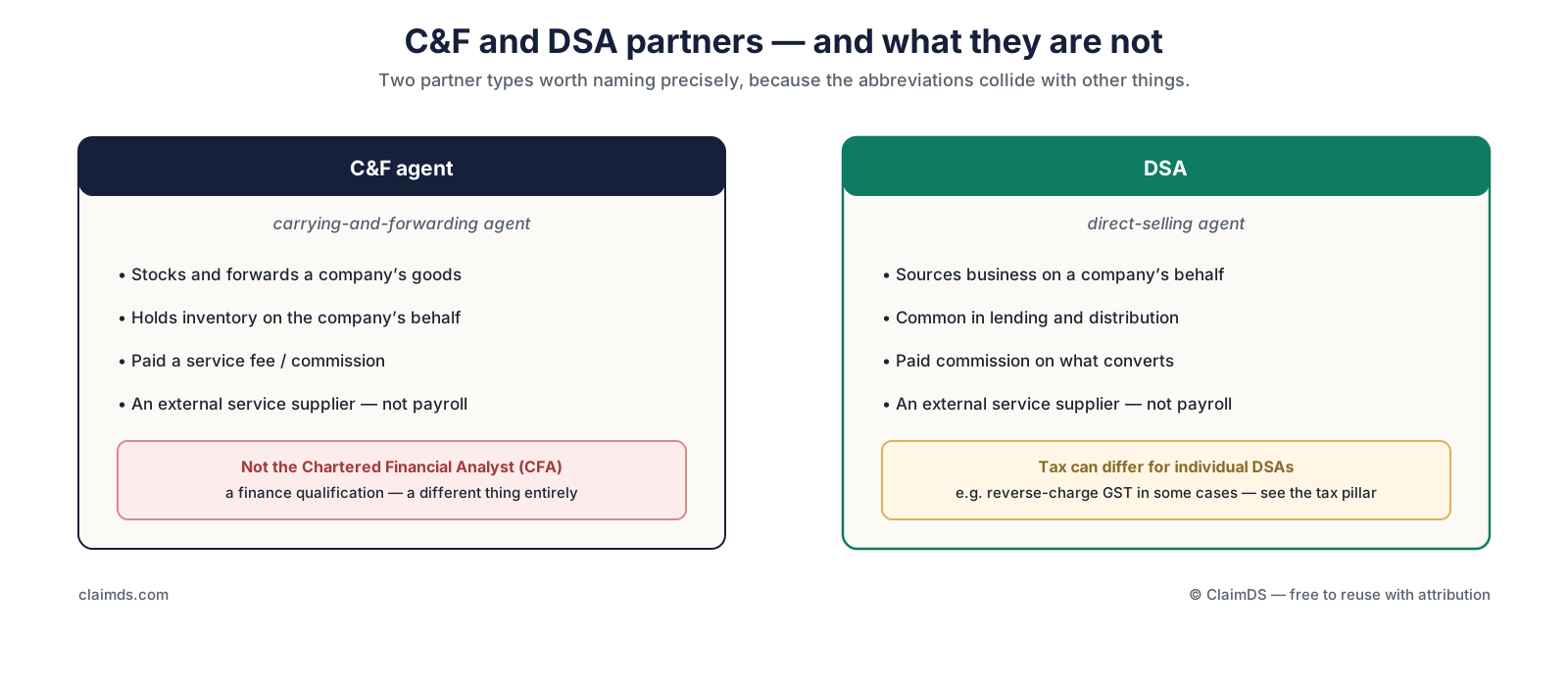
Source: RebateLedger — free to reuse with a link back to this article.
What a C&F agent is
A carrying-and-forwarding (C&F) agent holds a company's inventory and forwards it — receiving stock, storing it, and dispatching to distributors or customers on the company's behalf. It is a logistics-and-stocking role, and the agent is an external service supplier paid a service fee or commission, not an employee and not a distributor buying and reselling on their own account. What a C&F agent does in the channel, and how it differs from a distributor, is covered in what a C&F agent is and distributor vs dealer vs super-stockist.
To be unambiguous: the C&F agent here is the carrying-and-forwarding role. It is unrelated to the Chartered Financial Analyst, a finance qualification that shares the CFA abbreviation.
What a DSA is
A direct-selling agent (DSA) sources business on a company's behalf — most commonly in lending, where a DSA brings loan applications, and in distribution. The DSA is paid commission on business that converts, under an agreement, and is again an external service supplier rather than an employee.
How both are paid
Despite the different roles, the payment pattern is the same as any partner commission: an agreement defines the scope and rate, the partner delivers, they invoice, and they are paid after TDS on the base with their GST handled per the rules. The commission agreement and the commission invoice format apply to C&F and DSA partners just as they do to any sales agent.
A tax point specific to individual DSAs
One tax nuance is worth flagging for DSAs. For certain individual direct-selling agents providing services to a bank or NBFC, the reverse-charge mechanism can place the GST liability on the recipient rather than the DSA. Whether it applies depends on the arrangement, and the detail sits in the dedicated tax articles, reviewed by a chartered accountant. Confirm the treatment of your DSA payments with a professional. See TDS on commission and incentive: employee vs agent and TDS on the GST component of commission.
Read next
- Channel partner and sales-agent commission — the pillar.
- How to structure a commission agent agreement and commission invoice format.
- Referral and channel-partner commission programs.
- What a C&F agent is and distributor vs dealer vs super-stockist.
RebateLedger pays C&F, DSA and every other partner type through one engine — agreement terms, payout, TDS on the base and the partner's GST — in an auditable trail.
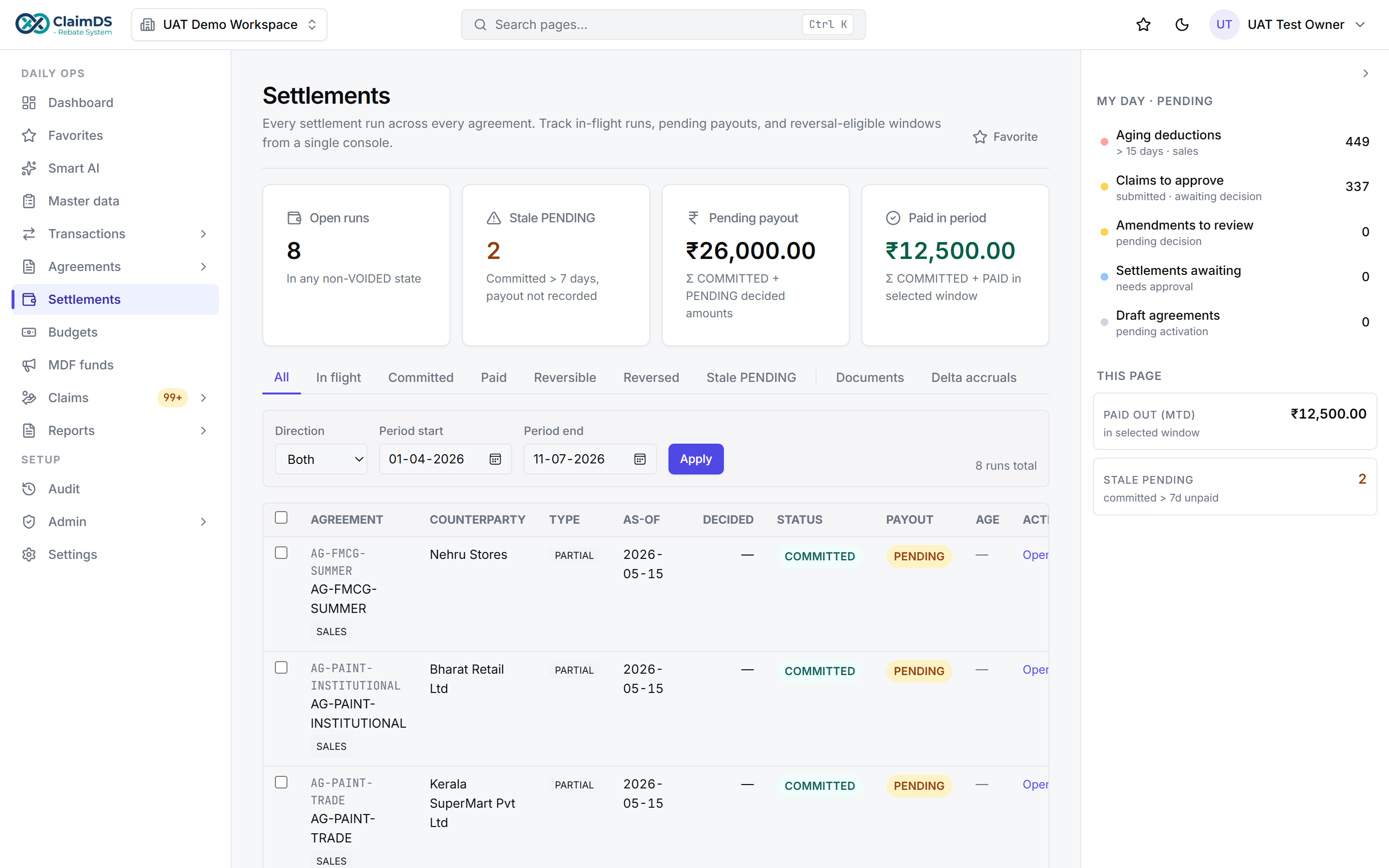
The RebateLedger settlement view — payouts calculated, approved and settled in one place.
Book a demo to see C&F and DSA commissions calculated and settled alongside the rest of your channel.
Frequently asked questions
What is a C&F agent?
A C&F, or carrying-and-forwarding, agent stocks and forwards a company's goods on its behalf — holding inventory, and dispatching to distributors or customers. It is an external service supplier paid a service fee or commission, not an employee. A C&F agent is unrelated to the Chartered Financial Analyst qualification, which shares the CFA abbreviation.
What is a DSA in sales?
A DSA, or direct-selling agent, sources business on a company's behalf and is paid commission on what converts. DSAs are common in lending, where they bring loan applications, and in distribution. Like other external partners, a DSA is a service supplier paid a fee, not an employee reselling goods on their own account.
How are C&F and DSA partners paid?
Both are external partners paid for a service under an agreement — a C&F agent typically a service fee or commission for stocking and forwarding, a DSA a commission on converted business. Payment runs through an invoice, with TDS deducted on the base and the partner's GST handled per the rules, the same as any partner commission.
Is a C&F agent the same as a Chartered Financial Analyst?
No. A C&F agent is a carrying-and-forwarding agent in distribution — a logistics and stocking role. The Chartered Financial Analyst, which shares the CFA abbreviation, is a finance professional qualification and is unrelated. This article is about the carrying-and-forwarding agent, not the qualification.
Is GST handled differently for a DSA?
In some cases it can be. For certain individual direct-selling agents providing services to a bank or NBFC, the reverse-charge mechanism can place the GST liability on the recipient rather than the DSA. Whether that applies depends on the arrangement, so confirm the GST treatment of your DSA payments with a professional.
How are CFA agents compensated by manufacturers in India?
CFA agents are paid a service fee, not a trading margin, because they never own the stock: typically a fixed monthly fee, plus a variable component per case handled or a small percentage of routed turnover, with out-of-pocket costs reimbursed at actuals. The fee is a taxable service — the CFA invoices the principal, who can claim the input tax credit. CFA economics turn on throughput and service levels.
What is a DSA and how is it different from a CFA?
A DSA — direct selling agent — sources customers or orders for a principal and earns commission on business generated, without touching inventory. A CFA — carrying and forwarding agent — is the opposite: it warehouses and dispatches goods without any selling role. Demand-side agent versus supply-side agent; success-linked commission versus throughput-linked handling fees. Keep the scopes distinct in contracts, because the compliance and liability profiles of selling and custody differ.
See RebateLedger on your own claims data
A 30-minute walkthrough tailored to how your channel actually settles claims.